How AI Personas and Affinity Agents find who will care about your next launch

Your customers' motivations to buy often shift overnight when a new product launches, a social trend spikes, the weather changes, or a major event is announced. The challenge for many marketing teams is whether the system can match the moment to the right customers before it passes.
Lifecycle marketing systems are built to optimize against known data. They execute against predefined logic and historical behavior. That works when customers repeat past actions, but it doesn’t solve the challenge of creating relevance without the context of historical behavior. Will this customer want this new offer?
A customer in Austin bought hiking boots in November and a canvas tote in January. In March, you launch a linen dress collection. Should she see it?
Your segment builder says no.
That logic is technically sound, but it breaks down when you need to assess a customer's likely interest in something new.
Rules require explicit evidence. Predictive audiences require labeled training data for each product–customer pair. When the product is new, a campaign concept is untested, or the customer has never entered the category, there is nothing reliable to score.
But customers can care about something long before your data reflects it. Closing that gap requires the ability to evaluate a match between a customer's broader behavioral patterns and an emerging opportunity.
That is what AI Personas and the Affinity Agent are designed to do. Together, they enable an Agentic Marketing workflow that matches customers to real-world moments as they emerge rather than waiting for history to catch up.
AI Personas: The behavioral abstraction layer
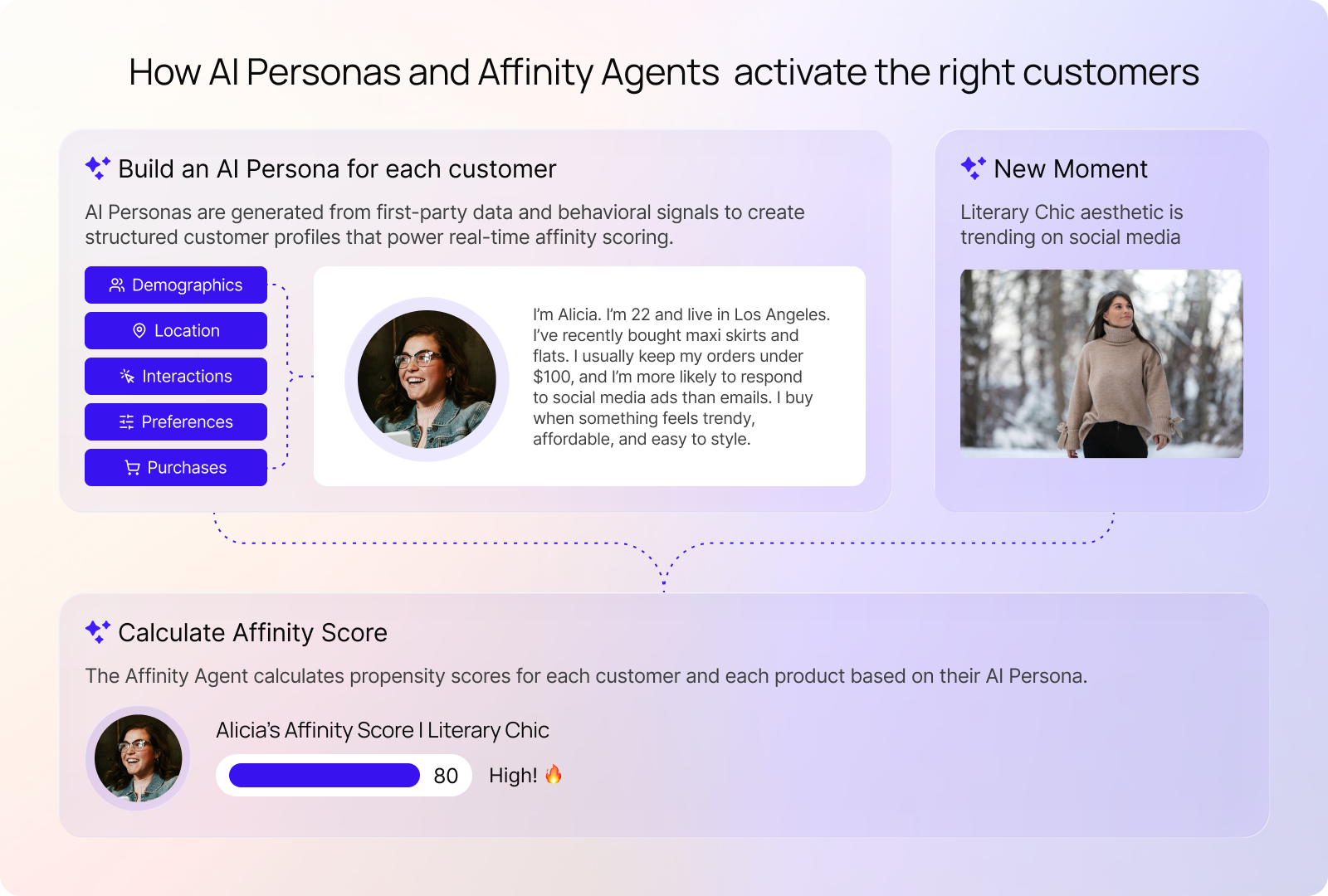
AI Personas represent a behavioral model of each customer, created from first-party data. Simon AI analyzes demographic attributes, purchase behavior, browsing depth, recency, frequency, and cross-category patterns stored in your data warehouse. Then, customers are grouped based on multi-dimensional behavioral similarity.
Each group or cluster of behavior becomes an AI Persona, a structured behavioral profile that captures tendencies in a human-readable and inspectable way. In Simon AI, you can review narrative descriptions, representative customers, and the signals that contributed to a particular group.
The system continuously evolves. Assignments refresh as behavior changes and new customers are evaluated based on early signals and similarity to existing groups. Every contact receives a persona ID that becomes a stable attribute for segmentation and activation, enabling persona logic to be immediately operational in your existing workflows. You can rename, reorganize, or hide personas to reflect your business, and convert any persona into an activatable segment directly.
Is this possible without agentic workflows? A capable data science team could build clusters inside Snowflake and score them against new products. The practical difference is maintenance and scale. Recalculating affinity for every new opportunity, refreshing persona assignments, and preserving scoring context across campaigns requires constant manual work.
That is the power of an agentic system that operates on live data (in Snowflake, for example), removing manual work that doesn't scale and allowing marketers to act quickly and independently of data teams.
The Affinity Agent: The real-time scoring engine
AI Personas clarify who the customer is behaviorally. The Affinity Agent evaluates what they are likely to care about next.
The Affinity Agent scores how well a specific moment or opportunity aligns with each persona's behavioral profile. It does not require the customer to have purchased, browsed, or clicked in the relevant category. It evaluates fit based on the patterns the AI Persona already encodes.
It answers a real-time question of “who should see this right now?” in five structured steps.
1. Inputs. The Affinity Agent takes in the opportunity being evaluated (a product launch, campaign theme, or cultural signal), along with candidate SKUs and live persona profiles from your first-party data. Scoring is recalculated for each opportunity, so every evaluation reflects its specific context.
2. Meaning matching. The system interprets what the opportunity represents. It compares semantic attributes rather than exact keywords. Those attributes are evaluated against the behavioral tendencies encoded in each AI Persona.
3. Structured reasoning. For each persona, the agent evaluates the likelihood of engagement and the messaging fit. Because AI Personas encode cross-category behavior, this evaluation works even when direct purchase history for the item is limited or nonexistent.
4. Affinity scoring. Each persona receives a probabilistic relevance score for the opportunity, ranging from 0 to 100. Customers inherit the score associated with their persona. This cascade allows opportunity-to-persona alignment to be computed once and applied across all associated customers. Marketers apply confidence thresholds to balance reach with expected intent.
5. Ranked outputs and persistent signals. The system produces engagement-ranked audiences and recommended products aligned to high-scoring personas. Customer-by-opportunity scores are stored, building a persistent affinity matrix that grows more precise as additional opportunities are evaluated. As new campaigns run and new moments emerge, prior scores provide compounding context for future targeting decisions.
This is different from traditional, supervised predictive audiences trained on historical conversions. Persona-based scoring evaluates fit across broad behavioral patterns, so new launches and customers with limited history can be included from the start.
How it works: A retail walkthrough
Consider a marketplace brand with a broad design catalog and a seasonal surge of gift buyers. In January, engagement declines. The team wants to re-engage customers without defaulting to broad discounts.
A spring “cottagecore aesthetic” trend around natural textures, handmade details, and earthy palettes begins gaining traction.
Step 1: A cultural moment is detected through Simon AI Social Moments, signaling rising interest in cottage-inspired design themes.
Step 2: The Affinity Agent maps that theme to relevant SKUs across the catalog, identifying products aligned with attributes such as handmade styling and sustainable materials.
Step 3: The Affinity Agent evaluates each AI Persona against the opportunity. This process represents a structured “interview” of the personas that leads to an Affinity Score (such as Conscious Minimalist: 87, Seasonal Gifter: 74, Bold Maximalist: 31)
Step 4: Customers inherit their persona’s Affinity Score. A high-confidence threshold surfaces a focused audience of customers strongly aligned with the trend. A moderate threshold expands reach for testing while preserving relevance.
Step 5: Ranked audiences are paired with products that match the moment and feel natural for each persona segment. Simon AI then activates campaigns into engagement platforms such as Braze.
Within the high-confidence group are lapsed buyers who never purchased cottage-themed items before. They surface because their broader behavioral profile aligns with the opportunity.
Customer + moments in practice: SeatGeek
SeatGeek needed to match millions of fans to thousands of Tier 2 events that couldn't justify manual audience builds. Simon AI created fan AI Personas and Affinity Agents scored how well each new event aligned with those personas.
Audiences were pushed directly into Iterable and refreshed continuously as new events launched.
As a result, SeatGeek achieved a 70 percent increase in GTV per contact versus manually built audiences.
Read the full SeatGeek case study.
Match your customers to moments with Agentic Marketing
Most CDPs help you activate the segments you already know how to define. AI Personas and the Affinity Agent help you identify which audiences should exist in the first place, helping your team to understand "who will care next."
See how AI Personas and the Affinity Agent work on your own customer data and walk through a real moment end-to-end. Get in touch here.
Stay in the know!
Recommended resources

Simon AI is now part of Monetate, joining customer and contextual intelligence to on-site personalization

Plan, build, and launch personalized campaigns from a single chat
Build campaign emails from a conversation, not a code editor
Recommended resources
.webp)
How AI turns social spikes into targeted campaigns, before trends fade


SeatGeek achieves 70% performance lift by matching fans to thousands of events with Simon AI™ Agents