Blog
Unlock true customer 360
Seamlessly unify and activate customer data from your cloud data warehouse and beyond.



.webp)


Power 1:1 personalization
Deliver hyper-personalized customer experiences to forge deeper connections and transform casual customers into loyal advocates.


.webp)


.png)


Boost your bottom line
Discover the industry's latest tips, tricks, and trends to elevate your customer marketing strategies.





.webp)


.png)

.webp)
.webp)
.png)


.png)


Together, the two platforms bring everything a brand knows about its customer to every send and every session.
Simon AI has been acquired by Monetate, connecting the customer intelligence and agentic workflows of Simon AI to the most valuable surface for lifecycle marketers — your website. Monetate is the leader in AI-powered digital and omnichannel personalization, experimentation, and experience optimization, delivering more than 100 million personalized sessions a day.
Before I get into the details, our customers can be confident that both the Monetate and Simon AI products will continue as individual products with dedicated teams and roadmaps, along with a new integration that delivers greater value to our combined customer community. There will be no disruption to current customers, and Simon AI will continue bringing new customers onto our product.
The acquisition comes with new capital, and Monetate is significantly increasing its investment in product development as well as Concierge and strategic services across both platforms. At a time when agentic capabilities are dramatically changing what is possible for marketing teams, this is the right time for rapid product development and the support that teams need to adopt AI and deliver measurable results.
The problem we set out to solve
Matt Walker and I founded Simon AI more than a decade ago after having watched companies spend millions on data their marketers couldn't use. We built the platform to change that, and today it shapes messages and offers across more than 100 channels.
D2C brands continue to work towards using everything they know about a customer, in the moment, on every surface that customer touches, from email, SMS, and ads to their website and app. Showing returning customers highly personalized messages. Putting the right offer in front of them at the right time. Making every checkout easy no matter what channel they begin their journey on. Using their real-world context and their last action to decide what they see next. Then letting what happened on the site shape the next email or text.
What makes this hard is that the pieces run on separate systems. Customer data in one, the website in another, email and ads in a third. And the website, the surface customers see most, is the one CRM/lifecycle teams have the least impact on.
Personalization across all digital experiences
When I first met with Steve Maher, Monetate’s CEO, about this opportunity, we started by asking some big questions, such as "What would a platform that optimizes all digital experiences look like?"
The solution to this has three parts:
- Data that's fast and deep. Capabilities that can make real-time "same page" decisions as customers browse the web. And capabilities that can reason about LTV, 10-year transaction histories, inventory levels, and even the weather, when making the best customer-level decisions.
- Delivery that integrates on-site along with paid and owned channels so that each customer has a single, personalized experience across all surfaces. It should all work with knowledge of a customer and their real-world context, in real time.
- An AI-enabled global delivery model. The solution needs deep human domain expertise, complemented by always-on AI agents for 24/7 guidance.
Steve and I saw that Monetate and Simon AI were building two halves of the answer. Simon AI unifies customer data where it already lives, combines it with real-world signals, and activates it across email, SMS, push, and ads. Monetate owns the moment of experience on-site and in app. Monetate's on-site capabilities further the vision we set out with.
With the combined products, every send and every session is now shaped by everything a brand knows about its customer. That gives brands deep customer intelligence and full control of their digital experiences to optimize conversion and customer lifetime value.
Day One benefits
While realizing the full potential of the vision is still out in front of us, there are some big "Day One" benefits that we're thrilled about:
- A new "Tier One" integration. We've been working hard to integrate the Monetate on-site optimization platform into Simon AI to enable fast, easy workflows, built for marketers, that drive personalization at scale on-site. Our product teams have already created an integration connecting the two platforms, so the audiences and customer signals you build in Simon AI can now drive Monetate experiences and experiments, starting today.
- Hands-on global support. We're all hands on deck to help our customers solve problems and deploy new agentic capabilities. By bringing both teams together, we now have full global reach, a much larger team, and new investment in product development and customer success.
With our new combined capabilities, your website starts treating customers like it knows them. The audiences and signals you already built will decide what a shopper sees, so the sessions you pay for convert better. And the site will react in real time. When a shopper acts, the experience changes on the next page view, not in the next campaign.
Agentic capabilities that make campaign exploration, setup, and activation easier and more effective are already showing results at leading brands. SeatGeek achieved a 70% performance lift matching fans to thousands of events with AI agents. A leading global fashion retailer doubled engagement with weather-triggered campaigns, increasing click-through rates 106% and revenue per session 40%. And an apparel brand increased SMS conversion rates 50% with contextual personalization.
We can now bring these results to your site and your app through the Monetate products.
What's next
The integration between Monetate products and Simon AI will continue to develop alongside new features in the coming months.
In addition, we’re rolling out our first incentive program and will share more in our conversations with customers in the coming days. Our shared philosophy is "show don't tell", so we will do our best to put innovation into your hands as early as possible.
Please reach out to me or your customer success contact with your questions and to begin exploring the possibilities of the combined products for your brand.
Thank you to the customers and partners who got us to this point. We can't wait to show you what comes next.

Lifecycle marketers I talk to have plenty of campaign ideas. Their best ones never ship.
Most of their week is spent waiting on other people.
Some of my recent conversations echo a familiar set of blockers and compromises:
A marketer at an apparel brand wanted persona-differentiated Mother's Day campaigns. The idea was to send new arrivals to premium buyers and bundles to pack buyers. The persona attributes didn't exist on their customer records. Audiences had to be built across two systems and two teams. The data work alone would have taken weeks, which was not an option.
They ended up sending one email to everyone, as usual.
Another, at a travel brand, was sending 12 emails a week. Too many landed with one-time browsers, too few with high-intent customers. The signals to tell them apart were in their data. Their segmentation tool couldn't see them. Rebuilding required a new intent attribute, a new audience model, and a Q2 data team sprint.
The sends kept going to the same list on the same cadence.
A third, at a grocery brand, watched a recipe trend take over social feeds for ten days. The catalog had every ingredient. To act, they needed an audience of recent ingredient buyers, filtered by stores with stock, with products enriched as personalization fields, and a suppression rule for recent sends. Each step took a different ticket and the data work outlasted the trend.
Soon, the trend faded and customers were already cooking something else.
All three marketing teams were stuck on data and execution. But in the real world, signals shift in hours. The systems built to act on them work in weeks, or whenever the next opening in a data team sprint allows.
Introducing your always-on data and execution team
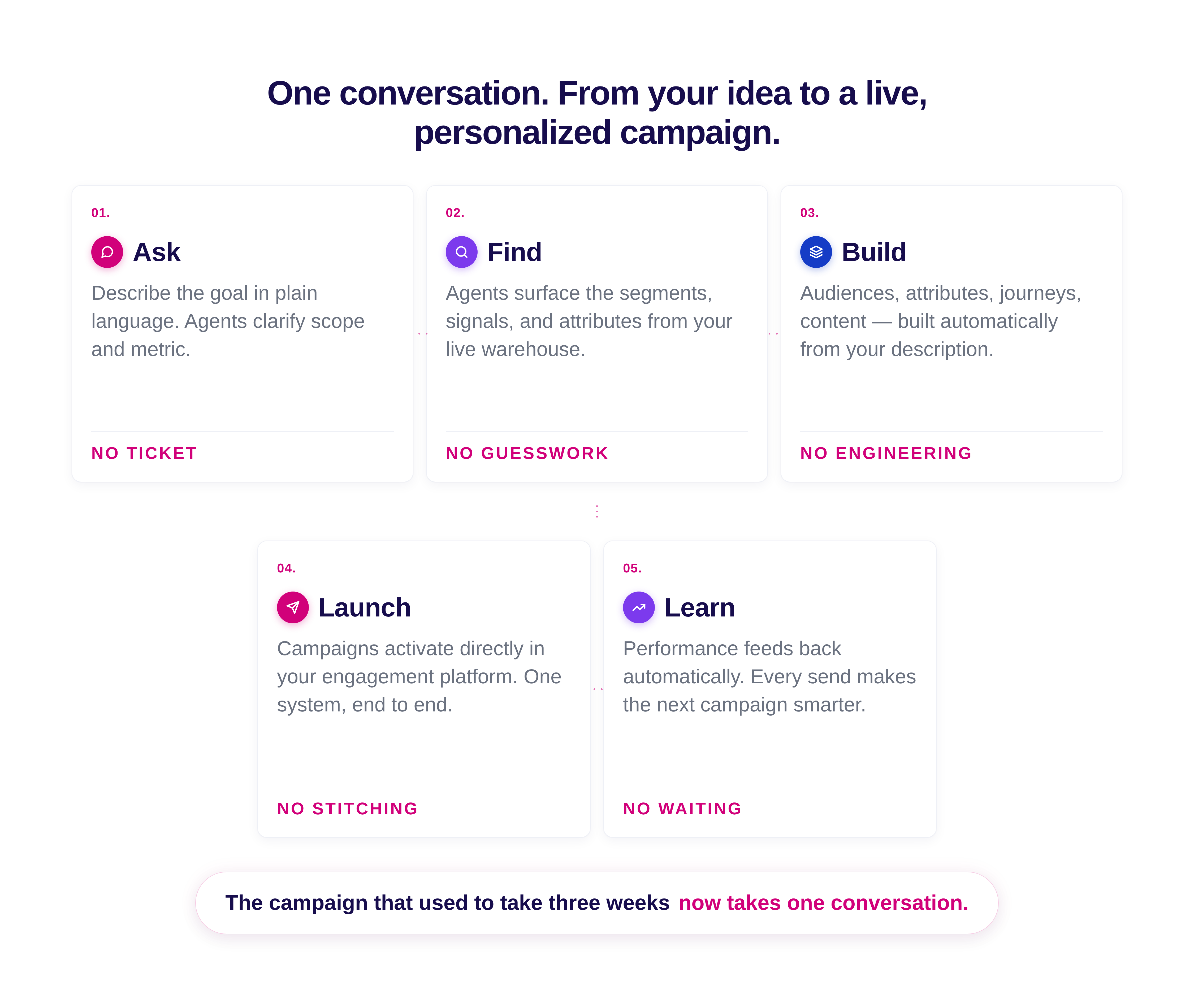
Today, Simon AI launches a new chat experience built for lifecycle marketers to end the bottlenecks, dependencies and handoffs required in today’s marketing systems. It consolidates the work of specialized data, audience, and execution agents operating on 100x data into a single conversation.
You describe what you want in plain language. The agents find the right data, build the audience, and trigger the campaign to your engagement platform.
This gives marketing teams full access to live data and the ability to launch personalization at scale, with more precision and speed. All without traditional tickets, tool switching, or coordinating handoffs and waiting for responses from other teams.

Ship a personalized campaign in one conversation
You run lifecycle for an apparel brand with a broad catalog. NBA-licensed gear is one slice, but your personalization stops at the purchase. Fans get the same post-purchase email whether their team is in the playoffs or eliminated last week. You've been pushing your team to fix this. The post-purchase email should know who's a fan and which team they care about.
You're on a mission this week to ship and prove the idea's value before the premier matchups land. In any other quarter, this concept would have taken weeks of tickets and handoffs across three internal teams.
This morning, you open Simon AI and start working.
Set up a post-purchase campaign for customers who bought in the last seven days. Enrich each customer record with NBA fan status and team affinity to power the personalization in our post-purchase email. Suppress anyone who's gotten more than three sends in the last two weeks. Ship to our engagement platform.
Simon AI comes back with the plan:
- A recent-purchase audience of 4,200 customers
- A fan-classification AI Field built from purchase patterns and team-affinity signals
- A Social Moment for Lakers vs. Celtics tonight
- A send-cap of three in the last two weeks
Each customer record gets enriched with fan status, team, and the moment, ready for the email.
You push back.
Tighten the recent-purchase window to five days, and exclude anyone who unsubscribed from any campaign in the last 30 days.
The agent revises in place. The audience narrows to 2,800 customers. Roughly 35% classify as NBA fans.
You ask for the launch. The audience lands in your engagement platform with each customer's fan status and team affinity attached as profile attributes. You review and approve. The Social Moment fires the send before tip-off.
Tonight, your post-purchase email lands in inboxes with the context that makes each customer feel known by your brand. The work that used to take three teams and three weeks took one conversation and a single morning.
For work that runs longer than a single conversation, create a Project with a goal (retention, repeat purchase, LTV). The agents inherit your goals and context across every chat.
AI is only as good as the data it works on
None of this works without the right data underneath. Most marketing AI is built on a subset of customer data. It sees only the fields, audiences, and signals the marketer and data team thought to predefine. Everything else is invisible to the system.
Simon AI is the most complete customer data solution in lifecycle marketing. It combines the first-party data you already have with the third-party data shaping what your customers want.
Your first-party data is every transaction, profile, browse, and engagement signal in your customer record. Your third-party data is what's happening outside your brand, live world moments that include cultural trends, social moments, and events that shift demand. Simon AI works across both.
The agents read every signal across this combined view. They write enriched attributes and audiences back to your warehouse so that each campaign improves what comes next, and the system gets smarter.
Behind the chat, specialized agents handle the hardest work for you. They read and structure your data, detect real-world moments, coordinate the campaign through to your engagement platform and more. You don't choose which agent to invoke. The system routes the work based on what you ask for in your conversation with Simon AI.
What do you want to do today?
The post-purchase example above is one workflow. The chat handles many of the jobs you do in a typical day.
Audit your data for gaps. Type "What's missing in my customer profiles?"
Agents identify the fields where you have low coverage, such as customers without lifetime value, segments without engagement scores, or geographies missing from your data. Stop building campaigns on what you assume is true.
Diagnose what's working. Type "Which segments drove the most revenue last quarter?"
The agents read your campaign performance data and return the answer. No SQL, no analytics ticket, no waiting for the deck.
Build a program from a goal. Type "Build a welcome series for new subscribers."
Agents propose a multi-step flow to trigger logic, target segments, and sequence emails. You iterate from there.
Campaigns that ship today
In Simon AI, the work runs as you interact with the chat. New fields are created when you ask. Campaigns ship the same day they're conceived. The signals you noticed yesterday are in today's campaign.
You decide which ideas to ship and which customers they're for.
Your week goes back to the work that engages customers and grows your brand.
This is what Agentic Marketing makes possible. The campaigns you ship reflect what's happening with your customers right now, while it's still happening.
Already on Simon AI?
The new Chat is rolling out across customer accounts now. Open it and try it on the campaign you're planning this week, and reach out if you have any questions.
Not on Simon AI yet?
We'd love to walk through your use cases and show you how Simon AI helps your team ship more of the campaigns you plan. Set up a use case workshop with our team here.

When I ask lifecycle marketers what slows them down, it's rarely the idea. It's the build.
Your merchandising team finalizes a new collection on Monday. The brief hits your inbox on Tuesday morning. By Wednesday, you're still waiting on engineering to QA Jinja logic you copied from last quarter and rewired by hand. Thursday arrives, and the email isn’t ready.
That's the workflow most teams still use. New-collection launches, winbacks for lapsed buyers, loyalty-exclusive early access, seasonal pushes. You copy an old template and start editing HTML. Then wait for another team to make sure nothing breaks. A five-minute copy change takes three days to ship. The build process is too brittle for routine changes.
On top of this, your customers expect more personalization than your build process can deliver. You need to incorporate loyalty tiers and regional variants in the same send, with behavioral triggers on every message. Your data grows every quarter and can support that complexity, but your template build cycle hasn't changed in years.
Code sits between you and the finished email
Every personalization condition adds code. And every line of code adds risk, more people touching the file, more chances for something to break before anything ships.
So teams play it safe and ship "good enough" to avoid another round of QA and a missed window.
Plenty of AI tools generate email copy, but that's not the bottleneck. Structure and logic are. For example, ChatGPT generates copy you paste into a template and hand-format. Drag-and-drop editors build layouts, but can't write conditional logic. And Copilot autocompletes Jinja, but doesn't know your content library or brand standards.
Each solves a part, but none of them produces a finished, deployable email. AI can help you write. It hasn't helped you build new email templates.
Until now.
Simon AI acts as a marketer's data and execution team, helping you understand your customers, decide who to reach, and execute personalized campaigns more effectively.
You start with an idea or a goal in a chat, and AI agents handle the complex work, so you can act without waiting on technical resources. Now, Simon AI Agents include content skills that focus on building and refining deployable email templates across Simon Mail, SendGrid, Braze, Iterable, and other engagement platforms.
Describe what you want. Get a deployable email back.
To use Simon AI’s content skills, work inside the content editor with the same templates and blocks your team already relies on. Describe the email you need in plain language, and you get back a complete HTML/Jinja email with structure, logic, and personalization intact. Ready for production, built on your brand's existing content system.
Need to edit something that's been live for months? Just open it and describe the change in the chat.
Simon AI Content Agent rewrites the relevant sections without losing everything else. Simon AI works from your library of branded content templates, the headers, footers, and design elements your team has already built and validated.
Every new email inherits the brand standards and responsive behavior already baked into those components. The output is on-brand and production-ready because it's built from assets that are already in the system. No HTML generated from scratch that breaks in Outlook.
If the output needs adjustment, you keep prompting or edit the generated code directly. You and your teammates can inspect every line to ensure everything is in order.
A promotional email, built in one conversation
Back to Monday. Your team just finalized a collection launch. Think linen sets for the coastal grandmother crowd, or a collab with a creator whose following tripled last month. You need the email fast.
Start by describing what you need to do in the chat:
"Create a promotional email announcing our new collection. Clean and editorial. Reuse our standard header and footer. Include a product grid and a primary CTA."
It comes back complete with the brand header from your content library, the editorial layout, the product grid placeholder, the CTA button, and the standard footer. No code touched.
"Make it feel more premium. Emphasize versatility."
Simon AI Content Agent then adjusts the messaging, while the structure stays intact.
"For loyalty members, add a short early-access callout above the fold. Everyone else sees the standard version."
Conditional Jinja, written and inserted.
Now layer it....
"For customers in cold-weather regions, lead with transitional layering pieces. For warm-weather regions, feature the warm-weather lineup. Keep the loyalty callout for both."
Geographic targeting and loyalty status, combined in one email. Two regional variants, each with a loyalty condition. Zero Jinja written by hand.
.png)
Dynamic personalization that used to require a technical review now happens in the chat with Simon AI. And what used to take three to five days with engineering QA becomes a deployable email in under 30 minutes.
Your new email build workflow
Before: Concept Monday. Brief Tuesday. Engineering ticket Wednesday. QA Thursday. Ship Friday, maybe.
After: Concept Monday. Template built Monday. Personalized Monday. Shipped on Monday.
The bottleneck used to be the build. Now you can focus on what to say and getting your message out when the moment is right.
The hours you used to spend on builds go to testing, learning what resonates with your customers, and delivering results. The campaigns that used to ship "good enough" now ship with the personalization they were designed for. You depend less on technical teams for everyday changes and ship with more confidence. That's what your customers see.
Already on Simon AI?
You have access to the new content skills now. Open the content editor and try it on the campaign you're building this week.
Not on Simon AI yet?
We'd love to walk through your use cases and show you how Simon AI helps you unlock personalization at scale and launch faster. Set up a use case workshop with our team here.
Your customers' motivations to buy often shift overnight when a new product launches, a social trend spikes, the weather changes, or a major event is announced. The challenge for many marketing teams is whether the system can match the moment to the right customers before it passes.
Lifecycle marketing systems are built to optimize against known data. They execute against predefined logic and historical behavior. That works when customers repeat past actions, but it doesn’t solve the challenge of creating relevance without the context of historical behavior. Will this customer want this new offer?
A customer in Austin bought hiking boots in November and a canvas tote in January. In March, you launch a linen dress collection. Should she see it?
Your segment builder says no.
That logic is technically sound, but it breaks down when you need to assess a customer's likely interest in something new.
Rules require explicit evidence. Predictive audiences require labeled training data for each product–customer pair. When the product is new, a campaign concept is untested, or the customer has never entered the category, there is nothing reliable to score.
But customers can care about something long before your data reflects it. Closing that gap requires the ability to evaluate a match between a customer's broader behavioral patterns and an emerging opportunity.
That is what AI Personas and the Affinity Agent are designed to do. Together, they enable an Agentic Marketing workflow that matches customers to real-world moments as they emerge rather than waiting for history to catch up.
AI Personas: The behavioral abstraction layer
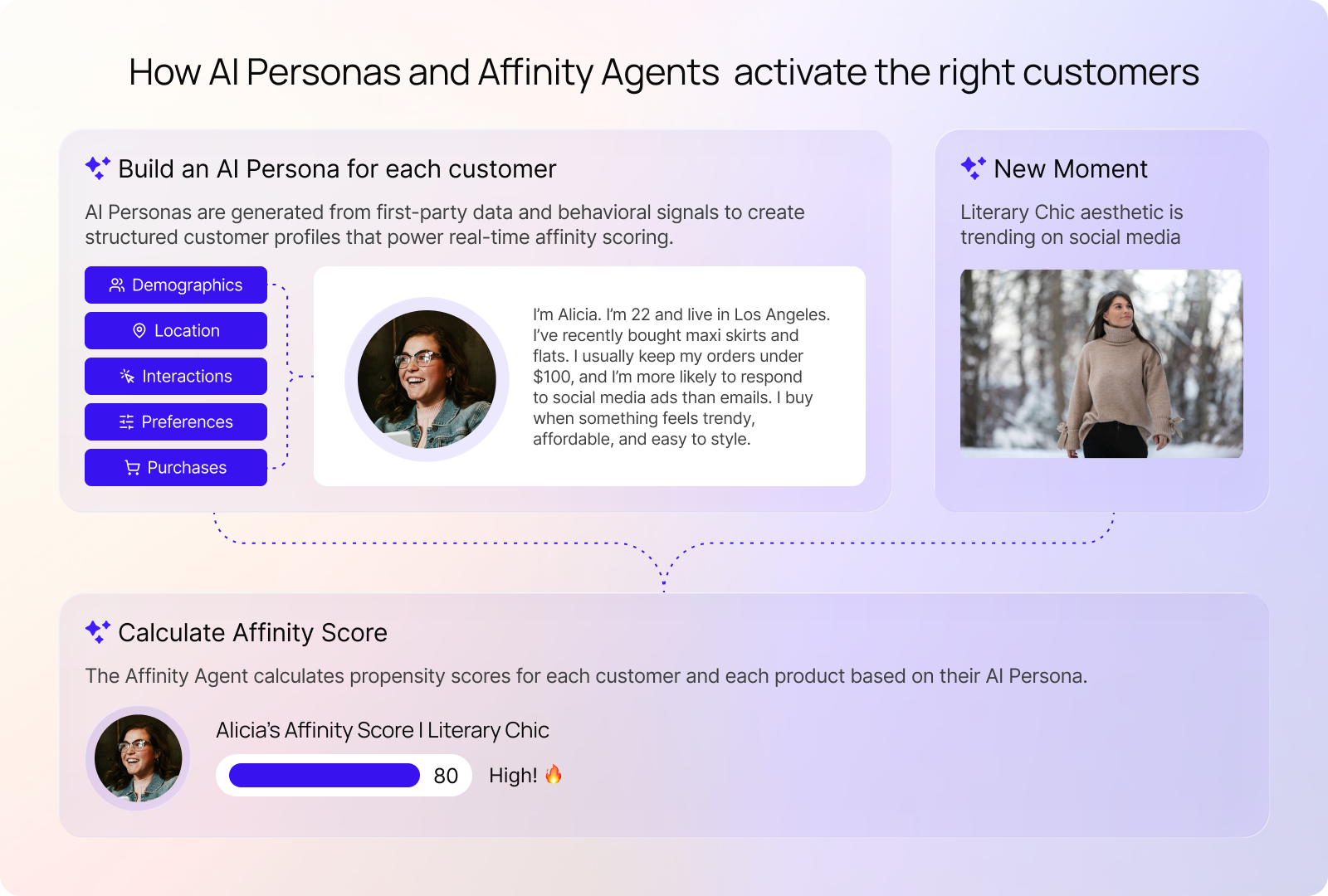
AI Personas represent a behavioral model of each customer, created from first-party data. Simon AI analyzes demographic attributes, purchase behavior, browsing depth, recency, frequency, and cross-category patterns stored in your data warehouse. Then, customers are grouped based on multi-dimensional behavioral similarity.
Each group or cluster of behavior becomes an AI Persona, a structured behavioral profile that captures tendencies in a human-readable and inspectable way. In Simon AI, you can review narrative descriptions, representative customers, and the signals that contributed to a particular group.
The system continuously evolves. Assignments refresh as behavior changes and new customers are evaluated based on early signals and similarity to existing groups. Every contact receives a persona ID that becomes a stable attribute for segmentation and activation, enabling persona logic to be immediately operational in your existing workflows. You can rename, reorganize, or hide personas to reflect your business, and convert any persona into an activatable segment directly.
Is this possible without agentic workflows? A capable data science team could build clusters inside Snowflake and score them against new products. The practical difference is maintenance and scale. Recalculating affinity for every new opportunity, refreshing persona assignments, and preserving scoring context across campaigns requires constant manual work.
That is the power of an agentic system that operates on live data (in Snowflake, for example), removing manual work that doesn't scale and allowing marketers to act quickly and independently of data teams.
The Affinity Agent: The real-time scoring engine
AI Personas clarify who the customer is behaviorally. The Affinity Agent evaluates what they are likely to care about next.
The Affinity Agent scores how well a specific moment or opportunity aligns with each persona's behavioral profile. It does not require the customer to have purchased, browsed, or clicked in the relevant category. It evaluates fit based on the patterns the AI Persona already encodes.
It answers a real-time question of “who should see this right now?” in five structured steps.
1. Inputs. The Affinity Agent takes in the opportunity being evaluated (a product launch, campaign theme, or cultural signal), along with candidate SKUs and live persona profiles from your first-party data. Scoring is recalculated for each opportunity, so every evaluation reflects its specific context.
2. Meaning matching. The system interprets what the opportunity represents. It compares semantic attributes rather than exact keywords. Those attributes are evaluated against the behavioral tendencies encoded in each AI Persona.
3. Structured reasoning. For each persona, the agent evaluates the likelihood of engagement and the messaging fit. Because AI Personas encode cross-category behavior, this evaluation works even when direct purchase history for the item is limited or nonexistent.
4. Affinity scoring. Each persona receives a probabilistic relevance score for the opportunity, ranging from 0 to 100. Customers inherit the score associated with their persona. This cascade allows opportunity-to-persona alignment to be computed once and applied across all associated customers. Marketers apply confidence thresholds to balance reach with expected intent.
5. Ranked outputs and persistent signals. The system produces engagement-ranked audiences and recommended products aligned to high-scoring personas. Customer-by-opportunity scores are stored, building a persistent affinity matrix that grows more precise as additional opportunities are evaluated. As new campaigns run and new moments emerge, prior scores provide compounding context for future targeting decisions.
This is different from traditional, supervised predictive audiences trained on historical conversions. Persona-based scoring evaluates fit across broad behavioral patterns, so new launches and customers with limited history can be included from the start.
How it works: A retail walkthrough
Consider a marketplace brand with a broad design catalog and a seasonal surge of gift buyers. In January, engagement declines. The team wants to re-engage customers without defaulting to broad discounts.
A spring “cottagecore aesthetic” trend around natural textures, handmade details, and earthy palettes begins gaining traction.
Step 1: A cultural moment is detected through Simon AI Social Moments, signaling rising interest in cottage-inspired design themes.
Step 2: The Affinity Agent maps that theme to relevant SKUs across the catalog, identifying products aligned with attributes such as handmade styling and sustainable materials.
Step 3: The Affinity Agent evaluates each AI Persona against the opportunity. This process represents a structured “interview” of the personas that leads to an Affinity Score (such as Conscious Minimalist: 87, Seasonal Gifter: 74, Bold Maximalist: 31)
Step 4: Customers inherit their persona’s Affinity Score. A high-confidence threshold surfaces a focused audience of customers strongly aligned with the trend. A moderate threshold expands reach for testing while preserving relevance.
Step 5: Ranked audiences are paired with products that match the moment and feel natural for each persona segment. Simon AI then activates campaigns into engagement platforms such as Braze.
Within the high-confidence group are lapsed buyers who never purchased cottage-themed items before. They surface because their broader behavioral profile aligns with the opportunity.
Customer + moments in practice: SeatGeek
SeatGeek needed to match millions of fans to thousands of Tier 2 events that couldn't justify manual audience builds. Simon AI created fan AI Personas and Affinity Agents scored how well each new event aligned with those personas.
Audiences were pushed directly into Iterable and refreshed continuously as new events launched.
As a result, SeatGeek achieved a 70 percent increase in GTV per contact versus manually built audiences.
Read the full SeatGeek case study.
Match your customers to moments with Agentic Marketing
Most CDPs help you activate the segments you already know how to define. AI Personas and the Affinity Agent help you identify which audiences should exist in the first place, helping your team to understand "who will care next."
See how AI Personas and the Affinity Agent work on your own customer data and walk through a real moment end-to-end. Get in touch here.
.webp)
When I bring up using social trends to trigger CRM campaigns, I hear one of two things: "Is that even possible?" or "We've tried. We can't move fast enough."
A creator posts about a product. A meme takes off that aligns with your brand. A trend spikes. "Very demure, very mindful" sends modest workwear sales soaring. The Oasis reunion sends 14 million fans scrambling for 1.4 million tickets. The “Albanian Riviera” goes viral and tourism doubles overnight. Canvas tote bags go from grocery sacks to status symbols and sell out in minutes. Your catalog has exactly what people want. The demand is there for the taking, often for only a brief moment. But acting on it is slow or impossible for most CRM marketing teams.
Social is where customer attention lives. But it sits outside the way CRM marketing works. Systems are built to organize known data and execute against predefined logic. They're not designed to capture what customers are responding to right now, or why their behavior is changing.
That makes relevant messaging harder. Social activity, emerging fashion, cultural shifts, new events influence customer behavior immediately. Long before they show up in your CRM. By the time they do, they've been flattened into historical attributes or lagging indicators. And without a way to connect live context to your first-party data, you can't connect a trend to the customers who care about it.
So the pattern repeats. Your team spots a trend, files a data request to check relevance, waits on SQL or a ticket to build the audience, then another 48 hours to brief creative. Within a week, you're ready. But the moment is gone, or at best, you show up too late to seem relevant.
Trends can emerge in hours. Campaigns move at the pace of planning cycles. Observing a trend is not enough if you cannot quickly answer:
- Is this moment relevant to our customers?
- Do we have a product or message that fits?
- Who actually cares?
- What should they see?
Most teams either miss the moment entirely or blast everyone with a generic message, hoping for the best. Noise, not relevance.
Introducing Social Moments
Simon AI™ Social Moments enables timely, personalized marketing by detecting viral social media trends and cultural moments that matter to your customers. It pinpoints relevant trends, breaking news, weather, and local events, then automatically surfaces the customers most likely to be interested.
How moment-driven activation works
Detect. Simon AI Moment Agents monitor social media signals for spikes that indicate emerging relevance, then match them against your customer data and product catalog. They evaluate how quickly engagement is accelerating to catch trends as they rise. When a signal crosses a threshold you set, the system generates an AI Moment, a structured trigger specifying what's happening and why it matters.
Identify and Assess. Affinity Agents take AI Moments and match them to customers using AI Personas to score relevance, even for customers with limited purchase history. You get engagement-ranked audiences with relevance scores and predicted metrics, including CTR, conversion rate, and average order value.
.webp)
Activate. Automation Agents route high-relevance audiences directly to your engagement platform (Braze, Iterable, Attentive, etc.) with content and product recommendations ready to deploy. All this happens without traditional manual setup, segmentation tickets, and scheduling delays.
In practice, you see a ranked list of emerging trends matched against your product catalog, with audience size. Click into a trend to see customers scored by likelihood to engage, ready to sync directly to engagement platforms. No data ticket. No SQL. You're live the same day.
Social Moments playbook

Trend-aware abandoned cart
Turn a stalled cart into an opportunity. That forgotten item became the thing everyone wants.
Trigger: A product in abandoned carts starts trending on social.
Audience: Customers with the trending item in cart, prioritized by Affinity Score.
Activation: Enhance your existing abandoned cart flow with timely context.
Personalization: Trending SKU highlighted, plus complementary products based on cart contents.
KPIs: Recovered carts, AOV lift, time-to-conversion improvement.

Trending event digest
Same weekly send, now it feels handpicked. Each fan sees the events that match what's buzzing for them.
Trigger: Scheduled send combined with real-world trend signals.
Audience: Full send list, with events personalized by Affinity Agents.
Activation: Your existing recurring campaign featuring trending artists and surprise tour announcements matched to each customer.
Personalization: Each recipient sees the events most relevant to their profile.
KPIs: Engagement lift vs. baseline, CTR improvement, ticket conversion rate.

Viral hero SKU flash
A product is spiking. You have hours. Reach the customers who'll care while the trend is rising.
Trigger: A creator post or social mention drives sudden demand for a specific SKU.
Audience: Customers most likely to engage, scored by Affinity Agents.
Activation: Flash campaign across email, push, SMS and website while the trend is still rising.
Personalization: Variant and creative chosen based on relevance. VIP customers get early access.
KPIs: Time-to-activate, CTR to conversion, sell-through rate.

Trend-powered re-engagement
Bring back lapsed customers with a product that's trending right now.
Trigger: A pop culture moment or viral trend aligns with products in your catalog.
Audience: Customers who haven't purchased in 60+ days, especially seasonal or gift buyers, whose past behavior suggests affinity for the trending theme.
Activation: Re-engagement campaign featuring catalog items matched to the moment. No new creative required. The trend is the hook.
Personalization: Each recipient sees products matched to both the trend and their individual purchase history.
KPIs: Reactivation rate, revenue per re-engaged customer, engagement lift vs. generic winback.
Ship your products while the trend is spiking
Social Moments shrinks the time between spotting a trend and acting on it. Detection, audience scoring, data prep and activation happen in a single workflow, so your team launches faster, with relevance that enhances your brand.
Behind Social Moments, AI agents work continuously on your live customer data via the Simon AI Composable CDP. Personalization is built on your first-party data. The guesswork and data requests that used to slow you down are handled autonomously.
Ready to see how it works? We'd love to talk through Social Moments use cases for your brand.
.webp)
The following recap pulls from our recent webinar, How Winning Teams Use AI to Turn BFCM Shoppers into Repeat Buyers, featuring Katharine Toll and Paige Rotar from Simon AI. Both work closely with direct-to-consumer brands, helping marketing teams use agentic AI to launch campaigns faster, uncover new revenue opportunities, and personalize at scale.
You'll acquire 30-40% of your annual customers this Black Friday / Cyber Monday. Most will never buy again.
Not because your product failed them or because they didn't like your brand. But by the time you figure out who they actually are and what they need next, the moment is gone. You spent millions on acquisition, but your tools can't process changing customer intent and real-world context fast enough to convert them into repeat buyers.
After 90 days, first-time buyers who haven't returned rarely become valuable customers. If you convert just a fraction more during this window, you’ll fundamentally change your growth trajectory. The stakes are high. The window is narrow. And most teams can't act fast enough to capture it.
Why most CRM teams can't keep up
By early December, you’re looking at tens of thousands of first-time Black Friday / Cyber Monday buyers grouped into a single “BFCM 2025” segment. Yet, they certainly don’t all belong in the same follow-up journey.
Some shoppers came in for the discount and are unlikely to respond to full-price offers this month. Others were buying gifts and probably won’t re-engage until they start shopping for themselves later in the season. Then there’s a sizable group who spent real time exploring new categories, browsing repeatedly, adding items to their carts, and reading reviews. These are all signals that they may be open to a second purchase soon.
Your job is to separate these patterns so each customer gets the follow-up that actually fits their intent.
The data you need is in your warehouse, but accessing it means submitting a ticket to engineering. By the time the fields get built, it's mid-December. The 90-day window is half gone. Even teams that already have the right data face the same slowdown because segment creation is still manual, rules-based work.
Traditional marketing operates on rules and schedules. But customer intent ebbs and flows, changing quickly. The difference between a team that can process all these signals while they're fresh and one that's always two weeks behind is the difference between profitable growth and expensive churn.
How leading brands are solving this with AI
Working with retail brands through their highest-stakes acquisition moments, I've seen the teams that are winning this race for repeat buyers do something different. They're not trying to move faster manually. They're using AI to process customer signals and real-world context at machine speed so they can respond to intent with value and relevance while it's still fresh.
Three AI plays are fundamentally changing how this work gets done. Together, they deliver personalization that matches how customers actually shop and give CRM marketing teams what they need to turn first-time BFCM buyers into repeat customers.
Each play helps you surface intent earlier, respond while it’s still fresh, and keep more of your newly acquired shoppers engaged during the 90-day window when repeat behavior forms. AI turns data into live attributes, activates campaigns when real-world signals align with intent, and evaluates every customer individually.

Here's what each play does, and how they work together:
Play 1: AI-powered audiences — building and scaling actionable signals.
Most CRM teams work with the same static segments—"Deal-Seeker," "Lapsed," "High-Value"—not because those buckets represent the only signals that matter, but because those are what is wired into their systems. Product reviews, support transcripts, browsing patterns, and sentiment signals can be difficult to access and understand, require engineering tickets, and risk long turnaround times.
AI-powered audiences transform the marketing workflow from static labels to executing with dynamic, predictive attributes called AI Fields. Instead of just knowing someone was a "Deal-Seeker," you can layer on social-trend affinity, post-peak purchase propensity, or channel preference shift. This represents a shift from manual, slow, rule-based segmentation to automatic, fast, and adaptive relevance for the real-world signals you need to identify who is most likely to buy again soon.
How AI-powered audiences work
AI-powered audiences run through four ongoing steps that update audiences as customer behavior changes:
- Analyze live data - Agentic AI brings together what customers browse, buy, and respond to, along with the signals they leave in reviews or support chats.
- Uncover hidden patterns - As behavior shifts, AI picks up emerging themes, changes in sentiment, and early signs that interest or loyalty is moving in a new direction.
- Assign actionable attributes - These signals become AI Fields that continuously update to reflect what a customer tends to prefer, how they engage, or which channels they lean toward.
- Create dynamic audiences - When similar patterns show up across customers, new audiences form automatically. They stay current because they use live data to update based on what people are doing now, not old segment rules.
For example, if someone moves from weekly to monthly purchasing, the system notices the shift immediately, AI Fields and audiences are updated, becoming immediately actionable rather than discovered weeks later.
.png)
Play 2: Contextual activation — triggering messages when real-world context and intent align
Your winter apparel campaign runs on a schedule. Every Monday at 10 am, everyone who browsed jackets gets the same message, regardless of whether it's 65 or 30 degrees in their city. Your segments are static. They can't keep up with changing conditions like weather shifts, trending styles, and local events. By the time your campaign launches, the moment may have already passed for a customer.
Contextual activation is powered by AI agents that create dynamic, always-on optimization that incorporates real-world signals, like weather, social trends, and local events. Instead of calendar-driven campaigns, you combine audience intelligence with context to trigger messages when intent and conditions align. The result is hyper-relevant engagement that is based on the moment, not just the audience.
Simon AI Social Moments is a powerful example of contextual activation, using live social and cultural signals to trigger messages when demand is emerging, not after it’s already passed.
How contextual activation works
The system works in a steady loop:
- Signal fusion - AI combines what customers are doing with what’s happening in the world around them, weather shifts, local events, seasonal changes, or trends that may influence why they’re shopping.
- Intent detection - As those signals overlap, the system notices when real-world conditions line up with a customer’s interests. A cold snap, an upcoming storm, or a regional event can turn past browsing into a meaningful moment.
- AI Moments - When the timing is right, the system sends timely messages tied to that context. If temperatures drop in Denver, customers who have been exploring outerwear receive cold-weather recommendations. If conditions stay warm, the message waits until it’s actually relevant.
Campaigns are triggered by real-world signals to match the when and why a customer is likely to make a purchasing decision. Post-BFCM engagement is driven by propensity and relevance, so your CRM marketing team is sending fewer emails to people who aren't ready, and perfectly timed messages to those who are. Open rates climb. Conversion improves. You're building trust through relevance, not eroding it through spam. Contextual activation helps your team reach customers when their interest is strongest, improving repeat-purchase conversion without increasing send volume.
Play 3: Synthetic consumers — Individual-level prediction and decisioning at scale
Traditional segmentation infers intent from past behavior: Someone bought winter gear six months ago, so route them into the winter gear campaign. AI Fields surface smarter patterns—deal-seeker affinity, channel preference shifts, emerging interests—but you're still working backwards from data points, trying to guess what someone wants based on what they've done.
Synthetic Consumers create AI personas that think like your customers. Instead of inferring intent from historical actions, you build a dynamic model of each individual that simulates how they actually make decisions. Then you can ask it directly: "How interested is this person in this specific product right now?"The model reads the customer’s full pattern of behavior and produces an affinity score that reflects their level of interest. It’s not a spreadsheet of data points. It’s a way of asking a representation of the customer how likely they are to engage.
How synthetic consumers work
Synthetic consumers operate through three connected steps. Together, they create a representation of each customer you can query directly and activate in real time.
- Dynamic customer models - The system builds a working profile, an AI persona, that acts like the customer would across different situations. It interprets past activity, context, and trends, and turns them into actionable predictions you can use for highly relevant targeting.
- Intelligent interest scoring - You can ask this model about specific products or campaigns. Instead of simple yes/no logic, it returns an affinity score that reflects how likely the customer is to care about what you're offering.
- Context-aware reactivation - Those scores are combined with real-world context. When the timing makes sense, AI agents determine when to re-engage the customer. When it doesn’t, the message waits.
.png)
Even customers in the same segment—deal-seekers, loyalists, gift buyers—have very different attributes and interests. Synthetic consumers let you personalize at the individual level while making thousands of decisions automatically. This lets you prioritize high-affinity customers during the 90-day window when repeat behavior forms, instead of relying on broad segments that treat all BFCM buyers the same.
Depending on your data, goals, and readiness, all three of these plays can work together. Here's what that looks like in practice.
How AI turns a Black Friday browser into a repeat buyer
Taylor browses your site on November 29th. She's 34, lives in Denver, and has abandoned cart three times researching insulated jackets for backcountry skiing. She finally makes a first purchase during your 40% off sale: a mid-weight jacket, first-time customer.
Now, AI agents scan her complete behavioral profile. She viewed technical gear, not fashion outerwear. Her browsing history shows skiing and hiking categories. Cart abandons suggest research, not price-hunting. Purchase timing coincided with ski resort announcements. She gets dynamically categorized into "High-Value First-Time Buyers" and "Cold Snap Layering Seekers", live attributes that appeared the day the pattern emerged.
From December 1, AI monitors external signals for contextual activation. Regional temperatures forecasted to drop December 4-6. Local ski resorts are announcing opening day. Her browsing showed interest in base layers she didn't purchase. The system holds the message, waiting for context to align with intent.
On December 4, temperatures hit 28°F in Denver. Ski season opens. The system queries Taylor's synthetic consumer model: "What's her affinity for technical base layers right now?" The model evaluates her complete profile and responds: "I'm gearing up for another ski season in the Rockies. I need reliable gear that can handle backcountry conditions. I'm looking for technical outerwear that performs in extreme cold but won't overheat me on the uphill."
Taylor’s affinity score reaches 89/100 for technical base layers.
Taylor receives a "Comfort starts at the base" email featuring technical base layers, triggered by demonstrated interest, weather alignment, and individual-level affinity scoring. The product recommendation matches what she's planning this weekend. No discount needed because relevance is the value.
At the same time, AI is busy processing similar scenarios for tens of thousands of other BFCM customers, routing gift buyers to March campaigns, suppressing discount-seekers from full-price offers, and matching product enthusiasts to relevant categories.
One journey template becomes thousands of individually timed moments. This level of precision requires clean data foundations and clearly defined campaign goals. But once configured, these decisions happen automatically.
"Getting to that why is important, but being able to systematically do that across your entire customer database is the real challenge." Katharine Toll, Head of Sales, Simon AI
Explore how AI can improve your BFCM performance
Ready to explore what's possible for your brand? Book a 45-minute AI Use Case Workshop with our team. We'll walk through high-impact AI use cases tailored to your goals, identify fast-start ways to scale personalization, and show you how AI connects customer behavior with real-world context to turn Black Friday / Cyber Monday buyers into repeat customers. You’ll walk away with three use cases to help you activate real-world signals and convert more of your BFCM shoppers into repeat buyers. Request your use case workshop here.

Every marketer feels the same pressure as Black Friday and Cyber Monday approach: too much data, too many touchpoints, and too little time. What used to be a four-day promotional burst has become a high-stakes, multi-week competition for attention, engagement, and conversion.
Historically, brands coped by throwing more staff, more promotions, and more budget at the problem. But that approach no longer scales. The limits of manual planning, static segments, and fixed calendars become painfully clear during BFCM, when behavior shifts by the hour and last year’s “best practices” simply can’t keep up.
More brands are now turning to Agentic AI to change this equation. These AI systems use multiple autonomous “agents” that collaborate to analyze data, generate content, and make decisions in real time. Marketers still define the strategy, guardrails, and brand standards; Agentic AI simply executes the operational complexity. The result is segmentation and journeys that optimize as customers move through the funnel… not after the fact. And while these capabilities shine during the BFCM rush, their real value emerges once the season ends, when the intelligence gathered during “peak” becomes the foundation for long-term loyalty.
Here are five ways Agentic AI is reshaping the BFCM playbook and extending its impact well into the new year.
1. Smarter segmentation and micro-segmentation
The Challenge
Traditional segmentation schemas can’t keep pace with BFCM activity. Increased engagement carries with it more signals for each customer. Additionally, purchase intent and customer behavior shifts dramatically during the BFCM window. A “VIP” customer in September might act like a deal seeker in November. A low-frequency browser might suddenly exhibit high-intent behaviors that would normally take months to emerge. If your campaigns are wired to historic behavior, you’ll miss the real intent in front of you.
The result is a familiar holiday problem: irrelevant messages, poorly timed incentives, and wasted impressions during the most expensive week of the year.
How Agentic AI Helps
Agentic AI transforms segmentation from a static categorization exercise into an adaptive, real-time intelligence system. Instead of marketers defining each segment manually, data and insight agents continuously propose, test, and refine dozens of micro-segments based on what is actually working. Specifically, these agents:
- Ingest behavioral, transactional, and contextual signals (browse paths, cart actions, device, time of day) and update segments on the fly.
- Identify moment-in-time intent clusters, such as “Gifts for Dad researchers,” “high-margin category explorers,” “early morning mobile shoppers,” or “repeat browsers showing second-purchase potential.”
- Continually re-evaluate and refine micro-segments based on behavioral, transactional, and contextual signals: what people browse, how often they return, whether they show price sensitivity, what channels they use, etc.
- Connect directly to your engagement platforms, so each micro-segment is routed to tailored messaging flows.
2. Offer optimization without eroding margin
The Challenge
BFCM has always created tension between revenue and margin. The instinct to “win the weekend” pushes teams toward deeper and broader discounts, at the expense of eroded brand equity and compressed margins exactly when paid media is at its most expensive. Without precise insight into who needs a discount and who doesn’t, brands err on the side of over-discounting. The result: strong top-line performance paired with weakened profitability and increased discount dependency among customers.
How Agentic AI Helps
Agentic AI treats offer decisioning as a continuous optimization engine. Rather than relying on a pre-defined promotion calendar, the system dynamically adjusts incentives at the micro-segment level as new data points emerge. To achieve this, AI agents:
- Continuously test discount levels, offer framing, and incentive types (percent off, dollar off, gift with purchase, early access) across myriad micro-segments.
- Adjust offers dynamically based on predicted purchase probability, historical LTV, and price sensitivity.
- Auto-suppress discounts for customers who are likely to buy at full price or with lighter incentives such as early access.
- Surface new offer concepts that would be difficult to test manually at scale, then recommend the winners for roll-out, with supporting data.
In practical terms, you can set guardrails around margin and brand standards, then let AI explore the space within those constraints. This leads to smarter use of margin, not blanket erosion.
3. Product recommendations powered by real-time inventory
The Challenge
Every holiday season puts extraordinary strain on inventory. Products sell out quickly, supply chain snafus cause late arrivals, and inaccurate inventory data lead to a poor customer experience. Traditional recommendation engines typically rely on static models and stale inventory snapshots, resulting in promotions for items that are out of stock or hard to ship before key holiday deadlines.
This disconnect between personalization and inventory creates unnecessary friction. Customers click on items they can’t buy, and brands miss opportunities to move high-margin or well-stocked products.
How Agentic AI Helps
Tapping into AI’s ability to reconcile multiple datasets and structures on the fly, these systems merge personalized recommendations with real-time inventory levels. In terms of activity, these agents:
- Integrate live inventory feeds with recommendation models, incorporating stock levels, sell-through velocity, and margin into product rankings.
- Prioritize in-stock and high-margin products, while automatically suppressing or deprioritizing low-stock SKUs that are at risk of going out of stock.
- Suggest intelligent substitutes and complements when popular products sell out, based on similarity and historical attach patterns.
- Factor fulfillment windows into recommendations, highlighting items that can still arrive by key dates such as Christmas or New Year’s.
This turns recommendations from a static “You might also like” widget into a real-time merchandising engine, tuned to both customer and business opportunities, all while avoiding the poor customer experiences that undermine long-term loyalty.
4. Customized creative at scale
The Challenge
The creative output required during BFCM has outpaced what even the best teams can produce manually. Daily deal waves, multiple micro-segments, and omnichannel execution demand a constant stream of variations: subject lines, product callouts, onsite messaging, SMS copy, and paid media creative. Yet teams are still expected to maintain brand consistency while increasing personalization. It’s almost an impossible combination.
The result is predictable: generic campaigns, reused assets, and missed opportunities to tailor messages to specific behaviors.
How Agentic AI Helps
Agentic AI amplifies the creative team’s capabilities by generating high-quality, on-brand variations at scale. Creative teams establish the voice, guidelines, and narrative direction; AI systems handle the multiple variation complexity. To achieve this, they:
- Generate tailored subject lines, headlines, CTAs, and product copy for each segment or intent cluster.
- Adjust tone, urgency, and framing based on region, engagement level, and lifestyle context (e.g. single, couple, family).
- Work from pre-approved brand guidelines and guardrails, so messages stay on voice and within legal and regulatory boundaries.
- Run continuous multivariate creative tests, then roll out winners automatically while retiring underperformers.
- Support channel-specific creative, such as shorter, more urgent SMS copy, richer email stories, and tighter paid media variants.
By marrying expressive AI capabilities with automation and journey agents, these systems help marketers reap the benefits of truly customized content, without sacrificing brand guideline consistency.
5. Dynamic journey and channel optimization
The Challenge
Holiday campaign performance changes by the hour. Email may spike in the morning and fall flat by mid-afternoon. SMS may surge right before shipping deadlines. Paid media ROI may swing dramatically based on time of day, audience saturation, or creative rotation. Yet most marketing calendars are locked weeks in advance and journeys are built as locked decision trees, not adaptive systems. Manual optimization isn’t just inefficient, it’s near impossible at BFCM scale.
How Agentic AI Helps
Agentic AI turns the entire journey into a responsive system. Optimization agents watch for shifts in engagement, identify friction points, detect fatigue, and work with automation agents to adjust communications accordingly:
- Monitor engagement across email, SMS, app, web, and paid media in real time, looking for shifts in performance.
- Adjust send timing, frequency, and channel mix automatically, based on live response curves and diminishing returns.
- Move budget between channels where you see better incremental return, especially in costlier paid media and retargeting platforms.
- Detect funnel friction, such as spikes in cart abandonment or checkout exits, and trigger immediate re-engagement using the channel most likely to work.
- Coordinate messaging across platforms for each micro-segment to reduce overlap and avoid bombarding the same customer with redundant promotions.
You still set the strategy and guardrails, but you are no longer manually dialing every lever during the highest-pressure week of the year. Instead of making decisions in hindsight, the system acts in real time, exactly when the opportunity exists.
Conclusion: BFCM as the launchpad for lifelong loyalty
Agentic AI transforms BFCM from a high-pressure holiday sprint into a continuous intelligence loop. The same systems that optimize segmentation, offers, creative, and journeys during peak season become the backbone of long-term customer value immediately afterward. Brands can carry forward micro-segments, elasticity models, inventory signals, creative learnings, and journey insights into the new year.
The net effect is that winning BFCM no longer means a mad rush of offers and batch-and-blast promotions. It means creating systems that deliver a customized holiday experience for each user. And done right, these systems keep working long after the surge ends, turning seasonal shoppers into loyal, long-term customers who stay engaged well beyond December.
.webp)
One of the most important collaborations in customer experience is the partnership between data and marketing teams. After all, there’s no “data-driven marketing” without data. In my own experience as eCommerce and marketing leader, my data partners have been some of my most important collaborators, helping my team and I to both understand our customers better and mobilize those insights into true 1:1 experiences.
And yet, I’ve also witnessed marketing / data relationships that were strained and ineffective. Marketing teams that felt slowed down by data team timelines, and data teams that felt reduced to “report pullers,” saddled with tactical asks instead of being viewed as strategic partners.
The stakes of this misalignment are high: missed opportunities, slower decisions, wasted spend. In a world where customer expectations evolve daily and competitive advantage is often won by speed AND precision, no company can afford friction between these two critical functions.
The good news is that it doesn’t need to be this way. There are a handful of blockers that get in the way of an effective partnership, and all are addressable. This article explores the "why" and the "what" at the heart of this: Why these cross-functional alignments happen and What marketers can do to address those factors. Along the way, we’ll look at real-world examples, practical frameworks, and the role that modern martech tools (from CDPs to AI) can play in making the partnership hum.

Why marketing and data teams are often misaligned
To fix the disconnect between data and marketing, we first need to understand the root causes. In my experience there are a handful of common ones.
1. Differing mandates
On the surface, marketing and data should be perfectly aligned: both exist to leverage insights that improve the business. But in practice, their priorities diverge. Marketing focuses on speed and iteration, using rapid testing cycles to capitalize on evolving markets and gauging success in base growth and revenue. Data teams focus on precision and structure, with success measured in accuracy and stability.
This creates the classic “fast vs. accurate” tension. Marketing pushes to launch in days. data prefers more time for model validation and testing protocols. Both are right in their context, but without alignment, each can feel the other is an obstacle.
2. Timeline expectations
Modern marketers live in days and weeks, driven by aggressive campaign calendars and test-and-learn cycles. data teams often work in weeks and months, driven by structural design, thorough validation, and robust governance. Ironically, those same safeguards are what ensure the data reliability that marketing depends on.
When expectations collide, frustration builds. Marketers complain data is too slow. Analysts see marketing as reckless. Without a shared rhythm, collaboration stalls.
3. Language barriers
Every business discipline has its own lexicon. Marketing talks brand, funnels, and storytelling. data teams talk models, regressions, and confidence intervals. Each side’s jargon can feel opaque to the other, creating artificial barriers when they try to compare notes.
The problem isn’t just language; it’s cultural. Marketing often prioritizes creativity and narrative. data prioritizes precision and statistical truth. Neither is wrong, but the disconnect can foster a sense that the two teams are talking past each other.
4. The “request vs partnership” trap
One of the biggest sources of tension is how requests are framed: “Can you pull me a list?” or “Can you generate a report?” Unsurprisingly, analysts feel undervalued when reduced to servicing tickets instead of helping shape strategy.
The irony? Your data team can be a powerful strategic partner when you include them in the planning. Most data professionals want to solve complex problems, not just extract CSVs. And their deep knowledge of the data can help unlock insights you didn’t think to ask for.
Why all of this matters
The cost of an ineffective marketing / data partnership goes beyond tense relationships and messy email threads; it results in lost opportunities and real business impact. Even mild misalignment limits what the partnership could achieve.
Poor targeting can waste ad spend, leaving growth on the table. Campaigns fall behind competitors because targeting analyses take too long. New datasets get delayed because requirements are either undefined or over-defined to the point of paralysis.
Ultimately, trust erodes. And with it, go both speed and collaboration
How to build a high-performing partnership
The good news is that this relationship doesn’t have to be a tug-of-war. With the right practices, the marketing / data partnership can become a powerful strategic engine.
So let’s look at some of these practices:
Shift the relationship from service desk to strategic partner
The first, and perhaps most important, mindset adjustment is for marketers to avoid treating the data team as a service desk. Instead:
Learn data as a second language
In an age of data-driven decision-making, modern marketers need to be as comfortable with data concepts as they are with brand concepts. The more you understand how data works and how to talk about it, the easier it will be to frame your questions and requests in a way that the data team can respond to. And once that happens, barriers give way to partnership.
For example, a marketer may be interested in testing different creatives, but they’ll benefit from understanding test cell sizing and the parameters of statistical significance to ensure that the data team can analyze the results with the reliability and timeliness they’re looking for.
Or a marketer may be looking to quantify the stages of the customer journey, from email open through purchase. But to achieve that, their analyst partner may need to combine (or “join” in data-speak) a few different “event tables.” Just understanding that extra layer of complexity allows you to talk through the challenges and get to a solution. It may even result in modifications that will make similar analysis easier in the future.
In its simplest form, marketers think in “stories” (profiles, audiences, journeys) and Analysts think in “structures” (tables, rows, events). But data is foundational to both. And an expanded vocabulary builds on that foundation.
Define clear roles and expectations
In arenas from sports to the military, high-functioning teams are built on an understanding of roles (who does what) and expectations (when and where they do it).
Business is no different, which underscores the importance of marketing and data teams being aligned on each other’s roles and expectations.
Who drives test definition? Segmentation rules? Data governance? Without clarity on these, both sides will duplicate effort, or worse, expect the other team to do it and drop the ball.
Equally important is aligning on SLAs, or service level agreements, which is a fancy way of saying “define timelines for deliverables.” In our world of multi-tasking and competing priorities, “as soon as possible” is simply not sufficient for either a request or a promise. Rather, effective teams establish expectations around when requests will be reviewed and engage in a respectful negotiation around practical timelines for both sides.
Align on the metrics that matter
At the end of the day (or quarter), business outcomes are what matter, and both teams should rally around the goals and metrics that drive those outcomes. That means structuring analytics around key metrics like customer acquisition cost (CAC), lifetime value (LTV), average order value (AOV), and average revenue per user (ARPU). Other metrics like impressions, click-through rates, and conversion are important diagnostic tools, but both teams should agree on where they fit in the hierarchy of campaign analysis.
Equally important, both teams should agree on the one primary “success metric” for a campaign or program. In some cases, it may be conversion, but in others it may be AOV. Crisp analysis and decision-making rely on a clear “north star” metric that will determine success for each campaign, test, or pilot program.
And lastly, both teams should agree on a “source of truth” for analysis and results. Even if the marketing team runs its own analysis, the data should come from a source that has been blessed by its data partners. Nothing erodes trust faster throughout the organization than two analyses or dashboards that show different numbers.
Build rituals and celebrate wins
Effective collaborations don’t happen overnight. They require structure and repetition to build muscle memory and reinforce behaviors. Here are a few elements that I’ve found to be effective tools in the marketing / data partnership:
- Weekly syncs between marketing and data: These ensure that key projects are moving forward, provide a forum for surfacing and resolving blockers, and enable reprioritization when required.
- Joint retros for big campaigns: Tying inputs to outcomes is one of the most effective ways to motivate people. Sharing the revenue or customer engagement that came from the data team’s segmentation schema or pro forma analysis both motivates them and crystallizes the marketing partnership.
- Co-presenting results to leadership: When marketing and data teams are aligned in their presentations to the executive team, it sends the signal that they are in it together and have each other’s backs. As an added bonus, it gives the executive team greater confidence in the numbers being shared.
- Celebrate wins together: Strong collaborations are powered by collective wins. By celebrating successful outcomes together it strengthens the bonds between both the teams and the individuals among them.
Where modern martech can help
Technology can’t fix a poor relationship, but it can provide the kind of sound foundation that good partnerships are built upon. And there are three key capabilities to consider when powering the marketing / data partnership.
CDPs as the bridge between marketing and data
A CDP (customer data platform) unifies customer data into a single source of truth, transforming raw warehouse data into marketing-ready datasets and unified customer profiles. In doing this, it centralizes, cleans, and standardizes multiple data sources, resulting in a database that both teams can trust.
This “democratizes the data” by making it more accessible to the marketing team, without sacrificing the rigors of data governance the Data team requires. Marketers can define and size segments without pulling analysts into every request. Analysts can empower marketers by setting up datasets applicable for multiple use cases, rather than fielding tickets for every segmentation request.
For example, marketers want to launch a win-back campaign. Without a CDP, back-and-forth is required to define “churned.” With a CDP, “churned” is a standardized audience segment, and is adjustable with additional filters and variables set up by the data lead and controlled by the marketer.
This shift turns conversations from “Can you pull me a list?” to “How should we define and govern this segment together?”
Engagement platforms leveraging CDP inputs
Once a CDP is established as the source of truth for customer data, marketers can set up event triggers that automatically send audience segments and supporting data to engagement platforms that drive marketing-defined campaigns and customer communications. These platforms can drive activation on paid media (Meta, Google, Tradedesk), CRM channels such as email and SMS, and even direct mail and Customer Care outreach.
If the engagement platform is rich enough with channel integrations, it can even enable multi-channel communications and customer journeys. And with a CDP (like Simon AI) supplying rich data feeds, the emails, SMS messages and other touchpoints in those journeys can be highly customized.
For example, a customer browsing a product without purchasing triggers a CDP (Simon AI) to launch a follow-up email via an engagement platform, like Braze, that is personalized with customer data, product info, and customer offer (based on predicted customer value). After a day without a reply, Braze automatically triggers a follow-up SMS (as part of the journey set up by marketing) with options for the customer to either purchase at a special price (based on predicted customer value from the CDP) or text with a customer care rep. And if the customer chooses to text with a customer care rep, Braze automatically triggers a follow-up text from the customer care team’s platform, establishing direct rep-to-customer communication.
And all of that happened without any custom data feeds or targeting criteria from the data team. The result? Marketers move faster, Data teams focus on higher-value analyses, and customers receive a true 1:1 experience.
Agentic AI frees up data teams further
The newest evolution is Agentic AI: AI agents embedded within CDPs and engagement platforms. These platforms exponentially accelerate the customization and scale of 1:1 customer journeys.
Agentic AI can auto-build high-intent segments based on campaign goals, prep data for personalization, and draft entire cross-channel campaigns (timing, copy, visuals) for marketer review and approval.
%201.png)
This shift empowers both sides. The data team gains time to focus on higher-order work like modeling LTV frameworks or refining marketing spend attribution. Meanwhile, marketers are able to envision campaigns around myriad customer moments, delivering micro-journeys at a previously impossible scale.
A practical framework for marketers
To make all this tangible, here’s a quick checklist marketers can use to build a stronger partnership with their data teams.
The power of partnership
Marketing and data teams are better together, but only when it’s a true partnership. And marketers can take the first steps to make that happen. That means investing in the relationship, not just the requests. Share context. Learn about data. Build trust.
Because the best marketing stories aren’t just crafted with creative copy or eye-catching visuals. They’re written in partnership with the data team, where friction gives way to flow, and collaboration drives growth.

Today, Simon AI has announced the availability of the Simon AI™ Agentic Marketing Platform as a Connected Application on the Snowflake Marketplace.
This launch extends our commitment to helping enterprises bring agentic, AI-driven marketing directly to the Snowflake AI Data Cloud, empowering teams to reason over live data, detect key signals, and act in real time, without ever moving data or relying on complex integrations.
“Marketers have been promised AI for years, but the breakthroughs only come when data and intelligence operate as one. With this Connected Application, we’re giving enterprises a way to realize that vision—AI that acts on live data, securely and intelligently, right where it lives.” Jason Davis, CEO and Co-founder, Simon AI
What’s new
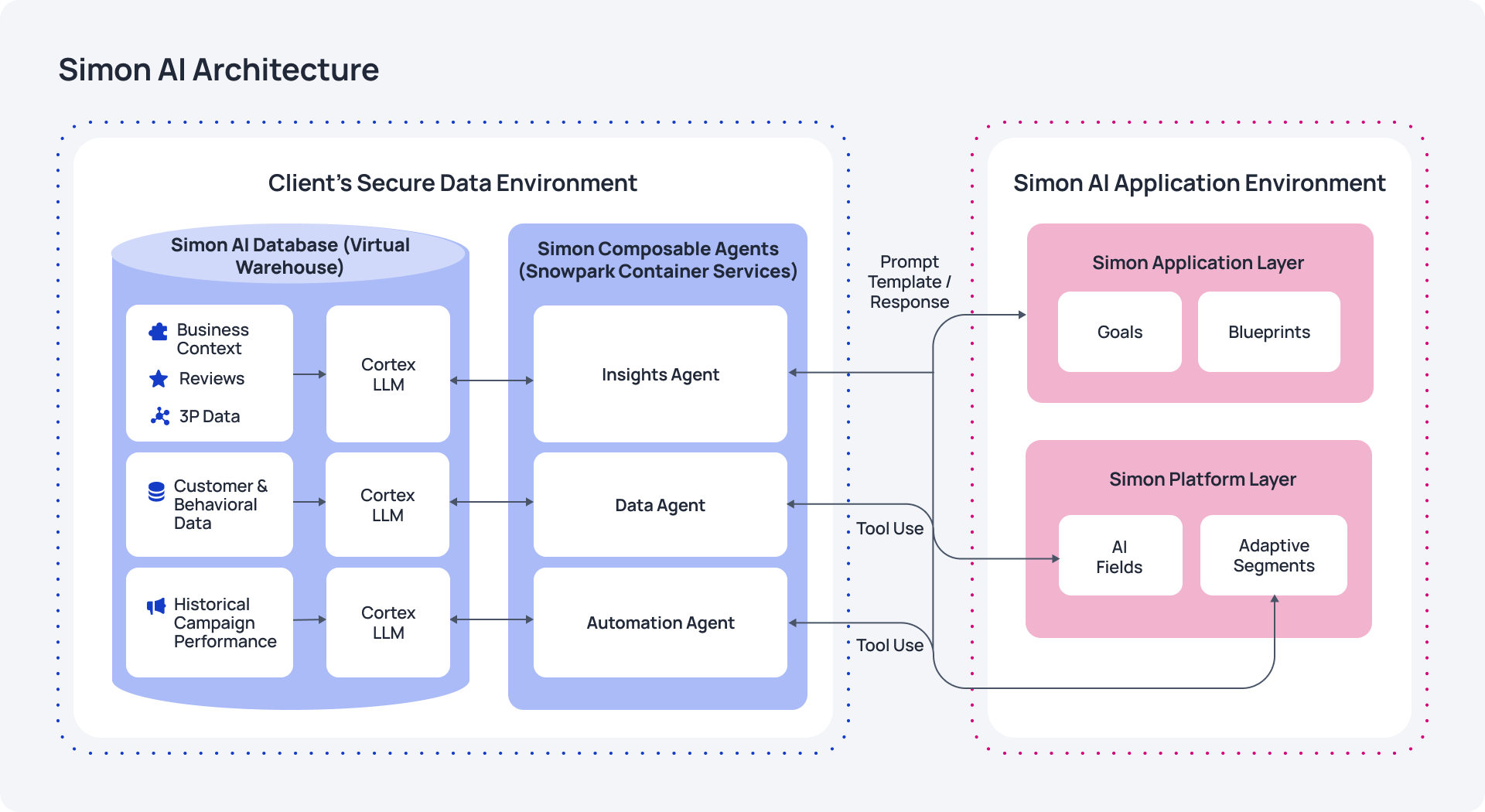
Simon AI is a connected app that leverages Snowflake Cortex AI to deliver marketing intelligence in place, within your governed Snowflake environment.
Composable Simon AI Agents reason over live customer data to surface insights, build audiences, and trigger personalized actions in real time. These agents are modular and flexible, allowing marketers to compose intelligent workflows that adapt as data changes.
This Connected App represents a major step toward autonomous, data-driven marketing, without breaking governance or moving data across systems.
Why it matters
Traditional marketing platforms extract and replicate data, slowing execution and introducing risk. Simon AI brings computation to the data, ensuring both speed and compliance.
The result is a fully governed, AI-enhanced activation layer, where marketing, data, and AI collaborate directly inside the Snowflake AI Data Cloud.
It’s a shift from manual segmentation to agentic systems that learn, adapt, and act, enabling marketers to operate at the same velocity as their data.
How it works
Composable Simon AI Agents form the building blocks of modern marketing orchestration:
- Insights Agents discover hidden patterns and opportunities from behavior, sentiment, or contextual data.
- Data Agents translate complex Snowflake tables into actionable marketing attributes.
- Automation Agents continuously trigger personalized messages and journeys across channels.
Together, these agents create a dynamic, composable framework that enables continuous optimization and 1:1 personalization.
What customers can expect
- Build and activate high-impact audiences up to 10x faster.
- Achieve up to 6x higher conversion rates
- Operate on live data with full security, governance, and lineage intact.
- Empower marketing teams to act independently, while data teams retain oversight and control.
This is what agentic marketing looks like: faster, smarter, and governed by design.
See it in action
Explore the Simon AI Connected Application on the Snowflake Marketplace.
Learn more from our CTO’s guest post on the Snowflake Medium blog:
Why Simon AI Chose Snowflake Cortex AI to Deliver 1:1 Personalization.
And revisit our earlier announcement:
Simon AI Launches Composable AI Agents for Marketers, Built on Snowflake Cortex AI.

Our vision
Marketing is evolving toward agentic marketing, where AI systems understand context, reason over live data, and act autonomously.
With Simon AI, a connected application on Snowflake, we’re helping organizations operationalize this future: combining live data, governance, and composable AI into a single, secure framework for intelligent customer engagement.
“Composable AI is the bridge between today’s marketing automation and tomorrow’s adaptive intelligence. Our vision is to empower every brand to build its own network of AI agents that collaborate across the data cloud to deliver experiences that feel truly human.” Jeff Walton, VP of Product, Simon AI
This launch represents more than just a Marketplace listing—it’s a milestone in the journey toward truly adaptive, data-driven marketing at scale.
A deep partnership with Snowflake
As an Elite Tier Snowflake Partner—the highest level of partnership within Snowflake’s ecosystem—Simon AI continues to push the boundaries of what’s possible with data and AI collaboration.
Our work with Snowflake Cortex AI has been recognized in the 2026 Modern Marketing Data Stack report, where Simon AI is featured for redefining how brands connect insights to action.
We were among the first companies to offer a Connected Application on Snowflake, and received Snowflake’s Powered by Snowflake Partner of the Year Award for our leadership in this new architectural model.
To see how this partnership delivers measurable impact, explore Snowflake’s official case study:
Simon AI: Composable Agents for Agentic Marketing on Live Data in Snowflake.
“Our collaboration with Snowflake has always been about more than technology, it’s about helping joint customers move faster while staying fully governed. This Connected Application shows what’s possible when two platforms align around a shared vision of bringing AI directly to enterprise data.” Alex Greer, Strategic Partnerships Leader, Simon AI
Together with Snowflake, we’re empowering enterprises to turn live data into live experiences, securely, intelligently, and at scale.
Learn how at simon.ai or contact our team to explore how Agentic Marketing can accelerate your data strategy.
Marketing leaders at retail brands are under pressure to prove AI can drive revenue now. At Shoptalk Fall 2025, we heard the same sentiment over and over—urgency to show results, hope that AI can deliver them, and confusion about how to get there.
Retail brand marketing teams are expected to elevate the customer experience and drive both conversion and LTV with the same or fewer resources. AI has moved fast from experiment to mandate. Leaders expect AI to finally solve the personalization challenges that have slowed their marketing teams for years.
But most teams aren’t ready. Teams are lean, data is often locked away or incomplete, and many depend on data teams (and sometimes they don’t have them). The promise of personalization still feels more like an aspiration than a reality to many marketers.
We’ll sum up what we heard from marketing leaders in dozens of meetings last week in Chicago:
1. Data is still the biggest barrier
Only about one out of three marketers we spoke with had their data in a good place, running both a cloud data warehouse and a customer data platform. Too many are still treating their CRM as the database of record. That’s a barrier to AI success.
Without a modern data foundation, AI can’t deliver. AI works as well as the data it operates on. Personalization at scale requires data that’s unified, accessible, and ready to act on. With that in place, AI agents can handle complex work and deliver value.
- Simon AI helps marketers explore all their data - first, second, and third-party data, structured and unstructured. It turns messy data into marketer-ready fields in minutes, not weeks. Learn more about the AI-first Composable CDP and the new operating model enabled by Composable Simon AI Agents.
2. Context is the signal marketers don’t realize they’re missing
Marketers spend most of their time wrestling with first-party data, with some dabbling in second-party data. But bring up third-party signals like weather or social trends, and the energy changes. Everyone agreed context is powerful, and most immediately asked, “How would we do that?”
Traditional data sources and CDPs tell you what happened (clicks, opens, drop-offs) to what customers, but they can’t tell you why. Without context, personalization is generic.
Simon AI activates real-world signals like weather, inventory, and social spikes to make campaigns timely and relevant. Simon AI™ Social Moments applies this idea to social context, detecting rising social demand and preparing audiences while interest is still building. Learn more about contextual personalization.
3. Execution is the everyday struggle that forces a painful trade-off
This was the most consistent frustration we heard. Even with data in place, teams struggle to move from insight to action. Campaigns take too long to build, and there’s too much dependency on technical teams. By the time a campaign goes live, the customer moment has passed.
Most marketing platforms force a painful trade-off. When you focus on volume, performance drops. As you personalize to convert better, volume drops. All your effort is on a few big bets. That’s the reality holding brands back.
The Simon AI Personalization Studio ends that trade-off — using Agentic AI on an AI-first Composable CDP to automate attributes, audiences, and workflows on live data while marketers stay in control.
4. The CDP market is noisy — and confusing
On the expo floor and in conversations with marketing leaders, it's clear that the CDP category has never been more crowded. Every vendor promises personalization. But most are layering on point-solution AI — faster content, better predictions, next-best actions.
That isn’t solving the real problem. Real personalization depends on two giant leaps forward:
- Marketer access to live, usable, complete data that is ready for a campaign
- The ability to execute hundreds or thousands of contextually relevant campaigns at speed and scale
Instead, most CDPs still leave marketers stuck with limited, predefined data, an inability to generate insights quickly, and a heavy dependence on data teams. This results in slow execution and a default to generic campaigns for segments. Campaigns take six to eight weeks to launch, long after the customer moment has passed.
- Simon AI cuts through data complexity with an AI-first Composable CDP and Data Agents that transform messy inputs into usable fields and live audiences. Learn more about Simon AI Data Agents that are live with customers now.
Turn messy data into marketer-ready attributes in hours, not weeks.
5. The cost of inaction is rising — differentiation depends on AI now
Marketers told us competition is fiercer than ever, and the gap between their investments and ROI is only growing. Time is essential — fast movers that use AI to solve customer experience problems today will have the edge in a future defined by rapid innovation and learning cycles.
For the moment, teams are overwhelmed with data but too slow to activate it, leaving campaigns generic and mistimed. Consumers, meanwhile, expect relevance instantly — whether in email, SMS, ads, or future agent-driven experiences.
Brands that move first will define the new standard for performance. Differentiation depends on using AI to close the gap between signals and execution.
- With Simon AI, brands accelerate differentiation by launching campaigns faster, acting on more signals, and scaling personalization without trade-offs. Learn more about the new marketing workflow that starts with a goal, and agents handle the hard work to wrestle with data and execution.
Early adopters of Simon AI are seeing measurable impact:
- Launch contextually relevant campaigns up to 10x faster
- Achieve higher conversion rates through adaptive personalization
- Drive material revenue growth by putting more campaigns in market, faster
Summing it up
Contextual personalization at scale is no longer optional, and the cost of waiting is only rising. Brands that move first are setting the new standard for performance.
That’s our read from Chicago. If you’re wrestling with the same challenges, let’s connect.
Why personalization "that finally works" requires AI embedded in every step of the customer data-to-execution workflow.
AI is transforming how marketing gets done. GenAI sped up content creation. Decisioning engines improved analytics and surfaced next best actions. But the greatest value of AI isn’t faster content or basic next steps, it’s solving the real complexity of personalization.
For marketers, the complexity has always been in the data → signal → execution process. Accessing, exploring, and activating data to turn raw signals into usable attributes across channels at scale has been the bottleneck. Marketing teams are locked in a dependence on technical teams, which inherently means that action happens after a customer moment has passed. The complexity of launching personalization forces painful trade-offs: more campaigns at lower performance, or slower, high-stakes bets with limited reach.
How Agentic AI changes the equation
Agentic AI ends that trade-off. By reasoning over live data, agents can generate new fields, detect signals, and launch campaigns that adapt as conditions change. Such work is impossible for people, or at least simply too slow and unscalable. With the right team of agents, personalization scales and performance improves.
AI needs the right foundation
The catch? AI is only as good as its foundation, the data. Too many AI use cases fail because they sit on incomplete or siloed data.
That’s why Agentic Marketing requires an AI-First Customer Data Platform. An AI-First CDP doesn’t bolt decisioning onto limited infrastructure. It embeds AI into its architecture, agents, and workflows so that marketers can act on a hundred times more signals and customer moments, and make a hundred times the decisions, without slowing down under the weight of complexity.
The CDP, reimagined
The CDP’s role has always been to connect data to customer experience. Now it must evolve. It must adapt continuously on fresh data, generating fields and audiences on the fly, and automating complex downstream execution to create micro-audiences at scale. The AI-First CDP isn’t a point AI solution on top of limited data. It’s the foundation for personalization at scale that finally works.
The evolution of Customer Data Platforms
Let's take a quick tour of how we got to where we are today. CDPs were invented to solve a fundamental problem: customer data was scattered across dozens of systems, with no easy way to unify it, resolve identities, and activate data for meaningful marketing tactics. Marketers struggled to see the full picture of their customers, and data teams struggled to keep up with endless requests for exports, joins, and custom pipelines. The original promise of the CDP was to bring all that data together and make it usable for customer engagement.
Traditional CDP
Traditional CDPs solved an immediate pain point by giving marketers a way to centralize profiles and create data-driven campaigns from one place. The promise was a unified customer view for marketing. But the limitations quickly surfaced.
Data had to be duplicated into the CDP, leading to latency and governance challenges. Analysts and data scientists were locked out of the loop, and the intelligence inside the CDP couldn’t flow back into the enterprise. These systems improved access for marketers but created silos for everyone else. A step forward. It felt powerful for a time, but data movement created pain.
Composable CDP
The next phase was the rise of the composable CDP. Instead of buying a packaged system, companies started building CDP capabilities directly on their cloud data warehouses. This solved key problems of duplication, latency, and governance. Marketers and data teams could finally share the same source of truth. Composable CDPs became a bridge between marketing and data infrastructure. The benefit was better alignment and fresher data.
The limitation is that workflows still remain manual. Data teams and marketers still have to define segments and journeys in advance. Campaigns remain a manual process, involving the right data and coordination between teams. Marketers often depend on data pulls or SQL from technical teams. Segments and journeys are delicate, locked to pre-defined rules, and slow to adjust when customer signals shift. Campaign orchestration becomes a series of handoffs, and optimization is still reactive rather than adaptive.
Composable CDP + AI decisioning
As composable CDPs matured, vendors began layering on AI decisioning. These engines promised next-best actions and predictive scores, and some have delivered incremental improvements. But AI decisioning is fundamentally a point solution. It is bolted onto existing systems rather than embedded across workflows. The limitations:
- Narrow scope: They optimize within the data they can see, which excludes the majority of contextual and operational signals.
- Manual dependence: Campaigns still rely on predefined segments and journeys built by marketers and data teams.
- Execution gap: Most AI-decisioning solutions require that recommendations be pushed into other systems for activation, which slows down response times and leaves optimization reactive.
The result is smarter recommendations layered on top of static workflows. Personalization is constrained by delicate segments, manual orchestration, and delayed activation. It has been noted that journey delay optimization (the days between the 1st, 2nd, and 3rd touchpoints) is the biggest lever for increased performance within AI Decisioning results. It's better than before, but still far from exercising the potential of AI for adaptive, data-driven marketing.
AI Decisioning is akin to racing down a mountain, but being constrained to take only a single route. If you’re able to explore all routes ahead of time, you may have chosen a different run. As the conditions of the mountain change, you may again revise which run to take. And looking across all skiers on the mountain, the best routes will vary by each person’s skill levels and abilities.
In short, there’s value in AI Decisioning (and it can also work alongside Simon AI), but it’s an optimization between the trees and doesn’t see the broader mountain.
The AI-First CDP
The AI-First CDP is different. It builds on the composable model, involves no data movement, and runs directly inside the cloud data warehouse with no replication or hidden black boxes. Unlike traditional CDPs, it doesn’t copy data into a proprietary environment. Unlike some composable add-ons, it goes beyond exposing predefined tables for marketer access. Instead, it makes the warehouse itself the execution engine.
Data composability
This is the role of data composability. By keeping all customer, contextual, and operational data unified in the warehouse, governed and extensible, it creates the foundation for AI to act in place on the full data universe. Data composability ensures agents can reason over the entire available universe of signals, not just a limited subset.
Composable AI Agents
On top of that foundation, Composable AI Agents are the breakthrough. They turn composable data into continuously adapting insights and execution, moving directly from the source of data downstream into engagement platforms. Agents handle enrichment, reasoning, orchestration, and optimization on live data. Marketers no longer have to manually define every segment or trigger. They set goals, and the agents take over. They find patterns, create new fields, detect real-world moments, prepare the data for marketing use, and automate the triggers that launch campaigns.
True unified data, 1:1 personalization at scale
An AI-First CDP extends data unification, analysis, attribute generation, and activation to customer, contextual, operational, and marketplace data in the warehouse itself. This means product inventory, service tickets, reviews, and weather patterns can all become real-time signals that drive personalization.
The result is personalization at real scale: not dozens of batch-built segments, but thousands of adaptive, contextual campaigns, connected to the enterprise data environment.
%201.png)
The core capabilities of the AI-First CDP
The AI-first CDP is a system designed to integrate AI into every step of the data-to-customer experience workflow. To understand what makes it different, let’s review the core capabilities that define the AI-first composable CDP:
1. Zero-copy AI engine: AI where your data lives
An AI-First CDP runs directly in a data cloud, eliminating the need for reverse ETL, the requirement of copying data out of the warehouse into other tools. That means no hidden stores, no replication, and no stale copies. Composable AI Agents tackle their “jobs to be done” on live data and governed data.
- Data never leaves the warehouse, preserving governance and compliance.
- Zero-latency activation enables real-time use cases
- Eliminates fragile reverse ETL pipelines and extra storage layers.
2. Operates on all data, not just customer profiles
Personalization requires more than demographic or behavioral fields. The AI-first CDP unifies operational, contextual, and unstructured data alongside customer profiles, giving AI the raw material to surface hidden drivers of engagement and conversion.
- Combines customer data, business data, and real-world signals and has the power to analyze it, prepare it, and execute on it.
- Escapes the trap of assumptions by letting AI explore all signals, not just the ones marketers predefine.
- Provides a complete view so campaigns can respond to the real factors influencing engagement and conversion.
3. Context is its superpower
The AI-first CDP adapts campaigns to real-world conditions by ingesting contextual signals, tying those signals to customer identity, and acting on these joined data points in near real time. For example, a zip code can be tied to a weather pattern, and a home address can extend demographic context.
- Pulls in signals such as weather, local events, or product availability
- Detects moments like frustration in support chats or sudden spikes in regional demand
- Responds instantly to what's happening now, not what was true yesterday
- Extends identity knowledge into the context layer, so every campaign can be enriched with a fuller picture of the customer and their context.
4. Embedded AI across workflows
Rather than simply layering AI on as a recommendation layer, an AI-First CDP embeds AI into the entire workflow, from finding signals to preparing attributes, triggering actions, and optimizing targeting. True AI-enabled personalization can add tremendous complexity to CDP workflows, but the AI-first CDP automates that end-to-end. It fundamentally improves workflows by introducing a new capability set where agents continuously reason and act on live data. Instead of dozens of campaigns, the AI-first CDP can adapt and execute thousands of campaigns at a time.
- Detects new signals and patterns tied to marketing goals.
- Enriches and structures data into marketer-ready fields.
- Continuously triggers and optimizes thousands of campaigns across channels.
.png)
5. Learns and shares with every cycle
The AI-First CDP creates a feedback loop by writing enriched intelligence back into the customer data warehouse so it enhances the source of truth and compounds the value of data over time. Every campaign fuels the next, strengthening the enterprise data foundation with new AI-generated insights and attributes.
- Creates new attributes automatically from raw and unstructured data.
- Writes predictions, performance insights, and enriched fields, audiences, and segments into the warehouse for enterprise use.
- Improves models and performance with each campaign cycle.
6. Makes data marketing-ready with a semantic layer
Even when all the right data is in the warehouse, it is typically still locked in technical schemas that marketers can’t use. The AI-first CDP bridges that gap with a semantic layer where agents translate raw data into business-ready concepts. This makes it possible for marketers to define goals in plain language while AI assembles the fields, audiences, and triggers behind the scenes.
- Enriched attributes: Predictive fields such as churn risk, intent, or product themes.
- Real-time triggers: Contextual signals like inventory changes, sentiment shifts, or spikes in demand.
- Goal-based workflows: Frameworks that translate marketer objectives into audiences, triggers, and campaigns.
7. Deep channel integrations and personalization fields
The AI-first CDP not only discovers insights, but it delivers them directly into every engagement channel. Deep channel integrations mean AI-generated fields and triggers flow seamlessly into email, SMS, push, in-app, and ad platforms without extra pipelines or manual work. Where most CDPs struggle with even basic personalization, like inserting a first name into a campaign, an AI-first CDP activates complex, context-aware personalization across all channels.
- Seamlessly orchestrates personalization fields across channels, enabling AI-generated attributes and triggers tied to resolved identities to flow into email, SMS, push, in-app, and ads without manual work.
- Continuously refreshes personalization fields based on fresh data so campaigns use the latest signals to reach customers at the moments they are most likely to engage and convert.
- Extends personalization fields at scale so thousands of campaigns can adjust automatically across channels.
Together, these elements allow marketers to define outcomes in plain language while the system builds and adapts the underlying orchestration automatically.
Is your CDP built for AI?
Most CDPs weren't. They promised personalization but left marketers stuck with backlogs, static segments, and missed opportunities. Ask yourself:
- Does your CDP run inside your warehouse with zero data movement?
- Does it unlock all customer, business, and contextual signals for AI use?
- Does it tie context to identity so AI can build a full customer picture in real time?
- Does it integrate deeply to create AI-powered personalization fields that work across campaigns and channels?
- Does it translate raw data into marketer-ready fields, audiences, and triggers with the help of agents?
If the answer is no, your CDP isn't ready for AI.
The new foundation for personalization
AI has changed the pace of marketing. Personalization can’t be batch-based or rules-driven anymore. To keep up, you need a CDP built for AI from the start, one that runs inside your warehouse, operates on 100x more data, and powers agentic workflows that adapt in real time.
That’s what we built Simon AI to do. A foundation that makes personalization finally work, at scale. Let’s talk about it. Contact our team, and we’ll show you how the Simon AI Composable CDP will unlock data for 1:1 personalization at your brand.
.webp)
I owe marketers an apology.
Before Simon AI, I led analytics and ML teams in government, SaaS, and e-commerce. Marketers were always the most demanding stakeholders I worked with. You needed more data, different data, perfectly tailored data. And you needed it yesterday. Too often, my answer was “Open a ticket.”
I didn’t get it. Marketing isn’t fickle. It’s situational. Markets move, customers shift, competitors react, and relevance has a half-life. You knew personalization was how to stand out, but the signals were hidden and the window closed before you could act. I didn’t give you a way to change that.
The Context We Missed: Weather Moments
One September, forecasts called for record heat followed by an early freeze across the Rockies and Plains. In Denver, that meant a 60-degree drop in days. At the e-commerce startup I worked for, we had the inventory customers would need. The marketing team had the right idea— launch weather-aware campaigns, timed around shipping windows.
Then the plan died. You couldn’t see the right signals, build the logic fast enough, or coordinate execution without weeks of work and a stream of tickets. Ironically, the weather feeds existed, but for logistics, not marketing. We missed the moment.
That’s the crisis every marketing team faces today:
- Data is everywhere, but most tools only surface what’s predefined. Untagged signals stay hidden, and teams act on assumptions.
- Customer records capture the what but rarely the why. Weather, sentiment, and inventory shifts explain behavior, but sit outside most workflows. Context is missing.
- Even when the right data exists, it takes a series of handoffs and tickets with the data team. By the time campaigns launch, weeks later, the moment is gone.
Now, AI is accelerating change in marketing. But while it’s being used for content and predications, most teams are not using it where it works with the greatest effect: solving for complexity. Data and execution are where the complexity lies for marketing teams.
A New Model for Marketing
Let’s solve for complexity in marketing, and let’s start with the toughest problem: personalization. Imagine that your workflow starts with your goal—“reduce churn,” “activate weather-driven demand”—and AI agents do the heavy lifting, surfacing insights, building audiences, orchestrating activation, and optimizing continuously.
Those agents operate securely in your data cloud, translating live customer and contextual signals into campaigns that continuously adapt. without handoffs or lag. Finally, a system that enables you to explore fresh customer moments, operationalize them, and then execute, all with the construct of your goal and your plan guiding the way.
We built Simon AI to do just that.
The Simon AI Personalization Studio is the workspace where marketers rapidly create and launch contextually relevant campaigns. It gives you a goal-based workflow powered by agents, running on a composable CDP in your enterprise cloud data warehouse. In one place, you can see your goals, signals, audiences, and performance, and interact with agents that handle the complexity behind the scenes.

Here’s how it works:
- Start with your goal in a Blueprint—a reusable playbook that translates your outcome into a strategy and execution plan. You describe the goal, and the Blueprint generates the audiences, triggers, and scaffolding you need.
- Agents explore your signals. They turn raw customer, product, and contextual data into concepts you can act on:
- AI Fields are attributes about customers or products. They enrich data so you can segment, score, or personalize. Think of a Cold-weather readiness score, an Affinity to heavy hoodies, or a Next-week heat index by ZIP. Put simply, AI Fields describe what you know right now, based on all the data.
- AI Moments are triggers from real-world events. They mark when something changes that should drive action, like a sudden cold front, a trending hashtag, or an inventory update. Put simply, AI Moments trigger the system to act at the right time.
- AI Fields are attributes about customers or products. They enrich data so you can segment, score, or personalize. Think of a Cold-weather readiness score, an Affinity to heavy hoodies, or a Next-week heat index by ZIP. Put simply, AI Fields describe what you know right now, based on all the data.
- Approve with control. Preview logic, audiences, and content before activation. Every step includes transparency, so marketers stay in charge and data teams maintain governance.
- Launch and activate everywhere. Campaigns push across your integrated engagement platforms from one place, and every action ties directly to outcomes like revenue, LTV, repeat purchase, retention, etc.
- Optimize continuously. As new signals stream in and performance shifts, agents automatically adjust targeting and recommendations, keeping campaigns fresh without manual rebuilds.

This represents a dramatic shift. Instead of endless tickets, handoffs, and one-off campaigns that trade scale for personalization, marketers now work in a purpose-built workspace with agentic support. You operate with the full universe of customer, business, and contextual data, and you execute with speed and scale. Personalization with context is no longer a costly compromise. It’s the new way of working.
Use Cases in Action
Simon AI is already powering new kinds of campaigns across industries:
- Weather-aware promotions. Forecasts by ZIP trigger localized offers—outerwear ahead of a cold snap, lightweight picks before a heatwave—automatically adapting as conditions shift.
- Contextual retail personalization. Large retailers use AI Fields and AI Moments to combine product data, customer behavior, and real-world context. The result is timely recommendations that increase repeat purchases and strengthen loyalty.
- Trend-driven marketplaces. Social trend detection surfaces emerging designs or themes. AI Fields match shopper affinities while Blueprints automate outreach, curating what to feature and when without new pipelines.
Simon AI™ Social Moments extends this model to social demand, detecting emerging trends and preparing audiences while interest is still building.
“In the live events business, timing is everything. Simon AI Personalization Studio lets us move at the speed of our market. When a hot artist announces a tour or a big game gets scheduled, our Blueprints automatically identify the right audiences and trigger campaigns across multiple channels. We’re capturing demand in the moment, not days later when the excitement has cooled.”
— Steve Mastrocola, Senior Director of Audience Marketing, SeatGeek
Why This Matters Now
The same moments that once slipped away, like a sudden weather swing or a surge in demand, are now opportunities you can act on. With Simon AI, those signals don’t just sit in the background. They turn into campaigns that help you stand out, convert more customers, and deliver experiences that actually feel relevant.
These kinds of capabilities weren’t accessible to marketers before. Simon AI changes that. The Personalization Studio is a place to set your goals, interact with agents that handle the complexity, and act on the full universe of customer, business, and contextual data, with the speed and scale today’s market demands.
Request a personalized demo of Simon AI today and see how your workflows transform with Agentic Marketing.