Blog

Unlock true customer 360
Seamlessly unify and activate customer data from your cloud data warehouse and beyond.



.webp)


Power 1:1 personalization
Deliver hyper-personalized customer experiences to forge deeper connections and transform casual customers into loyal advocates.

.webp)
.webp)

.webp)
.webp)


.webp)


.png)


Boost your bottom line
Discover the industry's latest tips, tricks, and trends to elevate your customer marketing strategies.






.webp)


.png)

.webp)
.webp)
.png)


As marketers, it can be hard to take a breath and plan for the future. You may be stuck putting daily fires out, so when do you have time left to strategize?
Predictive analytics can help you build a forecast and devise a marketing plan. It saves you from wading through spreadsheets and finding the patterns and trends yourself — and with advancements in AI and ML, predictive analytics are only getting better and easier to implement.
What are predictive analytics?
As the name suggests, predictive analytics use data modeling to predict the future.
If you’ve used past KPI benchmarks, market conditions, and competitor research to triangulate how you’ll perform this quarter, congrats! That’s a prediction. You took data from multiple sources to make an inference.
Where predictive analytics models improve on this technique, however, is in the scope with which they’re able to perform their modeling. Predictive analytics uses data mining, machine learning (ML), modeling, and the latest AI advancements to create predictions. Some models can give you this data in real time.
You‘re probably already connecting the dots and seeing why this is helpful, but let’s go over why predictive analytics can help you execute marketing strategies that create a personalized customer experience.
Why are predictive analytics helpful for marketers?
Marketers use predictive analytics for all sorts of things (and who doesn’t love a multitool?). They have some key benefits that address most marketers’ pain points:
Less time wading through customer data
Using predictive modeling saves time. Rather than having a human manually gather data from multiple sources — especially from data engineers if you don’t use a cloud data warehouse or a customer data platform — and put together a report (let alone do this regularly), predictive modeling can source insights for you.
Many marketers struggle to find time to gather the right customer data to adapt to customer needs and analyze marketing campaign metrics in real time, so it makes sense to offload this task to a trusted tool to do this for you.
Better data-rich insights
Once you’ve set up your project, predictive modeling pulls from multiple sources (typically sources aggregated in a cloud data platform, such as Snowflake, and activating that data customer data platform (CDP) such as Simon) to power up your decisions with data. Backing your ideas up with the customer data you already have leads to faster action, easy marketing campaign implementation, and real results.
Real-time updates
Trends move fast. Have you ever meticulously planned a campaign only to see the cultural zeitgeist shift before execution? Or try to send out a personalized SMS discount, only to learn the customer prefers emails?
Predictive analytics give you the most accurate customer data when you need it — and as customers’ needs change — to help you strategize the most effective marketing plan quickly and easily.
Are you sold on using your data for better predictions? Then let’s walk through some use cases to activate your data.
How to use marketing predictive analytics for actionable insights
When it comes to marketing, you can use predictive analytics just about anywhere — after all, you can interpret and assort data for almost any use case. To narrow it down, these are some of the big ones for more effective marketing strategies.
Segmenting audiences
With some handy dandy machine learning, your predictive modeling can use cluster modeling to group users into buckets, typically by:
- Geographic segmentation
- Psychographic segmentation
- Demographic segmentation
- Behavioral segmentation
- Other, such as lifecycle, buyer’s journey stage, potential churners, persona, etc.
Once you’ve segmented these audiences, you can activate your data by sending targeted campaigns to the right people on the right channel, at the right time.
Potential buyers
If you’re looking for a way to pinpoint potential customers, identification modeling can use existing data on your customers to pinpoint users like them who are close to a purchasing decision.
Simon Data has an example of this: purchase propensity. Being a CDP that integrates with Snowflake, Simon uses machine learning to find contacts that are primed for conversion — and contacts that are on the fence about buying.
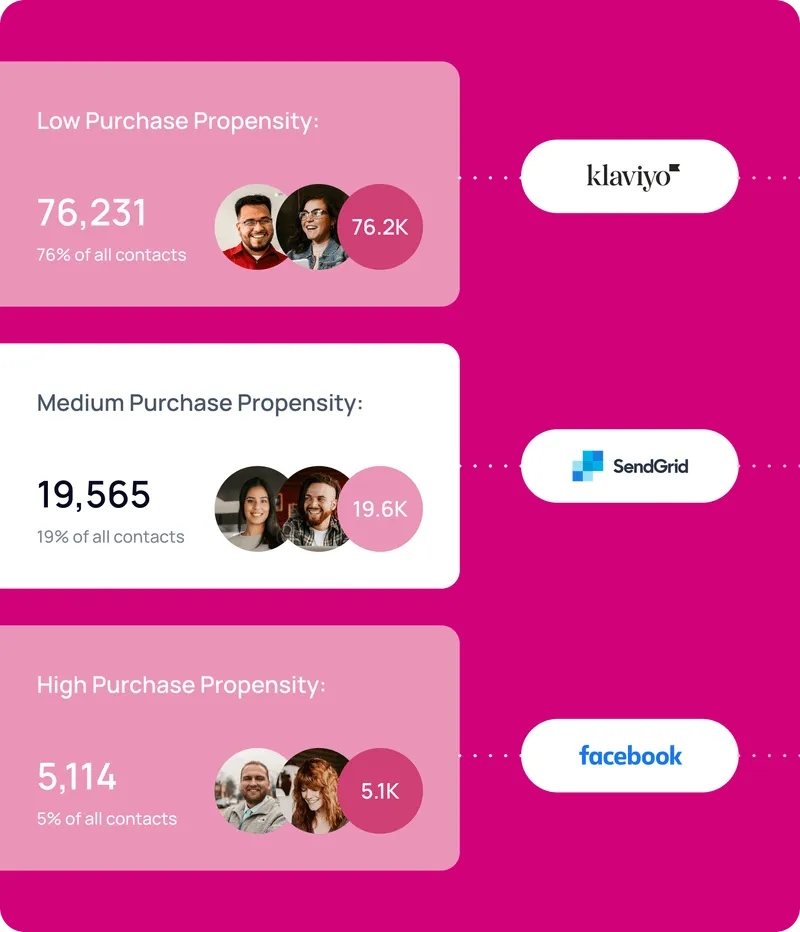
Another example of this is lead scoring. Predictive analytics can rank prospects by the possibility of conversion based on the prospects you already have. This is a nifty way to determine if a lead is qualified, or if your marketing efforts are surfacing qualified leads to begin with.
Potential churners and cart abandonment
Wouldn’t it be nice to catch customers before they churn and send them an email with an incentive to renew? Or, maybe you want to catch a group of people who aren’t able to fill out your checkout form and complete a purchase. Predictive analytics smartly identifies commonalities between your churners and can predict those likely to churn.
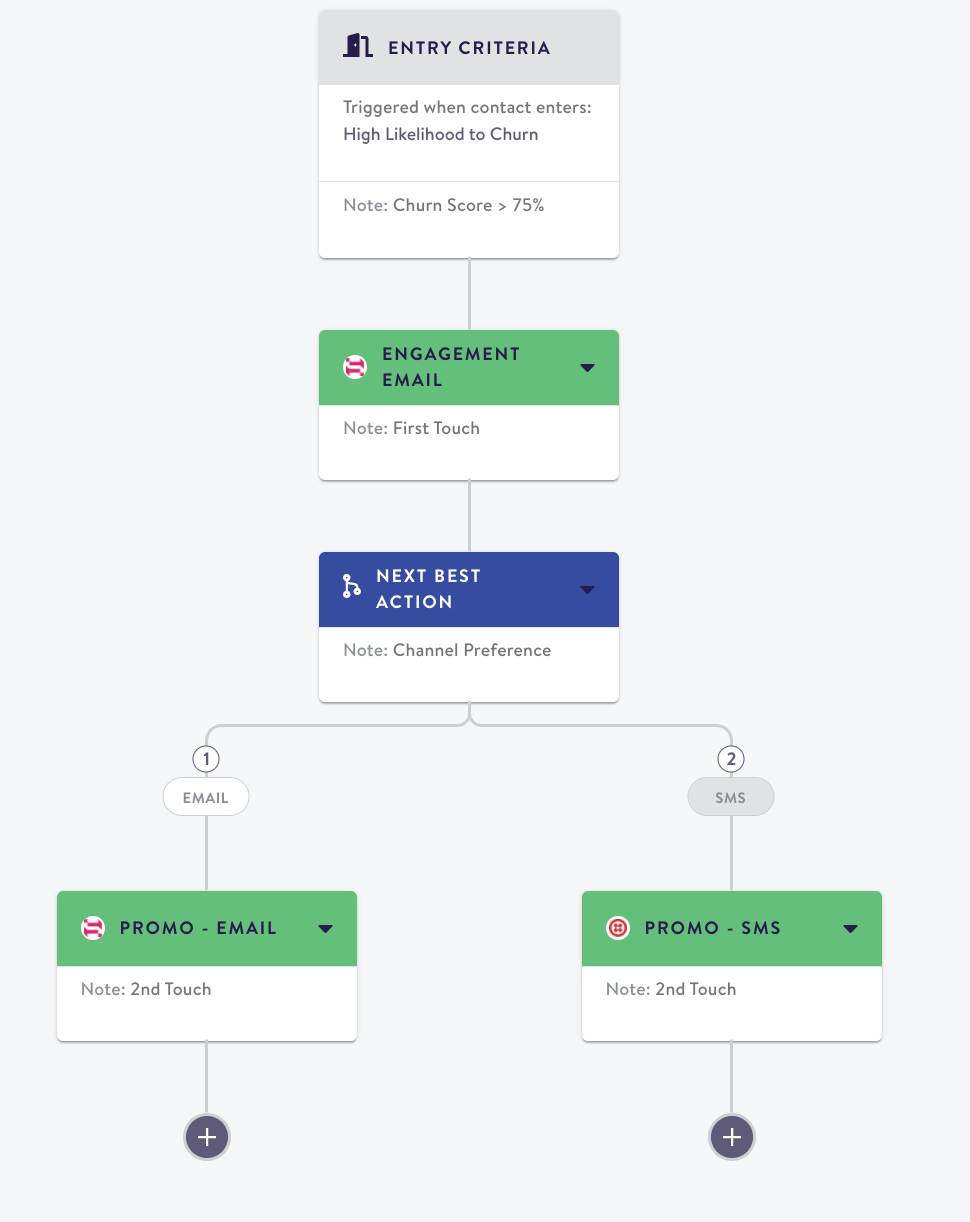
For instance, Vimeo uses segmentation to solve a big problem: free users churning before they uploaded their first video. Vimeo fine-tuned their email reminders to focus on users who abandoned their upload in real time. In this case, Vimeo was already aware free users were most likely to churn if they didn’t upload a video in their first seven days, but predictive analytics could also surface this issue.
Potential remarketing opportunities
Predictive analytics can find a segment of website lurkers. Better yet, you can also target users who are most likely to make a second purchase, or offer personalized discounts to incentivize customers who need a nudge.
Barkbox uses a CDP to run complex A/B tests and gauge whether their discounts are effective. Predictive analytics can take this one step further, finding users who’d be likely to purchase again if you offered a discount.
Staying on top of trends
With real-time data sourced from a wealth of customer information, you can predict and plan for trends faster than anyone else in the industry. Machine learning surfaces these trends from your data and gives you a chance to plan ahead.
For example, your predictive model may pick up on a seasonal downturn that will impact your industry based on the historical data it has. From this, you can prepare to weather the storm, as well as have a better understanding of why sales may be lower in this upcoming seasonal downturn.
Better customer personalization
The better you know your users, the more personalized your content can be. And personalization makes a big difference these days in how customers interact with brands.
Take as an example an industry that needs to be highly personalized: luxury travel. Travel + Leisure Co. successfully uses predictive analytics to offer vacation recommendations by gauging customers’ purchase propensity, perceived value, and urgency.
As you can imagine, this makes a huge difference over travel sites that serve the same vacation packages to everyone, and even more so for a customer searching for a luxury experience expecting to pay top dollar.
Say a luxury travel site might see a user returning over months, lowering the chance there’s a high level of urgency for their purchase. However, the user might have looked at packages to Fiji several times, thus increasing their purchase propensity.
And let’s say these packages are expensive, ranking their value highly. It makes sense that the travel company serves up targeted content (travel information, guides, discounts, etc.) to its relevant audience about trips to Fiji, with a departure date that’s not urgent. If you were that customer, you’d probably prefer this personalization.
Machine learning and AI make predictive analytics tick
With these facts in mind, wouldn’t anyone want to use predictive analytics? Obviously. If it came free, and if it were so easy to implement. The challenge is having a team with the skills to create an advanced predictive model, and the ability to house and activate your data in one hub.
That’s why most of us outsource this complex data modeling to a third party. CDPs can empower you to activate customer data if you’re storing it in a warehouse. The best CDP choices for predictive analytics have AI and machine learning with the ability to deliver these insights in clear, actionable terms.
With technology so new, you can be sure of a competitive edge. Not many tools offer predictive insights packaged neatly, but if you’re interested in finding one, consider booking a demo with Simon Data to learn more about its predictive features.

The silo struggle is real
Figuring out new technology can be a headache. You have to consider whether it’s just a fancy upgrade (i.e., Braze’s “modern” marketing cloud compared to Salesforce’s “legacy” marketing cloud), or if it’s a game-changer.
Back when I started at Simon Data in 2018, CDPs were this new, shiny thing.
Marketers knew their tech and strategies had to evolve, but there was — and still is — a lot of confusion about what CDPs can realistically do. Half the battle of a CDP sale was challenging marketers to break free from outdated practices.
Wouldn't it be awesome to personalize your emails instead of blasting the same content to everyone? To have customer insights that actually help you target the right people?
Marketers today are in an even tougher spot. Data is exploding, budgets are shrinking, and customers expect way more than they used to. Just keeping up feels like a marathon. But there's a way to turn that chaos into an advantage. A CDP isn't just another tool, it's a superpower for your entire marketing strategy.
Why a CDP is your marketing sidekick
A CDP isn't some boring data warehouse. Think of it as your sidekick — the key to growing your business and making customers feel truly seen.

Here's what it can do:
- Build a complete picture of each customer: Bring together all that scattered data and make sense of it in what we call a Customer 360
- Segment like a pro: Target the right people with the right message — no more guesswork
- Orchestrate amazing experiences: Make sure the entire customer journey flows across all your channels and supports your buyers even after they become long-time customers
- Find hidden insights: See the patterns in your data that tell you how to truly personalize every single customer experience
Plus, the best CDPs go the extra mile so marketers can:
- Tie the knot between anonymous visitors and known customers: No more wasted ad spend
- Enrich your data for smarter targeting: Reach even more of the right customers
- Build anonymous profiles: Expand your paid reach while still getting insights
But don't just take my word for it. Companies like Vimeo increased trial conversions 300% by optimizing abandonment using a CDP. RCI generated $13MM in revenue through website personalization after implementing a CDP. Want to see similar results? Check out these case studies.
Convincing your boss you need to implement a CDP
When you pitch a CDP to your leadership team, you should ditch the tech-speak and focus on the results they care about, such as:
- Increased CLTV: Show how personalized experiences make loyal customers who spend more
- Boosted conversion rates: Prove how targeted campaigns turn browsers into buyers
- Reduced CAC: Spend less by finding exactly the right audience (and eliminating the ones that aren’t)
Use numbers, use cases, case studies, arguments about future-proofing marketing, and even quick product demos to make the benefits of a CDP real and apparent. The point is that a CDP doesn't just cost money, it makes money.

Crafting your CDP implementation battle plan
Ok, time to get tactical! Here's how to make your CDP case and drive change in your company.
Be specific about your problems and needs
What's holding your marketing team back? Data silos, bad targeting, clunky customer journeys? Identify these pain points and make sure the CDP can help you solve them.

Do your homework
Explore the CDP options out there, then compare the pros and cons. Is your CDP composable? Does it sit on top of a cloud data platform like Snowflake? Consider scalability, user experience, security and data privacy, and pricing models. The goal is to find the right fit for your company.
Play nice with your other tech
The CDP has to make your whole martech stack work better, so focus on integration with your CRM, data platform, and marketing tools. And, if you already use Snowflake, your CDP implementation can be incredibly smooth. A CDP directly pulls data from your Snowflake data warehouse, giving you even richer customer profiles for smarter segmentation.
It also streamlines the process of sending that data to the email, advertising, web personalization, and other tools you use to connect with customers. With this tight integration, your marketing moves faster and is even more effective.

Think about your budget
Have resources ready to estimate costs and show a clear ROI. Highlight potential cost savings, revenue growth opportunities, and efficiency gains within your teams, workflows, and strategies that a CDP can help deliver over time.
Collaborate with your colleagues
CDPs can benefit multiple teams. Typically, using a CDP built on top of a cloud data platform means that the data engineers don’t waste precious time pulling outdated customer data lists for marketers, and marketers can easily activate customer data and respond to marketing strategies in real time. Work with your colleagues to make a compelling case that a CDP can benefit many teams within your organization.
Championing marketing change by addressing leadership doubts
You'll probably face some questions from leadership, so be ready for:
- "This seems complex": Start with a small project to prove it works (a "proof of concept") before advocating for a full-scale implementation. This will help you validate assumptions, fine-tune processes, and showcase tangible results.
- "What about data privacy?": Emphasize security compliance, a cloud data platform, and pick a CDP with strong privacy practices
- "Isn't this expensive?" Show the long-term savings and revenue boost a CDP creates, as well as the streamlined operations that bolster efficiency.
- "Won't this add complexity for IT or data teams?”: The answer to this objection is easy: A CDP can simplify your data landscape. Its built-in connectors reduce the need for custom integrations. Plus, cleaner, more accurate data makes IT's job easier down the line. Look for a CDP with robust security features and a strong track record of data governance.
Ultimately, you need to become the CDP expert in your company. Do your research, share success stories and industry benchmarks, lead training sessions, and prove the value of the CDP constantly and consistently.
By crafting a comprehensive battle plan, addressing concerns head-on, and positioning yourself as a CDP champion, you'll give yourself the best opportunity to get internal sign-off and support.
The future of marketing is unified, personalized, and data-driven
Marketing's future depends on harnessing technology to solve today's problems and get ready for tomorrow's.
To recap, a CDP gives you: One customer view, killer segmentation, seamless journeys, and the insights to make it all hum. That means happier customers and a fatter bottom line.
What are you waiting for? Now's the time for marketers to embrace CDPs, get ahead of the game, and deliver experiences that wow customers.
Want to take the next step? Check out our marketing strategy guides, case studies, our CDP buyer’s guide, and even request a CDP demo so you can see for yourself how it can transform everything you do.

You may have seen Snowflake’s major launch of their proprietary LLM called Arctic yesterday. And if you thought to yourself, “Snooze, yet another LLM that’s competitive with industry benchmarks,” you’d be joined by others, such as TechCrunch, who had similar reactions.
But TechCrunch is dead wrong.
Under the hood, the technology behind Arctic is incredibly impressive. The model has 480 billion parameters, training is optimized by a “Mixture of Experts” (MOE) architecture, and it features a three-part learning curriculum to optimize enterprise intelligence. Snowflake’s press release is incredibly detailed and goes into extraordinary depth on how it works.
This stuff is all super cool, and the technology itself is also somewhat inaccessible — even for someone like myself with a machine learning PhD!
But let’s take a step back and look at the larger picture. This launch effectively propels Snowflake as a key player in the LLM race, an area where they had been lagging for over a year. For Snowflake, it’s not about building a model with 500B parameters, it’s about developing a complete set of capabilities required to drive AI adoption for business applications. The algorithm is only a small piece of the puzzle.
For Snowflake, it’s not about building a model with 500B parameters, it’s about developing a complete set of capabilities required to drive AI adoption for business applications.
With Arctic now in place, Snowflake is poised to affect massive disruption around business processes and drive huge innovation around how LLMs can deploy in an enterprise setting.
Starting simple with AI
Let’s pretend you’re selling socks on the web. Today, you can go to OpenAI right now and ask the following:
>> Write me an email encouraging a customer to buy a pair of socks
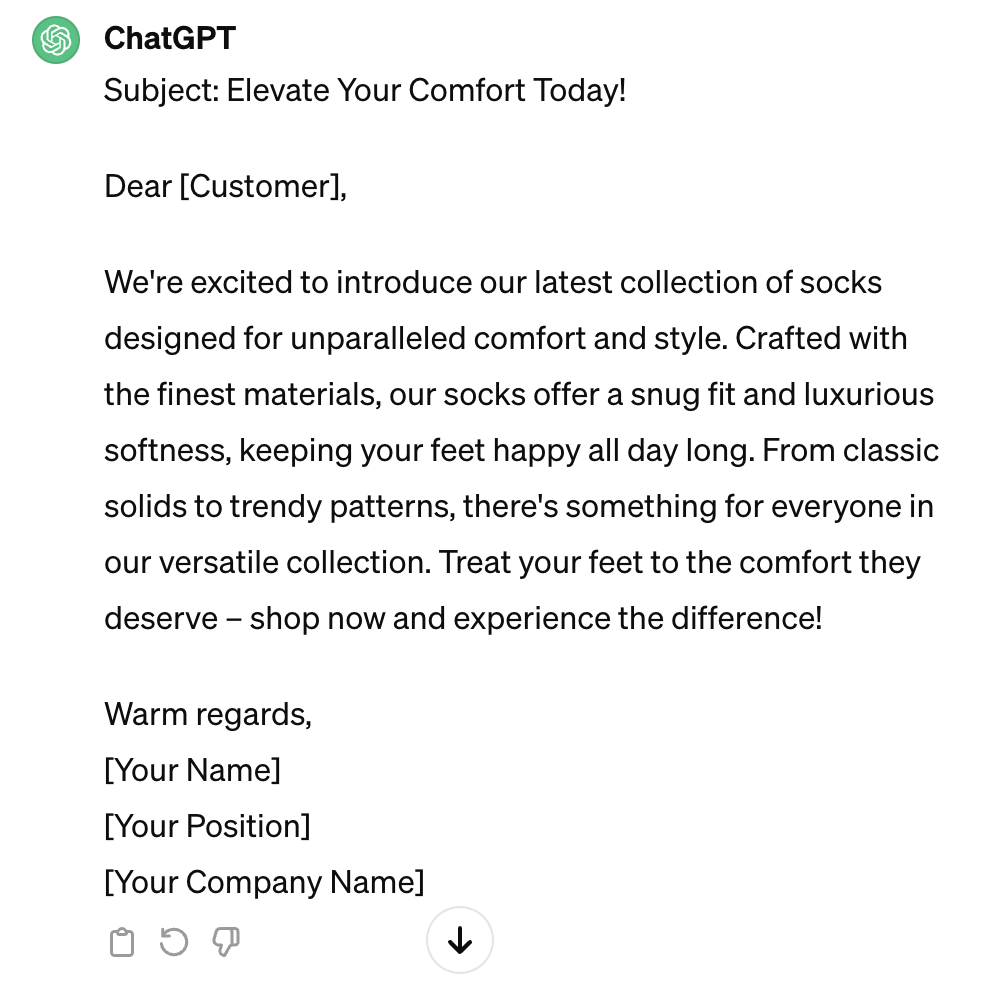
While the message is well-written, clear, and to the point, it’s not personalized, it’s not on-brand, and it has no context of historical effectiveness and what’s required to drive engagement and conversions. It’s also boring and sounds like something a first-year marketing student would write.
With a bit of information about the recipient, you can iterate on this significantly:
>> Now assume the customer is training for a marathon and likes to wear vivid colors

While this is an improvement, the message lacks a brand-specific tone and is built with zero insight into what sort of messaging is effective in converting sales.
Taking a step back, use cases like things generally require a set of basic enterprise requirements to truly be successful.
Requirement 1: High-quality data
There’s an adage in data: “Garbage in, garbage out,” and if the context on the customer is inaccurate or incomplete, algorithm quality just doesn’t matter. Understanding customer preference, real-time behavior, and historical content engagement is critical for success.
In this example, drawing from past messages written by the brand about similar topics, correlating that with historical engagement and conversion rates, and then pairing it with relevant customer data are some of the key data elements required for success.
Requirement 2: High-quality algorithms
The LLM needs to work for the application and use case, and in this example, there are real challenges around matching brand tone with compelling calls to action to drive outcomes. Without getting too much into details, optimizing context windows can be difficult in use cases like this, so the ability to tune or retrain models to fit brand voice is critical.
Requirement 3: Business application support
It’s going to be quite some time before marketing gets completely automated away 🤯. Until then (read: in my lifetime), tightly integrated applications are required to guide the algorithm, activate the outputs into the end use cases, and then experiment and iterate to learn what works and what doesn’t. An effective application strategy is much more than a pipe for execution. Rather, it creates a tight feedback cycle to drive business outcomes.
Requirement 4: Fully secure and governed
Your customer data is the crown jewel of your business. Data security today is more critical than ever — and your customers expect this more than ever.
The mad enterprise scramble
Ever since OpenAI launched in November 2022, there’s been a mad scramble across players to capitalize on opportunities like the use case outlined above.
In Salesforce’s most recent earnings call, Marc Benioff spent the majority of the time addressing Salesforce’s new Data Cloud offering alongside their AI offering, and spoke directly about this opportunity:
“Put your hand up if you're using Snowflake every day…. So many of our customers have islands of trapped data in all of these systems, but the AI is not going to work because it needs to have the seamless amalgamated data experience of data and metadata, and that's why our Data Cloud is like a rocket ship.”
Salesforce is masterful in identifying and positioning high-level business problems, yet their company DNA is rooted in software challenges that are far less technical than the challenges that modern cloud data and LLM-based AI have presented in recent years.
If I were a Fortune 500 CIO, I would not select Salesforce’s Data Cloud as the focal point of a five-year data strategy, if nothing but for the fact that Salesforce is 10 years late to this market.
What Snowflake has uniquely accomplished with the launch of Arctic is a completion of the value triangle:
- Data quality: Snowflake has been an established leader here for quite some time. Industry benchmarks across performance, cost, and scalability have consistently demonstrated this, and the scale at which Snowflake deployed also shows clear success.
- Application support: Earlier this month, Snowflake launched its Marketing Data Cloud and featured a set of application partners that are purpose-built to deploy on top of Snowflake.
- AI support: Not only does Arctic make Snowflake a contender here, but they’ve been incredibly thoughtful around dimensions that matter for the enterprise. A focus on code generation provides huge opportunities for workflow automation that plagues so many marketers today. And training costs that are a fraction of existing solutions open a new world of opportunities to train on first-party data and content.
The beauty of this model is that all of these points are wrapped up in Snowflake’s dedication to end-to-end security, which has long been a focal point and a core value proposition for today’s CIO. Snowflake’s best-in-class tooling also comes with a next-generation of governance tools to fully secure your data while enabling data access and business outcomes.
What’s worth noting in all of this is that Snowflake is focusing on the foundational data components via its Cloud Data Platform strategy. Whereas Salesforce saw a gap and built its own data cloud, Snowflake is not seeking to build a complete set of martech applications (or any other category, for that matter).
For Snowflake, it’s about creating a secure platform with great data and, as of yesterday, great AI, to enable any application to be built to drive this next generation of use cases.
.png)
You know the old adage: If you cast too wide a net, you’ll catch no fish.
The same holds true for your marketing efforts. If your marketing message speaks to everyone, it’s really speaking to no one. To be truly effective, your marketing efforts must be tailored to the customers you’re trying to reach.
Segmenting your customers into different audiences based on shared behavior and traits makes it much easier to tailor and target your messaging. But what’s better than a segment of a few hundred customers? We’d argue that it’s a segment of just one.
That’s where one-to-one marketing comes into play.
Below, we define one-to-one marketing, walk through the benefits, and offer a couple of examples of this strategy in action. We also give you a step-by-step guide to implementing a 1:1 marketing strategy for your business.
What is one-to-one marketing?
One-to-one marketing (or 1:1 marketing) is exactly what it sounds like: A marketing strategy in which your communications, messaging, promotions, and recommendations are all tailored to individual customers, based on what you know about them. This empowers you to create hyper-targeted marketing campaigns that are often more effective than more generic campaigns that try to appeal to a wider audience.
It’s also called personalized marketing, individualized marketing, or relationship marketing.
The top benefits of one-to-one marketing
The hyper-personalization and targeting that 1:1 marketing offers can bring several benefits, including:
- Increased engagement: When your marketing message resonates with your customers, they’re more likely to make repeat purchases or renew their membership/subscription.
- Cross-selling and up-selling opportunities: Convincing someone to make their first purchase with your business is often the hardest part of the customer relationship. Once you’ve got them hooked, one-to-one marketing opens the door to cross-sell and up-sell related products they may also enjoy or need.
- Lower CAC: Reactivating dormant customers with 1:1 marketing, especially after a period of long disengagement, can help you lower your customer acquisition costs (CAC) and increase the cost efficiency of your campaigns.
- Higher customer loyalty: The more a customer returns to your brand, and the better their experience is with your company, the more loyal they will be. This makes it harder for your competition to woo them away and may increase word-of-mouth referrals.
At the end of the day, all of these benefits translate into increased sales, higher revenue, and more profit for your business.
How to get started with one-to-one marketing
Implementing a one-to-one marketing strategy may sound complicated, but it’s rather intuitive when you stop to think about it. At its heart, personalized marketing revolves around you having a clear understanding of who your customers are — which is to say, it revolves around the collection, interpretation, and leveraging of data.
1. Gather customer data
Without customer data, one-to-one marketing would be impossible. After all, it’s what you know about your customers that allows you to create individualized messaging and assets. With this in mind, if you want to implement a 1:1 marketing strategy, you will need a plan in place to gather this data.
At an absolute minimum, you’ll need your customer’s name and contact information. This is enough to facilitate the most basic level of individualized communications (i.e., emails). But you’ll ideally collect additional information as well, which you can use to glean deeper insights to power your campaigns. This can include, but isn’t limited to:
- Transaction history
- Website interactions
- Page and product views
- Abandoned carts
- Mouse clicks and keystrokes
- Survey, poll, and quiz results
- Form submissions
- Customer journey and lifecycle
The good news? You likely already have a lot of this data stored in various systems such as your CRM, content management system (CMS), e-commerce platform, POS system, marketing platforms, etc. Learn why it’s so important to have a plan in place to collect zero- and first-party data.
2. Create customer profiles and segments
Once you have as much data as possible about a given customer, you can organize that data into a centralized customer profile, or 360-degree view.
These profiles hold everything you know about a customer — all of the different data points we discussed above, regardless of the source of that data — and act as a point of reference for your marketing efforts.

Customer profiles aren’t just handy for facilitating one-to-one communication. They also make it easier for you to group your customers into segments or audiences based on their similarities. You can then adjust your messaging, creatives, promotions, etc. based on what you know of each of these segments.
There’s no limit to how you might slice and dice the data to generate your segments. That being said, generally speaking, segmentation will fall into one of four buckets:
- Demographic segmentation: Segmentation by age, gender, income, job title, religion, marital status, etc.
- Psychographic segmentation: Segmentation by personality, lifestyle, social status, attitudes, activities, interests, opinions, habits, etc.
- Geographic segmentation: Segmentation by location, climate, culture, population density, language, etc.
- Behavioral segmentation: Segmentation by purchasing behavior, customer journey stage, customer loyalty, satisfaction, engagement, etc.
3. Serve individualized promotions, recommendations, and messaging
Once you’ve collected and analyzed your customer data, you can begin putting it to use marketing to your customers. A handful of examples of one-to-one marketing in action include:
- Individualized communication through email, social media messaging, and even text messaging — depending on which communication channel each of your customers prefers
- Personalized product recommendations based on past purchases and activity, and everything else you know about a customer
- Tailored promotions and sales based on your understanding of what each of your customers values
- More compelling ad creatives, landing pages, and calls-to-action (CTAs) that resonate with your customers and increase their likelihood of converting (or reconverting)
The right infrastructure makes all the difference
As we’ve noted above, one-to-one marketing is dependent on you having customer data.
But simply having that data isn’t enough. In its raw and jumbled state, living in separate systems around your business, it would be extremely difficult — if not impossible — to leverage that data for your marketing efforts at scale in a meaningful way.
To deploy one-to-one marketing at scale, you need to have the right technological infrastructure in place first. That’s where a cloud data warehouse (CDW) and customer data platform (CDP) come into play.
A CDW, like Snowflake, looks at all of the different systems and platforms that hold your customer data and brings it into a centralized database, where it can be cleaned and organized. A CDP, like the Simon CDP, pulls that structured data out of the CDW and uses it to generate the profiles, segments, and audiences you need to power your marketing efforts.

Ready to start building your one-to-one marketing strategy? Take a look at our CDP Buyer’s Guide to learn more about what to look for as you evaluate your options.
Interested in learning more about how Simon Data and Snowflake can help you truly unlock the power of 1:1 marketing? Request a demo today.

Marketers work hard at innovating omnichannel customer experiences that leverage data as their lifeblood — yet it’s common for the data activation layer to be a bottleneck in the marketing mix.
Effective data activation, simply defined, unlocks knowledge from your cloud data warehouse to become actionable by marketers within the end tools they use every day.
What it truly means to activate customer data
Great, reliable data should be a given, and it can be — except when it’s not. Data latency, inefficient workflows, and lack of a unified customer profile across the martech stack are just a few common pitfalls that can mar the best-laid plans. So what is effective customer data activation?
Effectively activating your customer data is at the heart of driving personalized, omnichannel customer experiences. So, before we get to how and why you want to activate your customer data, let’s touch on that first word: what do I mean by effective?
Effective customer data activation is that set of marketing activities orchestrated across your entire martech stack that, for the customer, creates a unified experience no matter what touchpoint or channel they may engage in.
Customer LTV is improved when optimal data activation works consistently to meet them, at any time, and wherever they are, with the right message for that moment.
Sounds simple enough, but if that’s the case, why do we still live in a world where, after a negative customer service interaction around a product we are unsatisfied with, we receive an email offering us the same product for less money than we paid?
Hopefully, this is the exception in your organization, but it does happen. Data drives the customer experience, and when that data is not synced, the right and left hands can cause frustration and even brand abandonment.
The role of customer data activation
What are the attributes of effective data activation and the common challenges to reaching that goal? For most modern marketing teams, data activation begins with their CDP.
The job of the CDP is to aggregate multiple data sources into a unified and actionable view of the customer. At its best, the CDP is a layer of orchestration that manages data between your martech stack — email marketing apps, Google Ads, Facebook, chat platforms, website personalization tools, etc .— and the data warehouse, like Snowflake.
But the landscape has become so complex, and demand for personalized experiences so high, that we are now seeing that activation itself must become a layer to ensure that great data really gets put to work.
And, because there are limits to CDPs, which we’ll discuss in a moment, the activation layer is coming of age to ensure your data management strategy really delivers the elusive customer 360 view, and that it can be easily pushed into multiple channels with minimum overhead.
Today, most marketing teams use a host of SaaS applications to perform myriad jobs in the customer experience; effective data activation means the highest quality data reaches all these tools quickly and efficiently.
Many teams still rely on data engineering for getting customer data out of the data warehouse, a latency that modern marketing simply can no longer afford.
Moreover, the activation of data within different applications may need to occur asynchronously: an email marketing launches a campaign at 5 a.m., the app has an in-app offer correlated to a live event that starts at 10 a.m., and social media pulse updates throughout the day. Sound familiar?
The challenge here is that the customer’s potential activity related to all this, which may include opening the email, clicking through to an offer, attending the event, making purchases, opting in for an offer, or making another purchase, needs to sync in real time.
As customers move along their journey, they break themselves into new segments based on behavior. You get the idea; marketers need a unified data foundation that they can access directly to avoid both latency and data fragmentation.
A world without ETL?
While marketing has had to rely on other teams to get access to data, strategies built around using a data cloud platform like Snowflake and a CDP like Simon to both segment audiences and activate customer data avoid the need to move data at all.
Expensive ETL and Reverse ETL processes are unnecessary when teams use a cloud data warehouse that lets marketers activate their customer data with no barriers.
Not to digress, but audience segmentation goes hand in hand with effective data activation; with direct access to real-time data (again, little to no latency because it doesn’t have to be moved), marketers can rapidly iterate campaigns and customer journeys as new information becomes available. Then, they can quickly activate it in the applications that reach those customers.
One example might be cart abandonment; with segmentation tools and live data, marketers could create a segment of abandoned-cart customers and send them an offer (as a nudge), while the completed purchase group receives a different offer or promotion.
With Snowflake and Simon at your fingertips, the segmentation and activation layers can almost become one.
For example, using Simon Activate, teams can quickly build advanced customer audiences by unifying data from their cloud data warehouse and all other sources.
In this case, marketers will want to ensure their CDP can resolve the identity issues that often arise with data from multiple sources; the onus is still on marketers to drive for that single, unified customer view before pushing out (activating) new communications.
Fortunately, AI is now on board to help, in some cases automating what was done by marketers and helping to drive efficiency and ROI on marketing spend.
Clearly, I’m arguing here for a zero-ETL approach to activating customer data; combined with no/low code activation tools, you can meet customers with relevant, timely experiences and more readily attain the ability to pivot, which is quickly becoming a must for today’s marketing teams.

It’s a bit like a never-ending repetitive sitcom when I connect with enterprise marketing teams. I often hear the same challenges playing on repeat. "We don’t have visibility into our customer data," they cry.
"We have to rely on our tech team to create audiences, and it takes so much time,” they grumble. "We use a lot of different tools that are as user-friendly as a Rubik's Cube in the dark," they lament. It's a universal truth, like gravity or the inevitability of someone hitting "reply all" by accident.
It doesn’t matter if it’s a retailer, a financial services company, a travel and hospitality business, or an airline… these are obstacles we hear across businesses of all sizes.
But they become particularly painful in the enterprise where there is often just more — more data, more identity challenges, more teams working to get campaigns out the door.
Just because these challenges are common doesn’t mean that they are unsolvable. Today, data is the lifeblood of successful marketing strategies. Every click, purchase, and interaction leaves a trail of valuable information that, when harnessed effectively, can drive business growth and customer engagement.
For enterprise marketing teams looking to navigate this vast sea of data, Customer Data Platforms (CDPs) have emerged as indispensable tools to help companies manage and utilize their customer information.
Understanding the evolving role of CDPs
At its core, a CDP is a centralized hub that collects, organizes, and analyzes customer data from various sources, including websites, mobile apps, CRM systems, social media, and more.
By consolidating this disparate data into a unified customer profile, CDPs offer marketers a comprehensive view of their audience, enabling them to deliver highly targeted and personalized campaigns across multiple channels.
We’ve seen a shift over the past couple of years where many enterprises have consolidated (or are in the process of consolidating) much of their data into a cloud data warehouse like Snowflake, Big Query, or Redshift.
Increasingly, data teams have beat the drum that there are risks to having multiple sources of truth for customer data. There are security risks, and it can be a heavy lift to ensure that data remains at parity on multiple platforms.
While many CDPs duplicate data into their own platforms for marketing use, some CDPs (including Simon Data) have aligned with the ethos that there should be one central source of truth — the Cloud Data Warehouse — and that the CDP should serve as an extension of those data investments so marketers can leverage customer data for audience creation and multi-channel personalization.

The term that’s emerged for this sub-category is “composable CDPs”. An added benefit of this approach is time to value. Because composable CDPs are integrating into the Cloud Data Warehouse versus replicating datasets, implementation tends to take weeks versus the months of heavy lifting we’ve seen with traditional CDPs.
As enterprise teams consider which CDP is right for them (and there are a whole lot of options out there), there are three capability areas that come to the forefront: identity resolution, the ability to leverage data for personalization at scale, and the ability to drive value quickly.
Identity resolution with a CDP
Now, let's talk about identity — not the philosophical kind, but the nitty-gritty, who's-who of customer data. Identity resolution serves as the building block on which good personalization must rest.
A core function of a CDP is to help resolve and stitch identifiers to a single customer record – or golden customer record. To understand your customers, you must be able to see how they have interacted with your brand — every browse session, every email open — and be able to pair this with their historical interactions like previous purchases.
In the enterprise world, identity can get very complex very quickly. It's crucial to have a CDP partner who can untangle the web of identifiers and stitch together a golden customer record. It's like playing detective but with fewer magnifying glasses and more flexibly customized identity business rules.

Beyond stitching together customer records, CDPs like Simon are also leaning into leveraging identity graphs to pair these customer records with more first-party identifiers.
For instance, products like Simon’s ID+ allows brands to identify more anonymous browsers that are actually known to significantly increase the reach of cart recovery campaigns.
And Simon’s Match+ appends additional HEMs and MAIDs to social campaigns to increase match rates in channels like Meta and Google. Expanding audiences and reach can provide immense (and quick) value to enterprise teams, especially when it comes to calculating ROAS and improving customer marketing metrics like CAC and LTV.
Personalization at scale
One of the most significant advantages of CDPs is their ability to facilitate personalized marketing at scale. By providing an intuitive interface for advanced audience segmentation, these platforms enable marketers to create highly tailored experiences for individual customers based on their preferences, behaviors, and past interactions.
Whether it's delivering personalized product recommendations, dynamic email content, or targeted advertising, CDPs empower enterprises to engage customers in more meaningful ways, ultimately driving conversions and fostering brand loyalty.
Launch personalized marketing campaigns faster
In marketing, timing is everything. CDPs allow marketers to create highly targeted and personalized audience segments in a fraction of the time compared to traditional methods.
These platforms offer intuitive interfaces and advanced segmentation capabilities that enable marketers to quickly identify relevant customer groups based on their preferences, behaviors, and past interactions. And, many CDPs, including Simon, use AI and ML to streamline processes across the entire org.

CDPs also provide real-time access to customer data and insights, enabling marketers to make data-driven decisions on the fly.
Whether it's monitoring campaign performance, tracking customer behavior, or identifying emerging trends, CDPs empower marketers with timely information that allows them to adapt and optimize their strategies in real-time. This agility is crucial in today's fast-paced digital landscape, where market conditions can change rapidly.
CDPs complement your MarTech stack
An ideal CDP partner will also help enterprise marketers better leverage the tools they already use. When enterprise teams are evaluating CDP tools, it’s important to understand how the CDP can integrate into the existing tech stack, and how it may help future-proof as your tech stack shifts over time.
Those audiences created and insights gleaned can then be deployed in any of the downstream tools already in use — ESPs like Salesforce Marketing Cloud, SMS platforms like Attentive, and paid media channels and partners like Meta, Google, and Liveramp.
The goal is to give customers the seamless experiences they expect across every touchpoint, from browsing a website to making a purchase in-store. CDPs play a crucial role in orchestrating these complex customer journeys, allowing marketers to map out and optimize the entire lifecycle—from awareness to advocacy.
Take the first step toward customer marketing success
It’s become abundantly clear to many enterprises that the ability to harness the power of data is critical to marketing success. Customer Data Platforms have emerged as essential tools for enterprise marketing teams, enabling them to unlock the full potential of their customer data and deliver personalized experiences at scale.
However, the CDP space (and marketing tech space as a whole) is very crowded and it can be tough to determine which CDP “flavor” is going to drive the most value for the organization.
Simon Data is not going to be the right fit for every brand. But for those that have invested in a cloud data warehouse like Snowflake, Big Query, or Redshift and are looking for better ways for the marketing team to access and leverage that data — and to drive value from that data quickly — the story quickly becomes compelling.
Looking toward the future of marketing, CDPs will remain a cornerstone of modern marketing strategies by helping businesses thrive in a competitive and challenging marketplace.
I, for one, love to see when enterprise marketing teams can break free from their data dilemmas and dive headfirst into new possibilities. Once they have better access to customer data and leverage an intuitive tool to create relevant and personalized campaigns, then the fun begin!
From there, it becomes a conversation of which use cases and campaigns will drive the most revenue and value for the business and we can finally move from obstacles to execution.
To see Simon Data in action, book a demo with us. If you’re just getting started with the CDP search, read our 2024 Buyer’s Guide.

Let's be honest: keeping up with customers these days is exhausting. They demand personalized experiences, but getting the right data to make that happen often feels impossible.
To achieve this level of personalization, marketers need to break their audience into tiny groups — and old-school segmentation just doesn't cut it anymore.
Thankfully, no-code tools like Simon Data’s CDP change the game entirely. Imagine easily creating those super-specific audience groups yourself. Now you can truly connect with your customers on their terms.
In this article, we’ll get into the nitty-gritty of how Simon’s no-code segmentation can help marketers deliver the 1:1 relationship customers expect.
The importance of advanced segmentation
Today, humans are constantly plugged in and powered on. We’re drowning in ads and messages from our phones, our inboxes, and even our favorite websites – it's nonstop marketing noise.
That's why getting your brand’s message to stand out is so tough. The only way to break through is to make it feel like you're talking directly to each customer about things they actually care about.
Here’s where advanced segmentation comes in. Instead of blasting everyone with the same message, you can use advanced segmentation to create laser-focused groups based on who they are, what they buy, and how they interact with your brand.
The evolution of marketing segmentation
Remember the days when you had to beg the IT team to create a simple customer list? It took forever, and by the time you got the data, it was useless.
Old-school segmentation was a total pain, and even then, you couldn't get the level of detail you needed to keep up with how fast customers' needs change. Thankfully, this has changed with the emergence of customer data platforms (CDPs).
So, gone are the days of asking your IT teams for customer data, along with the one-size-fits-all marketing blasts that fall flat.
Today's savvy customers want to feel understood — they expect experiences that cater to their specific interests. This makes pinpointing the right audience segments crucial for success. Unfortunately, traditional methods can be cumbersome, involving lots of coding and manual effort.
Here’s where Simon's no-code segmentation comes into play. It empowers you to effortlessly harness the power of the customer data you already have. With its user-friendly interface and seamless integrations, Simon lets you easily build those hyper-specific segments, paving the way for truly personalized marketing at scale.
The benefits of advanced no-code segmentation
Simplified workflows
One of the most significant advantages of advanced no-code segmentation is its ability to streamline marketing workflows. With Simon’s CDP, marketers can quickly and easily create sophisticated audience segments using an intuitive interface.
This eliminates the need for manual coding and complex data manipulations, allowing marketers to focus on strategy and creativity rather than technical implementation.
By providing a user-friendly interface and seamless integrations with leading data platforms, Simon makes segmentation accessible to marketers of all backgrounds and skill levels.
Enhanced personalization
Personalization is the crux of modern marketing, and segmentation enables brands to personalize their messages. By dividing audiences into smaller, more targeted segments, marketers can deliver personalized messages and offers that are more likely to resonate with individual recipients.

Using Simon's advanced segmentation capabilities, marketers can create hyper-specific segments based on a wide range of criteria, from demographics and purchase history to browsing behavior and engagement patterns. This level of personalization improves the effectiveness of marketing campaigns while enhancing the overall customer experience.
Enhanced marketing agility with no-code segmentation
Advanced no-code segmentation tools like Simon give marketers the power to adapt quickly to changing market conditions and consumer behaviors.
Marketers can create and refine audience segments in real time, allowing them to seize new opportunities and respond promptly to emerging trends. This agility not only boosts campaign effectiveness but also strengthens overall marketing strategy, and it ensures that organizations stay competitive in today's dynamic digital landscape.
Seamless integration with existing systems
No-code segmentation tools aren't just powerful, they play nicely with the systems you already use, too. Simon integrates smoothly with your favorite CRM, email platforms, and data tools.
This means you don't have to overhaul your whole setup to get started. All your important customer data flows into one place, making it easy to build those targeted segments. Plus, your entire team can work together more efficiently.
Scalability and flexibility for the entire org
No matter how big or small your business is, the right segmentation tool should grow with you. That's where advanced no-code solutions shine. Tools like Simon adapt to your changing needs. Need to manage a few simple customer groups? Easy. Want to handle massive, super-detailed segments? No problem.
This flexibility extends to your budget too. These solutions often have plans for businesses of all sizes, so you get the features you need without overpaying.
Seamless integration with Snowflake
Snowflake users, this is for you! Simon connects directly to your Snowflake data without any clunky setups. This means you can start using that valuable data to power your campaigns in record time.
Building powerful segments with Simon Data’s CDP
Simon's segment builder makes those complex audience groups a breeze. There's no coding knowledge needed, just an easy system that anyone on your team can handle. This means you spend your time figuring out the perfect target of customers, not struggling with technical stuff.
It connects seamlessly to your favorite data tools, giving you up-to-the-minute insights to make your campaigns hit harder.
If you're looking for a powerful audience-building tool that won't make you want to tear your hair out, Simon's segment builder is the answer.

In Simon's Connected deployment, marketers unlock the potential of their Snowflake data to craft highly targeted audience segments effortlessly.
Let's briefly look at how Simon's segment builder empowers marketers to create segments tailored to their campaign goals. For full documentation and technical help, please refer to our docs here.
Creating a segment in Simon Data
To build a segment in Simon, from the left navigation, click Segments., then click Create Segment. Now, the journey begins!
Defining the segment criteria
Ready to get into the weeds? This is where you can zero in on exactly which customers you want to reach. We're talking about details like what they've purchased, how they interact with your website... all the good stuff! Easily pick and choose from all your Snowflake data to create the perfect audience group. Simon also offers an AI-powered option to auto-generate segment descriptions, enhancing efficiency and accuracy within your segmentation.
You can think of filter groups as your precision targeting tool. They let you layer on those specific customer details to find exactly the right audience. Need customers who meet condition "A" AND condition "B"? Want those who meet "A" OR "B"? It's easy to switch up the rules to match whatever goal you have. With Simon, you can even combine customer properties and customer events, which not every CDP can do.
.gif)
Controlling segment size and real-time updates
Simon puts you in control of your audience numbers and provides you with real-time updates. By using our “Refresh” button feature, you can see exactly how many people fit your criteria in real time —no more guesswork! Then, easily adjust who you're targeting to make sure your campaign has the perfect reach.
Because Simon syncs up with Snowflake constantly, your audience lists are always accurate and up-to-the-minute, saving you the headache of manual updates.

How to save and manage customer marketing segments in Simon
Once you've got your segment just right, you can save it to use again later, which is helpful for campaigns you run regularly. You can also reference segments within another segment.
This is especially useful if you have common criteria used across multiple campaigns. because if (or when) a base segment criteria changes, you only need to update it in one place — all other segments with that criteria will automatically update.
Additionally, creating a segment in Simon will remain accurate and updated if your Snowflake data and segment criteria change. The real value of having segments available in your Snowflake instance is the ability to access deeper reporting and analysis beyond your in-app segment insights.
Unlocking audience insights with Simon segment insights
Segment Insights is like an X-ray for your customer groups. It shows you exactly who they are and what makes them tick. Just navigate to the Segments dashboard, pick the segment you're curious about, and boom: all the data (including person-level insights) you need to design campaigns that are guaranteed to hit the mark.

Driving marketing success with advanced segmentation
No-code segmentation with Simon takes the guesswork out of marketing. It lets you easily find the right audience for every campaign and deliver the kind of results that get noticed.
Big marketing team or small team – it doesn't matter. Simon's easy-to-use platform helps you find hidden gems in your data and turn those insights into campaigns that get results.
Simon's segment builder puts the power in your hands. Figure out exactly who you want to reach, then see the updates in real time. It's all designed to make your marketing life easier.
Ready to connect with your customers on a whole new level? Give Simon a try and see the difference for yourself.

Data collaboration is entering an exciting new era. Data clean rooms are quickly going mainstream, and marketers are beginning to understand the power and limitations of their first-party data.
First-party data has a market value to others and can be improved by sharing it, a feat that can now be done without exposing personally identifiable data (PII) or even the data itself.
The end of cookies only elevates the need for data collaboration in compliant and secure ways. Marketers still need customer 360s, and the combination of data clean rooms and CDPs can deliver them. The good news is the outcomes will be even better than the old way of collecting data.
What is a data clean room and why do I care?
Data clean rooms are not new, but they are becoming more mainstream. A data clean room is a secure, governed framework within which third parties, who may or may not be known to each other or the provider, have agreed to work together using the first-party data of one, some, or all of the participants.
A data clean room allows companies to run queries against other’s data, to share their own, and to analyze sensitive or regulated data without exposing that underlying data.
They eliminate concerns over privacy laws such as GDPR because personally identifiable information (PII) is anonymized, processed, and stored in a compliant way.
Understanding distributed data clean rooms
Recently, we’ve seen the growing popularity of distributed data clean rooms, based in the cloud, which allow parties to exchange and analyze each other’s data without that data ever having to move from its original location.
Data is shared but de-identified, greatly streamlining both compliance and security burdens, because every time data moves it creates a potential exposure in these areas.
Not having to move the data also increases operational efficiency as it eliminates the need for time-consuming ETL processes, not to mention the dependency on a data science team, involved in moving data.
Data producers can monetize their customer data
Why does this matter? Because the marketer’s remit hasn’t changed. Marketers must strive continuously for omnichannel, personalized, and differentiated customer experiences and cannot rely on first-party data alone to consistently deliver that.
The distributed data clean room combined with a CDP makes possible a critical shift in the marketer mindset: from being a data consumer to becoming a data producer.
By sharing anonymized data in a clean room environment that may include others in your industry, you can see how others work with that data in ways that can transform how you think about your customers.
And, while it won’t be the focus of this blog post, the ability to share data in a secure and governed way also opens the door to potentially monetizing your data, which feeds back into the marketing balance sheet to improve the ROI on your spend. Through a data clean room, marketers can control what data comes in, how data in the clean room may be joined to other data in the clean room, what types of analytics can be performed on their data, and what data, if any, can leave the room.

You can see the possibilities here; not only can you securely access data you could not otherwise, but you can see your own data acted upon in ways that glean new insights for you, too.
Data clean rooms keep you in control, allowing you to give access only to those parties with your permission. Some global brands have seen value in using distributed data clean rooms (and CDPs) across subsidiaries, divisions, and business units within their own companies.
This means marketing can elevate its status, once again, as a producer of data and insight, not just a consumer.
The benefits of data clean rooms and your CDP
Beyond these data-specific benefits, data clean rooms, cloud data platforms, and a CDP work together (and integrate with key marketing tools) to enhance the customer experience and empower marketers to innovate and experiment with marketing campaigns and strategies, such as:
Improved segmentation
A brand can connect its CDP to a data clean room to not only anonymize its first-party data but also analyze it alongside third-party sources. It can receive data from the clean room in the form of new customer segments or targeted audiences, all augmented from other anonymized data in the clean room, and feed it back into the marketing platform for activation.
Marketing campaign analytics at your fingertips
Data clean rooms can also help marketers with measuring campaign effectiveness. While your martech stack can measure the effectiveness of a campaign against itself (first phase vs. second phase, or the latest campaign stats compared with the same one run last quarter), anonymous data sharing can help you see how your campaigns performed against companies targeting similar customers.
Advanced marketing experimentation and predictive analytics
Distributed data clean rooms allow you to leverage your CDP using live, anonymized data to achieve customer segmentation, explore what-if scenarios such as new segments, and innovate new customer experiences.
A CDP can only be as innovative as the quality of data put into it. With live data shared anonymously from third parties, your CDP is supercharged with fresh insights to enable advanced audience segmentation and improved predictive modeling.
Elevating the customer experience
When combined with a cloud-based data warehouse like Snowflake, which can facilitate a distributed data clean room without moving data, we may well find that marketing has leapfrogged past the need for cookies with a secure and governed way to understand customer behaviors and journeys.
As the heart of your first-party data strategy, your CDP becomes an integral part of your data clean room strategy by extension.
In that ever-relentless pursuit of the 360-degree view of the customer, the CDP is the foundation from which you build customized, personal customer experiences at scale.
Data clean rooms bring further dimension to that first-party data, providing a critical edge to your marketing efforts as we navigate the current changes to the digital marketing landscape.

Generic marketing gets you nowhere. Today, customers demand tailored experiences, and brands that fail to deliver risk getting left behind.
That's where data onboarding and rich customer profiles (sometimes called customer 360s) give marketers the edge they need. Think of it as a tailored suit instead of a one-size-fits-all approach.
What is customer data onboarding?
Let's break it down simply. Data onboarding is the process of taking all your real-time, first-party customer data (think purchase history, email interactions, loyalty program info, and the like) and making it accessible in one, organized place, such as a Customer Data Platform (CDP).
Here’s a quick snapshot of how the Simon CDP integrates with Snowflake, a customer data platform, and other marketing tools to unlock your customer data.

Great, but why does data onboarding matter to marketers?
You may not think data onboarding is all that impactful or affects your day-to-day, but here's where things get exciting for marketers.
If your CDP is connected to a cloud data warehouse (CDW) like Snowflake, all your real-time customer data can easily flow between your warehouse and your martech stack for easy access and activation.
This means you can deliver more personalized marketing campaigns, based on real-time information, faster. With the ability to access and activate your goldmine of customer data within a CDP, you can:
Know your customers (like, REALLY know them): Onboarded customer data creates in-depth customer profiles that go beyond just a name and email. You can understand behavior patterns, preferences, pain points, and preferred channels — all the stuff that unlocks highly targeted messaging.

Personalize marketing at scale: Say goodbye to one-size-fits-all campaigns. Use rich data to segment your audience and deliver messaging that resonates. This means delivering not only offers and recommendations, but also website content tailored to a customer’s stage in the buyer journey, follow-up emails based on abandoned carts, and even ads targeted to their most recent product interest — the whole shebang!
Deliver omnichannel magic: Your customer's journey isn't a straight line. Customers go from browsing your website to interacting with an email to ghosting your texts and then, maybe, just maybe, they visit a store.
By onboarding your customer data from all your tools into your CDP, you can connect the dots and deliver a super-smooth experience across all channels, including website activity, email responsiveness, in-store visits, and responses to social media ads. It's about understanding the full customer journey, not just isolated touchpoints.
Measure what matters: When all your data is neatly organized, you can finally track those key metrics across campaigns. This means sharper insights and the power to justify every marketing dollar spent.

How does data onboarding work?
There's a bit of technical wizardry involved in onboarding for — and integrating with — your customer data for a CDP, but here's the gist of the process.
1. Gather your troops (AKA your data)
Think beyond the basics! Behavioral data like website browsing patterns, content engagement, and even customer support interactions offer incredibly valuable insights into interests and intent.
This phase is all about identifying and extracting relevant customer data. Your sources might include:
- CRM systems: Hubs like Salesforce or HubSpot storing sales interactions, contact details, and lead status
- E-commerce platforms: Shopify, Magento, etc., containing valuable purchase history, abandoned cart data, and product preferences
- Email marketing platforms: Mailchimp, Klaviyo, and similar, offering insights on open rates, click-throughs, and campaign engagement
- Offline sources: Don't forget those loyalty program spreadsheets, survey responses, and even in-store purchase records
2. Cleanse and prepare your data for onboarding
Messy, inconsistent data is a marketer's nightmare. This step ensures your data is pristine for effective matching and analysis.
- Formatting: Standardize date formats, correct address typos, and make everything play nicely with your CDP
- Normalization: Transform free-form text (like product descriptions) into structured categories for easier analysis
- De-duplication: Spot and merge duplicate customer records to avoid skewed personalization
3. Match and unify your data
This is the heart of data onboarding. A CDP will expertly stitch together customer data from various sources, creating that coveted complete customer profile:
- Deterministic matching: Based on unique identifiers like email addresses or customer IDs for precise matches
- Probabilistic matching: Uses advanced algorithms to infer matches based on similarities in name, address, browsing behavior, etc. This is key for bridging offline and online data gaps
- Identity Resolution: Merges matched data points into a single customer profile, resolving conflicts and prioritizing accuracy
4. Time to activate your customer data
Now your marketing superpowers are unleashed. Those rich data profiles fuel your campaigns across channels:
- Hyper-segmentation: Group customers based on demographics, purchase history, and even lifetime value
- Personalized content: Tailor emails, product recommendations, and website experiences based on real customer interests
- Omnichannel orchestration: Deliver coordinated messaging across email, SMS, ads, and even in-store interactions
- Attribution and analytics: Track campaign results with crystal-clear data, demonstrating ROI to stakeholders
Challenges and solutions in CDP data onboarding
While the power of data onboarding is clear, the journey isn't always without its speedbumps. Here are some common challenges and how to tackle them.
1. Challenge 1: You have data silos: Information is stuck in disconnected systems across your organization, making it difficult to create accurate customer 360s.
Solution: Prioritize integration. Top CDPs should have robust connectors to easily ingest data from your critical platforms (CRM, e-commerce, marketing tools, etc.).
2. Challenge 2: Inconsistent data quality. Typos, outdated info, and differing formats wreak havoc on matching.
Solution: Implement data quality checks and validation at the point of collection. Build standardization processes as part of your onboarding workflow.
3. Challenge 3: Privacy and consent: Today's customers are savvy about their data and they care about their privacy. Handling this sensitively is crucial.
Solution: Adopt a privacy-first mentality. Ensure your CDP offers clear controls for managing consent preferences and complies with regulations like GDPR and CCPA.
4. Challenge 4: Matching offline to online identities: Linking in-store behavior to web activity can be tricky.
Solution: Leverage hashed identifiers (e.g., hashed email addresses) when possible. You can partner with a CDP that specializes in sophisticated identity resolution techniques.
5. Challenge 5: Technical complexity: Onboarding processes can get technical, especially for non-technical marketers.
Solution: Choose a CDP built for marketers first that has a user-friendly interface and excellent support. Consider onboarding solutions designed to simplify the process for non-technical teams.
Remember, successful data onboarding and activation is a continuous journey, not a one-time event. As you collect more data and refine your marketing strategies, continue to optimize your processes for maximum impact.
Your next move: Data-driven marketing awaits
Every brand needs to put personalization at the heart of customer marketing. To stand out, you need to understand your customers on a deeper level – and that's where customer data and a CDP come in. They are the key to unlocking the experience that keeps customers returning for more.
Ready to deliver the 1:1 personalized experience customers crave? Let's chat! Simon Data can help you harness the full potential of your customer data.

I love running, but I have bad feet.
As CEO of Simon Data and with two young kids at home, things can get very busy.
When things get crazy, running is my outlet. Walk out the door, turn left, run two blocks, and then two laps around Prospect Park. Forty minutes and five miles later, I’m done. Exhausted yet recharged, my exercise for the day is complete.
But… I have bad feet, and when it comes time to buy running shoes, I can’t just buy any running shoes.
There used to be a store in my neighborhood called JackRabbit that specialized in just this. When you walked into JackRabbit, the place looked like any other shoe store — lots of shoes on the walls and apparel and accessories on racks around the place.
What set JackRabbit apart was the customer experience. When you walked in, you were greeted by someone who had expertise in their inventory and the curiosity to understand what you were looking for. Some people came to train for the NYC marathon. Others came for soccer cleats for their kids. I came to find the right running shoes — for my bad feet.
“Which kinds of shoes have you owned in the past?”
“Where and how long do you typically run?”
“What’s your stretching routine, and what other sports do you play?”
After five minutes of conversation, the rep actually understood the problems I was trying to solve. Patiently, they would help me find the right shoes, socks, and accessories for my bad feet.
Six months later when I needed a new pair of shoes, I’d find myself back at JackRabbit. Not because of their prices or its location, but because every time I’d have a conversation with the rep there, and pick up where I last left off. They understood me as a customer, they knew what I was interested in, and what problems I was trying to solve. This was what kept me coming back.
Experiences like this are what led us to start Simon Data. We saw a massive divide between the highly personal 1:1 experiences at places like JackRabbit, as opposed to the seemingly cold but efficient nature of ecommerce, and a broader set of brands struggling to digitize their customer experience.
Looking across this divide, we saw a gap that didn’t need to exist. Instead, we saw an opportunity for digital businesses to transform the customer experiences that their offline counterparts could only dream about.
This opportunity starts with a new wave of data investments that brands of all sizes are making.
How can Bark leverage data on your dog’s breed, location, weight, and favorite chew toys to make recommendations about dog dental care products?
How can 1-800-Flowers leverage data on gifts you’ve purchased for your mother, wife, and friends across their dozens of brands to help you find the perfect gift for all the mothers in your family this year?
How can Zillow leverage data across homes you’ve viewed, mortgage products you’ve read about, and agents you’ve contacted to help you find your dream home?
The potential for digitally enabled multi-channel brands to leverage data is endless. And our mission from day one at Simon is one of driving this next-generation of use cases.
Martech’s tumultuous evolution over the past ten years
Simon’s trajectory as a business has mostly been at odds with how the rest of the MarTech category has progressed.
Our thesis around data enablement comes with a POV that marketing can’t win this game alone. Marketing success starts with data investments, and data-savvy brands have invested in data centrally.
At Simon, our playbook is about building on top of these enterprise data investments and providing the application tier that unlocks these investments to drive next-generation customer experiences.
When we say “Simon can unlock your Customer 360,” we mean that you have all the data you need sitting within the four walls of your business today. It’s about eliminating data silos and greatly reducing the friction required for effective collaboration. This is the central thesis behind our Composable architecture.
.png)
When others in MarTech say they can unlock your Customer 360, 99% of the time the focus is on a rip-and-replace motion — requiring a rebuild from scratch and a complete reset of data strategies.
The best and clearest example is Salesforce’s recent rebranding of its CDP as “The Salesforce Data Cloud.” With this latest branding exercise, Salesforce now requires customers to house and maintain their data in Salesforce’s Data Cloud to enable marketing outcomes in their Marketing Cloud.
Salesforce isn’t alone in this camp of “vertically integrated data applications.” The gravity within MarTech to “own the data” is both pervasive across so many vendors and hugely problematic. Adobe, Oracle, and even Segment (which is launching what’s ostensibly a “Composable” app under the name “data link”) have all made massive pushes to fully own this data layer.
The rise of Snowflake and composability
MarTech has officially cannibalized itself around data ownership, and the market has figured out that an effective customer data strategy can’t exist as a subcomponent of one or more marketing tools.
Today, Snowflake has emerged as the clear winner among Cloud Data Platforms — and has taken a huge step forward in defining a real ecosystem around application partners that exist to unlock a broad set of next-generation applications.
In his last Salesforce earnings call, Benioff spoke about data that’s “trapped” in data systems across the enterprise, and posed the question, “Put your hand up if you’re using Snowflake every day [to drive business and marketing outcomes].” Benioff then uses this as a focal point to tout Salesforce’s new “Data Cloud” offering.

This year, Snowflake didn’t launch its new marketing cloud. Instead, Snowflake launched a new ecosystem that will enable brands to fully leverage their Snowflake data investments.
The benefits are clear:
- Centralized governance and control. With regard to privacy, consumers expect more today than ever, and this is mirrored by regulatory changes with GDPR, CCPA, and more. If customer data is striped across a half dozen or more MarTech applications, it’s impossible to manage consent, appropriately handle data erasures, or securely manage sensitive customer data.
- A common data layer. Your analytics tool should work alongside your BI tools which should work alongside CDP and attribution applications. Having a single source of truth with a set of applications that draw centrally from a common set of tables is critical to enable not just workflow continuity, but customer experience continuity as well.
- Unlocking the power of enterprise data and tools. How would your marketing strategy transform with 100 times more data and access to a next-generation of AI & tools to support this?
We’ve been part of the Snowflake journey for a while, and we’re thrilled to see our partnership and vision come alive.

Simon Data: Our take on today and the future of enterprise marketing
While Snowflake’s MDC launch is a big deal for the category, in many ways, it’s just another day for us at Simon. We’ve been hard at work building toward the vision I outlined above for years now.
Earlier this year, I sat down with David Wells, Industry Principal at Snowflake, and Scott Grove, VP of Marketing Operations at Vimeo, to talk about some of the joint work we’re doing together. We covered a range of topics around how we enable Vimeo to leverage their Snowflake investments, including automating workflows by reducing and eliminating the need for complex ETL, and also detailing a case study where Vimeo leveraged Simon and Snowflake to drive an increase of 300% in trial conversions.
So where’s all this heading — and where are we leaning in at Simon?
The beauty of the MDC is it’s not about building everything. It’s about focusing on what we can do best and what part we can play in this much larger ecosystem of MarTech use cases. It’s not about what any one vendor can do individually, but what can happen when it all works together.
The future for us at Simon is to drive that last mile of data enablement: high-leverage use cases that drive incremental ROI and LTV. Use cases that unlock a next-generation of personalization. Use cases that sit on the backs of massive enterprise data investments, starting with Snowflake but ending with a world of technology enabled by LLMs and AI.
A few of the ideas we have in mind?
- Automating workflows: “Build a dream homes email based on recent search activity.”
- Optimizing content: “Identify anyone who might be in the market to buy new running shoes in the next 60 days, and compose a compelling message based on their historical preferences.”
- “Audience of one” targeting: Everything from ad bidding optimization to audience targeting to paid media content
- And plenty more!
We're excited to be part of the journey when it comes to delivering 1:1 personalized customer experiences. In case you missed the Snowflake Marketing Data Cloud Launch, check out the video here.

As a marketer, I’ve become increasingly adept at catching mistakes in marketing emails or ads that come my way, like getting an email that says “You left this behind..” when, in fact, I left it in my shopping cart for an hour, and then returned to and completed the purchase. Or when I receive an email with recommendations for college textbooks, even though I haven’t needed one in over eight years.
But, as a marketer, I also know that those mistakes often stem from issues with customer data or limitations with marketing and data tools. So, before I dive into this blog post, I just want to say: It’s not you, it’s probably your data.
Regardless, the following marketing data mistakes should not be overlooked. Let’s get into it.
1. Not putting extra focus on advanced suppression and exclusion tactics
Crafting an audience segment with precise criteria is essential. Naturally, you want to aim to reach the cohort of customers that will drive the outcomes you want to see from your marketing campaigns. However, identifying the customers who should absolutely not receive a specific marketing ad, email, promo, or text is just as important.
Suppression and exclusion lists should be equally important when building a campaign, especially because marketers everywhere are pressured to do more with less budget.
Not only that, customers have exceedingly high expectations and get easily annoyed by irrelevant communications. This can negatively affect your customer relationships, and over time, lead to customer attrition. We don’t want that.
Here are just a few advanced suppression and exclusion tactics to help you target and spend smarter on advertising platforms while protecting your customer relationships.
Suppress customers from marketing campaigns that have recently complained to customer support or have left a bad review.
Not doing this is probably the fastest way to lose a customer, especially if their customer support issue hasn’t been resolved yet or they’re waiting for a refund or exchange.
A customer data platform (CDP), like Simon Data, can help by unifying data from all sources, including your customer support platform, so you can create segments using this data and sync them in real time to the marketing and advertising platforms you need.
Suppression on advertising platforms will only work if you can find and reach your customers online. This is challenging when customers use different email addresses for their online profiles (e.g., one email for shopping and another email for social media) or have multiple devices (e.g., mobile phone, tablet, laptop, work laptop).
Enriching your first-party data with additional hashed email addresses (HEMs) and (mobile ad IDs) can significantly increase your ability to match them on advertising platforms and target or suppress them as needed.

For limited-time deals and offers, exclude customers with a high lifetime value (LTV).
Why? Because your most valuable customers don’t need the extra push. Instead, focus on the audience segments that will drive a higher return on investment (ROI). Conversely, for campaigns where you want to engage only your high-value customers, you can suppress customers who have a low purchase propensity, calculated by machine learning.
Break down your suppression lists further, just as you would with your targeting.
If you have one large suppression list made up of customers who recently purchased athletic wear, well, that’s a missed opportunity to promote complementary products. For example, if someone recently purchased an athletic top, they can still receive ads for athletic bottoms.
2. Not using real-time data when real-time data is key to the campaign
Some campaigns just don’t work with batch data processing, which occurs when changes in a dataset are updated as a batch at a set interval. Batch data processing, even if the set interval is one day or one hour, is not optimal for certain types of campaigns. Here are some examples.
Your suppression lists, which we just talked about, will be inaccurate if your audiences aren’t syncing to your marketing and ad platforms in real time. It’s worse if you’re manually uploading CSVs.
How often have you seen an ad or email promoting the same or very similar product you just purchased? This is because you haven’t made it to the suppression list yet. So, even if you spent all this time carefully crafting your suppression lists, your campaign won’t perform as well if the data isn’t there when it needs to be. This leads to spending more by serving ads to the customers who shouldn’t be getting them.
Real-time data is also critical when sending marketing communications with dynamic content, such as inventory, pricing, deals, etc. For example, a travel services business may want to send a price drop alert via email to customers who were browsing flights but haven’t booked yet.
For this type of email, you’ll want to display the exact new price in the email at the time the email is sent, not two hours ago, or even 10 minutes before, which can result in inaccurate information and a bad customer experience.

For abandoned cart campaigns, you want the event data in real time to see exactly when and what a customer abandoned. Then, you can follow up with them at the right time to complete their purchase.
Want a real example? Vimeo recently optimized its abandonment campaigns with real-time data. Simon Data’s direct connection to their Snowflake Data Cloud allowed Vimeo to capture real-time user behaviors (in Snowflake), including the precise time that a user abandoned their video upload. With this data passing from Snowflake to Simon in real time, Vimeo could send communications to those users and test multiple send times with pinpoint accuracy (in Simon).
3. Not capturing the full customer picture, including small or unseen behaviors
You may think you have a solid understanding of your customer base, but there’s always more to be discovered — more behaviors to unlock and more context to be surfaced.
Good marketing is always about the details. For instance, every action a user takes on your website — what they’re looking at, where they’ve clicked, and what they’ve added and removed from their carts — gives you invaluable metadata that should be funneled back into the customer’s unified profile. These pieces of information can be unlocked by resolving customer identities.
Identity resolution is matching anonymous website activity to known customer profiles. This is important because customers often shop without logging into a specific retailer’s account or when using a different device.
In either case, you can build more complete customer profiles by matching that rich customer data to an existing profile — and without relying on third-party cookies. If you’re unable to match the unauthenticated users to known customer profiles in real time, you’ve missed the opportunity to engage with them in the moments that matter most.
Conclusion
While seemingly minor, these three data mistakes can significantly impact your marketing campaign's effectiveness and customer satisfaction. By prioritizing advanced suppression and exclusion tactics, leveraging real-time data, and capturing the full customer picture, you’ll drive better marketing and business outcomes.
But the best way to avoid these mistakes is to partner with Simon Data. Not only does Simon offer advanced segmentation, real-time content personalization, and identity resolution, but you also get a full team of technical, strategic, and customer success specialists that help you with all of it every step of the way. To learn more about Simon Data, book a demo.

“Great news! The team really enjoyed meeting you and we’d like to formally make you an offer!”
Who doesn’t love to hear those words after one has spent hours preparing for a job interview, meeting dozens of people, and hoping you made a great first impression?
Especially in today’s volatile and tight job market, getting a job offer feels like the equivalent of acquiring the coveted Golden Ticket into Willy Wonka’s Chocolate Factory — rare, exclusive, and filled with anticipation.
This is the feeling we hope all candidates feel when getting an offer from Simon Data.
Who is Simon Data, you ask? Simon Data is a Customer Data Platform that empowers customer marketers by providing them with better data, better workflows, and better tools.
It’s our mission to empower customer marketing teams with the data, tools, and support to drive 1:1 customer personalization across every customer touch point. But we also keep “personal” at the heart of our company.
We’re a values-driven org that puts our people first, above all else, and because of that, we’ve been named a “Great Place to Work” for the past three years and even made Fortune’s Best Employers in NYC list.
"Simon is an amazing company because people are at the core of its values. I see the company making improvements that benefit each person that works for Simon. As a person of color, I have held different roles and always felt my voice was heard and trusted. When making suggestions for improvements, I had the autonomy to try and experiment. I love that it is always a top priority of leadership to focus on the people at Simon." - A Simon employee, Glassdoor.com
Choosing an employer whose core values as a company align with your core values as a human being is the most important thing a job seeker should focus on when deciding between offers. Salary, growth potential, and responsibilities are all fluid — but the guts of who that company is and how they treat their employees are likely never going to change.
At Simon, our commitment to creating a values-centric culture is evident to our employees; however, our values may not align with your values (and that’s ok!).
If we do align, let's dive into how to stand out during our interview process. And if we don’t, let’s help you find the company that is the best fit for what’s important to you.
Standing out in the application process
Crafting a stellar resume
Have you ever heard the term “Dress for the job you want”? Well, the same principle can be applied to building a resume that will stand out to a potential employer.
If you talk to anyone who works at Simon Data, one thing will be evidently clear: we love DATA! Marketing data, customer data...data, data, DATA! The people who work here love the story data tells our customers and us.
If you look on our career page, most of the jobs we have posted look for people with experience in our space, such as another CDP or MarTech provider. On your resume, highlight how you’ve worked with data in the past. Better yet, how have you used data to solve the challenges that marketers face daily?
Understanding the challenges customer marketers face and how data can help ease their pain points are critical for our client-facing roles, such as roles within our sales, solutions architecture, and client delivery teams. Highlighting any experience you have in that arena will increase the likelihood of getting an interview.
While we value humility, don’t be afraid to brag a bit about yourself on your resume! If you’re in sales, highlight all of your quota achievements and sales awards. You’re a marketer? Show me how many leads your campaigns have generated!
Do you develop software? Talk to me about how your code helped scale an application to take in quadruple the amount of traffic compared to before you joined. Listing your accolades upfront will help cut through the fluff and get you in front of the right audience.
The power of your online presence
Many moons ago, people said your resume is the first impression you leave on a potential employer. Fast forward to 2024, and that’s no longer the case: your LinkedIn profile is your first impression.
There are currently 1 billion people who use LinkedIn, with an average of three new people joining the networking platform every second — that is A LOT of potential viewers of your profile!
Having a strong LinkedIn presence goes beyond your picture selection, keeping your jobs updated, and listing all of your accolades and certifications (which are all important).
Now, young professionals are using LinkedIn to build an entire online brand. If you want to stand out on LinkedIn, make logical connections and show you are a thought leader in your space. Share relevant and interesting content that will resonate with others in your field, or those you want to attract.
For Simon specifically, we love content about AI, CDPs, customer personalization, and anything innovative in the marketing technology space. Not sure what to share? Be active on the posts of people you admire — comment on their posts or give it a quick thumbs up, which will also help you stand out to your target audience.
Going the extra mile
Let’s face it: today’s job market is brutal. Most jobs receive over 500 applications, so to even land a quick intro with a company, you need to distinguish yourself from the candidate pool.
One thing that stands out to our hiring teams at Simon Data is a direct, succinct note on email or LinkedIn. Find out who works at the company you want to work for and send them a personalized LinkedIn message with a quick reason as to why you would be a great fit for the opportunity.
If they aren’t the right person to speak to, ask them who may be because they will likely forward your information to the contact you need. Once you get that well-deserved interview, be proactive about sending any relevant work to the hiring manager, such as a portfolio, to help showcase your experience.
Nailing the interview process at Simon Data
Company culture matters
The first step to acing your interview with Simon is to research and understand our company culture. This will not only help you to perform better, but it will also let you assess if we are the place for you.
We put our people above all else. We understand that our employees have rich, fulfilling lives outside of the proverbial walls of Simon Data; so when life happens, we are flexible! We’re a fast-paced, results-driven company that allows our employees to make a real impact on the company's bottom line.
As a small start-up, we run lean. This gives our employees the chance to wear many different hats. Unlike larger companies where you have strict processes to follow and hard lines to stay in, here you have the chance to color outside the lines and help build the Simon of the future.
Interview format
Simon is about results, and a part of achieving those results is to hire people faster while still maintaining a white-glove candidate experience. All of Simon Data’s open roles can be broken down into the same four steps:
Step 1: Recruiter phone screen
This is a 20-30 minute interview with Simon Data’s Sr. Recruiter Manager (spoiler alert: it’s me!).
While some of this time is spent assessing whether your skills align with the skills the hiring team is looking for, the larger goal is to ensure your questions are answered and that you walk away from the call knowing a little bit more about Simon Data and the role itself.
Step 2: Hiring manager behavioral interview
This is a 60-minute Zoom interview with the hiring manager. During this time, the manager will take a deeper dive into your resume, then transition into behavioral-style questions that cover the core competencies of the role they are hiring for.
Step 3: Remote onsite interview
This is a multi-part interview that takes roughly two hours. Here, you will meet the department head, an internal stakeholder, and a cross-functional resource who will conduct a values interview.
Step 4: The practical interview
You’ve made it this far! This is the final step, consisting of a 60-minute interview that will allow you to show off your skills to the team! The practical interview can take many different forms, such as, but not limited to, a mock discovery call, a mock internal strategy meeting, a case study, or a coding challenge. The goal here is to learn about your strengths, areas of opportunity, and how you would perform in a practical setting.
We know time is of the essence when job hunting, and we never want to miss out on you because we were too slow. Therefore, our goal is to get through the entire process within two weeks of your first call with Simon — if schedules allow it.
Showcase your spirit
Preparing for your interview with us will help you be more successful. We are passionate about our company’s mission, and we want to hire equally passionate people.
Recently, we revamped our website (shout out to our Senior Growth Marketing Manager, Natalie Santos!), and it’s an excellent resource to learn about who we are, who we help, and how we compare to the competition.
You’ll find comprehensive case studies about some of our champion customers and how we’ve provided value to them. Before you interview with anyone at Simon Data, browse our website and try to understand what we do.
If you find the information confusing, that’s ok! We love getting thoughtful questions about our product and company. We never expect everyone to immediately “get it” from reading through the website, but we appreciate the effort and natural curiosity.
Life at Simon Data: It’s about the people
Simon’s core values
A common theme you’ll hear from everyone who works here is that Simon Data has a people-first culture. Our culture is widely shaped by our five core values:
- Respect Everyone: Be good to people — show empathy, inclusivity, and kindness.
- Listen and Share: We empower each other to speak and exchange ideas.
- Learn and Develop: We have a lot we can teach, and we have a lot we can learn!
- Take Ownership: Don’t be afraid to take initiative!
- Build Strategically: We align our efforts around a clear vision and well-defined objectives.
“Respect Everyone” is the value we test during our Values Interview. Above all else, we prioritize hiring good people who treat others well. After all, no amount of talent can overcome being disrespectful to your colleagues.
The benefits Simon Data offers
Simon Data offers amazing benefits and perks to all of its full-time, US-based employees, and I’m proud to talk about them to candidates.
Healthcare: Our most popular benefit is our free healthcare for our employees and their families. We cover all the premiums and deductibles for our employees, their spouses, and children. Healthcare costs are a source of stress for many American families, and it is one less thing Simon wants their employees to worry about.
Flexibility: Our flexible culture is reflected in our flexible PTO policy. We don’t track or measure any PTO — take what you need (and yes, you are actually encouraged to take it)!
Stipends: In addition to our healthcare and PTO policies, we also offer generous wellness stipends, remote work stipends, and client spend stipends. Simon recognizes the importance of offering career growth opportunities to their employees.
We also offer a generous annual professional development stipend to all our full-time, US-based employees who have been with us for at least three months. This stipend can be used towards anything that will help to further your career, e.g., certifications, college courses, professional memberships, etc.
We also offer several mentorship opportunities, an annual engineering summer internship program, and access to training resources.
Join the Simon Data journey!
If you take away anything from this blog post, I hope it’s this:
- Simon Data puts their people first
- We are a values-driven organization that wants to hire good people
- It’s a tough job market, but there are many ways to stand out! Don’t give up
- We love data, and we hope you can love it, too!
If you’re interested in an opportunity at Simon Data, let’s connect!
You can find any of our open positions on our job board. Interested in Simon but you don’t see anything that’s for you? Please reach out to me directly! While the role may not be open today, you never know what the future can hold.
Interested in getting to know our CEO? Check out his Podcast Data Unlocked, where he interviews some of the best and brightest in the CDP/MarTech space. You can also get the latest content and information from the industry on our blog or by subscribing to our newsletter. Good luck!
