Blog

Unlock true customer 360
Seamlessly unify and activate customer data from your cloud data warehouse and beyond.



.webp)


Power 1:1 personalization
Deliver hyper-personalized customer experiences to forge deeper connections and transform casual customers into loyal advocates.

.webp)
.webp)

.webp)
.webp)



.webp)


.png)


Boost your bottom line
Discover the industry's latest tips, tricks, and trends to elevate your customer marketing strategies.






.webp)


.png)

.webp)
.webp)
.png)


.png)


The ways brands use and track consumer data are under a white-hot spotlight. Once, data attribution and consumer identifiers were easy to come by. Now, data privacy has taken center stage, making it more difficult for marketers to deliver on their directives of personalized experiences for every customer.
In June 2021, Apple announced a Mail Privacy Protection (MPP) feature to allow users to mask their email open rates and device usage. This is a prime example of how ad targeting is being directly affected by privacy concerns.
Because of such updates, marketers are having to change the way they collect relevant data to personalize their campaigns and user experiences. Third-party data is no longer the bedrock of digital advertising.
This means marketers have to find creative new ways to optimize their messaging, reach their ideal customers, and capture revenue.
Welcome to the cookieless future.
What does cookieless mean?
Cookieless tracking refers to a company’s ability to track users’ online activity without relying on third-party cookies.
Cookies are small pieces of data sent from a website and stored in a user’s web browser while the user is browsing the site. Cookies enable companies to track people’s online activity, such as which pages they visit, how long they spend on the site, search queries, what they click on, and even more private information that can be used for targeted marketing purposes.
Thanks to privacy and data security concerns coming to light, many people have become more aware of the potential risks associated with cookie-based tracking—especially third-party cookies. This has led to an increased demand for more private, secure options. As a result, we’re seeing an increase in companies moving toward cookieless tracking.
Cookieless tracking relies on other technologies, such as scripts that run when a user visits a web page. That information is then sent to a storage server rather than being stored in cookies.
Though different, this kind of tracking doesn’t come without its benefits. Because cookieless tracking is less dependent on third-party data, it is a more secure and reliable way for companies to track users’ online activity.
It also enables companies to track users across multiple devices and platforms, allowing them to build more comprehensive user profiles. Cookieless tracking also helps companies comply with new privacy regulations, providing a better experience for users.
__________________________________________________________________
The reality of a cookieless future is imminent. How are you preparing your clients for it?
Watch a discussion on how to help your clients adapt and thrive in a cookieless world. Gain practical insights on how to speak to client needs for managing and activating customer data.
The impact of a cookieless future
The end of tracking with third-party cookies will have a major impact on the digital marketing industry, as well as a slew of other industries that rely on tracking user activity to grow their revenues.
How specifically will the cookieless tracking trend affect the marketing industry? We see six major areas of impact:
1. Development of new strategies
Marketers will need to develop new strategies for targeting audiences, gathering insights, and understanding the performance of their campaigns.
2. Budget allocation
New measurement strategies mean marketers will need to reallocate funds as they transition away from cookie-based analytics. Additional spending may also be required in the short term to bring together the teams who can plan and implement these strategies.
3. Additional involvement of IT teams
This shift in tracking will require more input from IT teams in order to successfully structure new cookieless tracking solutions.
4. Greater reliance on contextual targeting
Cookieless tracking will lead to an increase in contextual targeting. Marketers will have to develop a deeper understanding of their target audiences and their online behaviors. It will no longer be enough to build customer profiles based on basic cookie-supported data.
5. Prioritization of data privacy
With the increasing focus on privacy, marketers will need to prioritize data privacy as they update their tracking practices to comply with regulations such as the GDPR.
6. Growing need for cross-device tracking
With cookieless tracking, marketers will need to invest in cross-device solutions in order to accurately track user activity.
With a robust customer data platform (CDP), you can gather data from across devices and platforms to create unified customer profiles and create sophisticated audience segments that sync to all the places you engage with your customers.
How will cookieless targeting affect the customer experience?
A cookieless strategy can be great for the customer experience in a number of ways. For one, using first-party data—that is, data provided directly by customers—allows companies to target customers with more personalized and relevant offers that they’ll actually be interested in receiving.
Additionally, cookieless tracking is more secure and transparent than traditional cookie-based tracking, which means customers can better trust the companies they are dealing with.
Finally, cookieless tracking can help companies align with new privacy regulations, ensuring that marketing data is handled in a way that is both ethical and compliant.
A note on cookieless targeting and first- and third-party data
First-party data is data collected directly from the customer, such as user name, email, and survey responses. Third-party data is collected from external sources, such as data brokers.
Cookieless strategies can be used to target users without requiring the use of third-party data. This means that companies can use sophisticated targeting methods without sacrificing privacy or security, as the data is not shared with any external sources.
How can marketers prepare for a cookieless world?
As the cookie-based tracking model becomes obsolete, the collective approach to digital marketing will go through its own evolution. Marketers who want to stay ahead of the curve should start preparing for the cookieless future now.
Here are a few tips to help you get started:
- Understand the different technologies. Familiarize yourself with the different cookieless tracking technologies available—essentially first-party data tracking—like through point-of-sale systems or email marketing efforts.
- Identify the most suitable tracking solutions for your business. Evaluate different tracking solutions to determine which ones will provide the best results for your business.
- Have a comprehensive user privacy policy. Make sure your privacy policy is comprehensive, covering all the data you collect and how you use it.
- Educate your team on cookieless tracking. Ensure your team is educated on alternative tracking technologies and how to use them.
- Re-evaluate your marketing strategies. Consider how cookieless tracking could influence your marketing strategies and adjust accordingly.
By understanding and preparing for the cookieless future, marketers can ensure they remain competitive in the digital marketing landscape without sacrificing revenue or slowing down growth.
Cookieless targeting strategies
Believe it or not, cookieless targeting strategies can be more precise and effective than cookie-based targeting.
Here are a few targeting strategies that work without the use of cookies:
- Offline data targeting: This means using offline data, such as purchase history from your customer relationship management platform (CRM) or CDP, to target your customers with relevant ads.
- Contextual targeting: This is when contextual data, such as the type of content being viewed, is used to target users with relevant ads.
- Geotargeting: Geotargeting employs users’ location data to target them with location-specific ads.
- Device targeting: With this type of targeting, users’ device-specific data—such as device type and operating system—is used to deliver them relevant ads.
By using cookieless targeting strategies, marketers can ensure their campaigns successfully reach the most relevant users.
But how do you actually implement these strategies?
Cookieless tracking with the Simon CDP
Simon Data offers a comprehensive customer data platform that helps marketers track, store, and analyze customer data without relying on cookies.
With Simon, you can gather customer data from across various platforms and touchpoints and combine it into a single, unified customer profile. With all the data in one place, it’s easier to understand your customers and create better, more granular audience segments. This means you can create more personalized, secure customer experiences—all without using third-party cookies. Simon also enables marketers to comply with new privacy regulations, such as the GDPR, ensuring all your customer data is handled in a legal and ethical manner.
Learn how Simon Data can help support a cookieless paid media strategy

If we’re living in the “decade of data,” why is data driven marketing still so hard?
The answer lies in the fractured martech landscape.
On one side we have fully featured marketing clouds. Salesforce Marketing Cloud is largely derived from an acquisition they made in 2013 of ExactTarget – a company which prided themselves as “marketers building software for marketers”.
But, more recently, a secondary camp has emerged with the fundamental premise that data today is incredibly complex – and that maybe marketers shouldn’t be building the software that powers all this. This camp has focused on complex data requirements – but has fallen short of marketer usability north stars that the ExactTargets of the world set out to build.
Let’s dig into what happened and how this split has resulted in a real conundrum for marketing teams trying to align on their martech & CDP strategy.
Path #1: Reverse ETL & The Modern Data Stack.
The Modern Data Stack has evolved as a set of roughly 1,000+ companies designed to clear, transform, aggregate, analyze, and integrate data.
At the core of the Modern Data Stack is the Cloud Data Warehouse with the primary players being Snowflake, Bigquery (Google), Redshift (Amazon), and Databricks.
These tools in some sense represent the ultimate playground for today’s data engineers, analysts, and data scientists. The tech is new, cool, fun, and interesting – and data experts spend their working hours comparing options, evaluating path forwards, and making noise on social media as well. If you’ve heard of the “Composable CDP”, these are the tools that need to be plugged together.
Path #2: Fully Packaged CDPs.
The roots of CDP as a category lie in data collection and data infrastructure that was built specifically for Martech applications. Today, platforms such as Segment & Tealium have reached a point of maturity where they’re able to satisfy many core marketing and customer facing applications – but they do so at great cost of integration and infrastructure investment. =
The beauty of the Modern Data Stack & centralized data infrastructure is that of building once, build great, and building completely – and then benefiting downstream. Specialized data infrastructure is by its nature duplicative.
Packaged CDPs
Composable CDPs
The positives…
Streamlined workflow designed for key marketing applications & campaigns
Data flexibility, purpose built for your cloud data environment & modern data stack
The negatives…
Severe data limitations across integration and ongoing data support & access
Disconnected workflows with campaign execution that requires multiple systems & teams for execution


With this divergence of data & technology strategy, the decision on which path to go down is a big one – and the implications are real.
Should you go down path #1, align yourself with your enterprise data strategy, and hope you can come out the other side with something that actual works?
Or do you go down path #2, invest heavily in integration & implementation, de risk your ability to get to end value – at the cost of undermining your data investments and unlocking the untapped potential that your organization has spent millions of dollars on?
At Simon, we believe that there’s a “have your cake and eat it too solution” – stay tuned for more next week as we dive into our approach to the category and something we call “Zero ETL”.

In today’s market, crypto is more present than ever.
The pandemic has made it easier for people to buy, sell, and trade digital currencies such as Bitcoin and Litecoin.
The last few years has also seen the rise of NFTs all around the world, which has completely changed the game.
Suffice to say, cryptocurrencies are democratizing the financial world.
However, that doesn’t mean that the crypto market doesn’t face its own set of unique challenges.
To discuss these problems and challenges, we’ve invited an expert on today’s podcast.
In this week’s episode of Data Unlocked, Jason sits down for a second time with Mayur Gupta, the CMO of Kraken.
Mayur is an engineer who evolved into a marketer with several pivots through his career.
He spent the first half of his career in tech and product management, but today, his focus has shifted to marketing.
Mayur has worked with some of the biggest companies in the world, such as Spotify, IBM, Freshly, and now Kraken.
Kraken is a digital asset exchange whose mission is to accelerate the adoption of cryptocurrency. They help their customers buy, sell, and trade digital currency in simple and effective ways.
In this episode, Mayur and Jason discuss the challenges with crypto and marketing, his role as a CMO of a fast-growing crypto business, financial education, and more.
Ready to learn?
Let’s dive in.

What are Clean Rooms? How do they work? And why are they much better for your business?
These are a few of the questions we answer in today’s Data Unlocked episode.
With Clean Rooms, you can make your marketing strategy better and more efficient.
How?
Well, that’s a question better left for our guest to answer.
In this week’s episode of Data Unlocked, Jason sits down with Aaron Fetters, CEO and Managing Partner at Transparent Partners.
Aaron has spent over two decades delivering value for the world’s largest brands, from Procter and Gamble to Kellogg to comScore.
Today, he is using his expertise to help Transparent Partners reach their goals.
Transparent Partners is a boutique consulting company whose mission is to empower industry leaders to drive profitable business growth through better connected customer data, technology automation, and enhanced collaboration.
In this episode, Aaron and Jason discuss Clean Rooms, how they work compared to Google Analytics, how new data privacy laws are affecting the industry, and more.
Ready to learn?
Let’s dive in.

In partnership with

Daasity ELT+ and Simon Data are both built on the Snowflake Data cloud, and together, the trio power data stacks built for consumer brands.
Marketers must approach data with a growth mindset.
While the data may be dynamic and growing, there are ways to capture insights and to leverage data into customer experiences that drive higher returns with less effort.
Fundamental to reaching that goal, however, is finding the right tools to build a data stack that’s powerful enough to centralize and cut down time to value, while still being accessible enough for marketers to test, iterate, and run campaigns quickly and easily.
With Daasity and Simon Data, marketers can finally build and test campaigns from end-to-end, starting with their owned data.
Daasity’s ELT+ enables organizations to centralize data from all tools and platforms, gathering insights across the entire org.

ELT+, with its extensive list of pre-built connectors, enables brands to centralize and normalize data from all areas of the business. Daasity brings this data within reach to form a single source of truth, facilitate analytics and automated reporting, and then push data downstream to Simon Data’s Customer Data Platform (CDP).
Simon Data then enables marketers to activate their data and deliver meaningful campaigns downstream that are built off a full 360 degree customer data profile. This cross-channel engagement means customers are receiving the most relevant messaging at the right time and on the right channel in their customer journey.
But the value of the partnership is enhanced by its foundation on Snowflake and the power it brings to the hands of IT and marketers alike. Snowflake’s best-in-class cloud data warehousing functionality facilitates cost savings on IT and data technology for merchants, and its extraordinary data security protects both merchants and customers.
Marketers understand that great messaging comes from great data, and this growth minded data stack means that teams don’t have to choose between a reliable data pipeline, robust analytics, or seamless CDP functionality.
Additionally, Snowflake turns your data warehouse into a marketing powerhouse, enabling marketing teams instant access to the data they need to create automated and personalized journeys and campaigns without draining IT resources.
The growth-minded data stack includes a commitment to centralizing around the cloud data warehouse as a single source of truth. This is critical, and absolutely necessary for growth-minded companies to lean into if they’re going to decrease time to value and lower acquisition costs. And with platforms powered by the Snowflake data cloud, both Daasity and Simon Data tap directly into data that marketers wouldn’t otherwise be able to access, turning data users into data experts.
In short, this next-gen partnership is the fastest and easiest way to put a true Customer 360 in your marketing team’s hands, and growth-minded companies have a winning solution that will set them apart from competition.

Like it or not, ChatGPT is the talk of the town – well, the world – right now. Everyone is saying that it’s going to change the game for brands all over the globe.
Ever since its launch, it’s been showing millions of people around the world how the future could look. And, truth be told, it’s exciting!
AI and machine learning could change everything for organizations everywhere. To discuss this, we’ve invited someone who’s been studying machine learning and keeping up with the trends on this week’s podcast.
In this episode of Data Unlocked, Jason sits down with Olly Downs, the SVP of Data, Analytics, and Machine Learning at BARK.
Prior to this, Olly held positions in big name companies, such as Zulily, Zillow Group, AdReady, and Microsoft Research.
Today, he leads BARK’s Data, Analytics and Machine Learning initiatives in order to enable quality data-driven decisions for the company.
BARK launched in 2012 with BarkBox, a monthly themed subscription of all-natural treats and toys for dogs. Today, they reach over 1.8 million dogs every month. And their goal is to “make dogs as happy as they make people.”
In this episode, Olly and Jason discuss machine learning and how it’s helping BARK learn more about their customers, the algorithmic work within the realms of data science, how to apply AI for marketing purposes, and more.
Ready to learn?
Let’s dive in.

Roses are red, violets are blue, it’s almost Valentine’s Day again, how prepared are you?
Here we go. You’re trying to figure out how to reach people during a time when audiences are a total toss-up. Some people love Valentine’s Day; some have high expectations of their partners; some prefer Galentine’s Day; and for some, it’s a sensitive time.
As a marketer, this may be one of the most complicated holidays to master. It’s not a predictable celebration like the Super Bowl, where people eat wings and drink beer and hang with their friends. There’s no “right” way to celebrate: pajamas and wine are great, a date night also works, and for some, doing nothing is the best way to go. So how do you know which direction to take?
You use data, of course! First and zero-party data can be crucial here in driving personalized campaigns. By relying on data that has been collected from consumers and their actions on your platforms, you’re getting a sneak peek into their preferences—more on how to best organize your data after we show you a few examples.
We <3 these activations – here’s why:
We’ve already started to see a few client campaigns that we have heart eyes for. We hope this gives you some inspiration and pointers on ways to market to your audiences.
1. Don’t use exclusionary language.
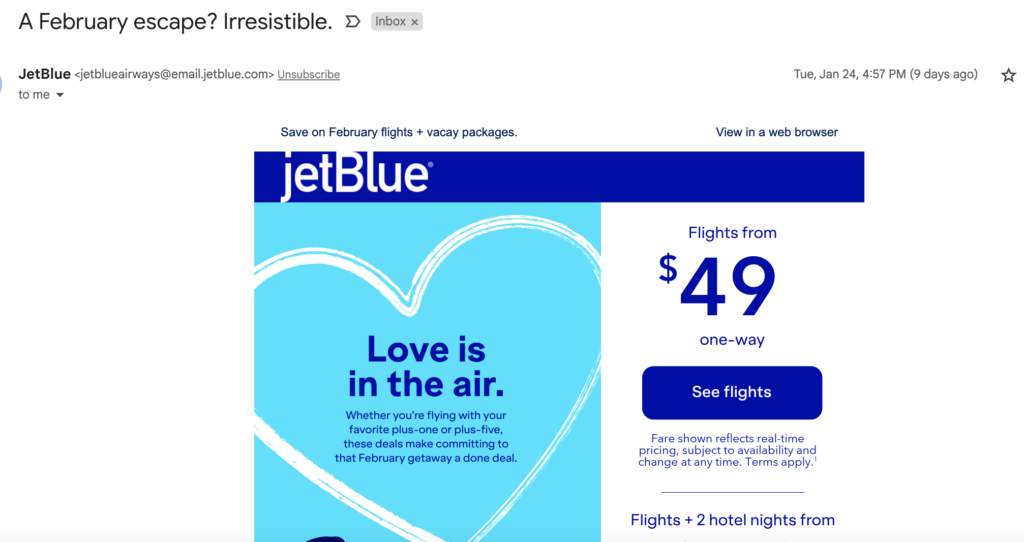
We adore this example from jetBlue. The subject line doesn’t mention Valentine’s Day, which means it isn’t alienating those who might not want to celebrate. In the actual email, the language is cheeky, but more importantly, it fits the theme while staying vague enough. You can travel with your family who you love, but a romantic getaway with a plus one is just as great.
They also sent this out before February started, ensuring they were ahead of the game.

2. Don’t forget your favorite Valentine!
It’s you! It’s easy to get swept away in the madness of buying gifts for everyone else you love – nieces, puppy, parents, siblings, significant other, etc. and planning out special celebrations. This text made me stop in my tracks. It reminds buyers that being selfish this month is okay! Add something to your cart for you too.

3. Create an exclusive coupon code for subscribers
Amazing creativity by Boisson here– they honed in on their red and rosé wines and are offering subscribers 10% off on those specific products for the entire month of February. This extended window to use the coupon is a great reminder that libations are always a good idea.

4. Or, even better, double their cart… for free!
Who doesn’t want to spoil their fluffy Valentines? As mentioned, I will be. BarkBox has an offer running that allows new subscribers to get two times the toys when they subscribe. The pups in the campaign are super adorable, and the offer is irresistible.
Their Instagram story links directly to the promotion making it simple for those interested to have a seamless experience.

5. Remind followers to drop a hint
People can be forgetful. We all have a lot going on – especially as marketers. Lunya is making it easier than ever for their followers to let partners know what they want this Valentine’s Day. Another helpful tidbit they shared on their Instagram stories is shipping “due” dates. It’s yet another reminder to procrastinators of when the latest possible order they can place to avoid sleeping on the couch.

6. Promote on-theme products
Baublebar is incredible at getting creative for holidays. Hearts are easy to include in jewelry, but even for Christmas, St. Patrick’s Day, and the Fourth of July, they create and feature holiday-specific products that consumers won’t want to be seen without. It helps that their products are also affordable (and cute!).
Never Settle
Whether it’s Valentine’s Day or any other day, personalized and powerful customer experiences are now expected by consumers.
Once you master the creativity piece of marketing campaigns – which these brands all clearly have – you’ll find even more success in personalization. As mentioned, first and zero-party data collection is crucial to executing targeted campaigns.
However, not only do messages to consumers need to be relevant and timely, but they should also be delivered in a respectful cadence. To know what this optimal outreach frequency looks like, marketing teams need a complete view of their customers across all touchpoints. This is no easy task, as marketing data is historically incredibly siloed.
Cloud Data Warehouses help centralize data in one spot, allowing for every customer touchpoint to sit in a centralized, secure, easy-to-use, and flexible platform. Pair this with a Customer Data Platform, and you’ve found the perfect match. Simon Activate allows marketers to execute data-driven testing, targeting, and measurement, making campaigns like the above feel incredibly tailored to both potential and current buyers.
Looking to launch marketing campaigns that your customers love? Reach out soon before the next wave of holidays (cough, Mother’s Day, and Father’s Day), so you too can have eye-catching personalized campaigns.

Today, we’re announcing the launch of Simon Activate, a solution that gives marketing teams the ability to quickly and easily build advanced custom audiences by unifying customer data from their Cloud Data Warehouse (CDW) along with additional sources. While traditional CDPs require a high degree of data and integration resourcing to see value, Simon Activate’s unique approach enables companies to create an actionable 360-degree customer view in days or weeks. The result is a solution that marketing teams can rely on for data-driven optimization of customer acquisition costs, lifetime value, and more to help drive faster revenue growth.
Companies are storing increasingly large amounts of data in their data warehouses and data lakes, but today’s marketing tools have legacy architecture that cannot integrate with or leverage data in a CDW. Simon Activate is purpose-built for the Cloud Data Warehouse and uses zero-ETL technology to offer an accessible and transparent data architecture. Unlike other solutions, Simon Activate is not limited to warehouse data for audience-building, and the identity resolution capabilities of Simon’s CDP allows users to combine data from their other sources into single, complete customer profiles. Its intuitive, marketer-friendly UI makes it simple to create hyper-targeted customer segments from a large volume of data to power and improve the performance of campaigns across their top channels.
“It was a deliberate decision to build Simon Activate on Snowflake and the greatest benefit we’ve seen is that it has allowed us to better integrate with CDWs in a way other CDPs/Martech tools that were built on legacy architecture cannot,” said Jason Davis, CEO, and founder of Simon Data. “Additionally, it has allowed us to build new products, such as Simon Activate, at speed as new customer needs and pain points arise.”
“Simon Data’s mission aligns with where we see the modern marketing data stack heading,” said Denise Persson, Chief Marketing Officer at Snowflake. “In 2023, marketers will face even more pressure to achieve higher ROI and deliver better customer experiences. It is critical to build a solid data foundation for your marketing engine. Simon Activate, Powered by Snowflake, provides simple, powerful capabilities that demonstrate what building your marketing stack on the Snowflake Data Cloud can unlock for joint customers.”
Industry-leading applications are Powered by Snowflake. By building on Snowflake, product and engineering teams can develop, scale, and operate their applications without operational burden, delivering differentiated products to their customers. With the Powered by Snowflake program, builders like us get access to resources to help them design, market, and operate their applications in the Data Cloud. To learn more about the Powered by Snowflake program and how organizations are building on Snowflake, click here.
How ASOS Activates Data
Simon Activate allows leading online fashion destination, ASOS, to create and send advanced segments to its marketing cloud that it otherwise could not have. Simon integrates with multiple third-party vendors to combine previously-siloed data, provide a single view of each customer and incrementally increase revenue.
“Simon Activate’s entire toolchain is seamless, purpose-built, and equips our marketing team with a complete and accurate customer 360,” said Ashley Fisher, Head of Technology, ASOS. “Simon Data’s Snowflake architecture has transformed our ability to deploy targeted marketing campaigns by allowing our marketers to launch campaigns in a matter of minutes. Now our overall program is more segmented, more personalized, and ultimately, much higher performing than that of our existing legacy architecture.”

What Happened?
According to a company regulatory filing a few weeks ago, Southwest Airlines reported an estimated $825 million, or 4% of their current market cap, in losses stemming from their mass service disruption over the holidays. U.S. Transportation Secretary Pete Buttigieg said the airline “failed its customers.”
How did this happen?
When frigid temperatures swept across the Northeast in December, it wasn’t surprising to see many major airlines experiencing delays and cancellations. But if you happened to open Twitter between the 22nd and 31st, or opened any other breaking news publication during that span, you probably noticed Southwest Airlines catching A LOT of heat from frustrated customers.
More than 15,000 Southwest flights were canceled starting on Dec. 22, including more than 2,300 canceled the week after Christmas – almost a week after the storm had passed. This was due to an archaic scheduling software problem, which has been an open secret at Southwest for quite some time. Longtime Southwest pilot, Larry Lonero, said, “The frontline employees have been watching this meltdown coming like a slow motion trainwreck for sometime…and we’ve been begging our leadership to make much-needed changes in order to avoid it.”
What can marketers learn from this?
By failing to take the necessary steps to transform a critical piece of company infrastructure, something like this was inevitable. It reminded me of when the super in my midtown loft apartment used cheap plywood to patch up our floor anytime there was a plumbing problem – What ensued was…well…I’ll leave it to the reader’s imagination.
So, what can marketers learn from this? In our world, we often talk about the importance of digital transformation in enabling brands to use data more intelligently to create the best possible experiences for their customers. So, while Southwest’s issue was related to an archaic scheduling technology, much of the same logic can be applied to outdated marketing systems (think legacy marketing clouds, on-prem databases, and “home-built” email systems).
Many businesses have accepted the reality that to succeed in today’s economy, they need to build a modern technology infrastructure that can support modern business practices. There’s a reason why Snowflake has a $45 billion market cap. Marketers need tooling that’ll allow them to be responsive to their customer needs and demands.
Ultimately, brands that fail to treat data as a first-class citizen in their business end up a) losing market share from their progressive-minded competitors, b) spending way too much time cutting data in excel for basic marketing asks and c) delivering cringe-worthy experiences to customers, that’s simply unacceptable this day in age, like below:

The Bottom Line:
Your customers deserve better. Especially during this seemingly never-ending period of economic uncertainty and unpredictable shopping behaviors. Finding ways to monetize existing customer bases and growing LTV will be paramount.
Brands can no longer afford to let outdated technology impede their ability to execute at a high level. They need to adapt.
Every customer has a long-term economic value to your business. Customer churn, also known as customer attrition, erodes profits and can even lead to reputation damage when unhappy customers tell others their reasons for leaving.
That’s why it’s so important for marketers to be aware of customer churn and take steps to measure and minimize it. In this article we’ll take a look at what customer churn is, how to effectively measure it, how to reduce it, and what tools are best for managing churn long-term.
What is customer churn?
Customer churn is the percentage of customers who stop doing business with a company within a given time period. This is an important metric to monitor because it indicates the health and sustainability of the business.
Low customer churn is a good indicator of customer satisfaction and loyalty. Likewise, a high churn rate shows customers are dissatisfied and lack loyalty to your brand—factors that will greatly impact the growth and sustainability of your business.
Marketers can use churn rates to measure the success of their buyer’s journey, customer lifecycle marketing efforts, and even omnichannel campaigns.
Types of customer churn
Customer churn can be broken down into a few primary types:
Contractual churn: Contractual churn is the most common form of customer churn. It occurs when customers cancel their subscriptions or contracts. This type of churn is most relevant to businesses with recurring services or subscription-based models.
Involuntary churn: Involuntary churn occurs when customers are unable to keep using a product or service due to technical or other issues. This type of churn is most relevant to businesses providing digital services or products.
Voluntary churn: Voluntary churn occurs when customers opt to switch to another product or service. This type of churn is most relevant to businesses that offer products or services in competitive markets.
Attrition churn: Attrition churn occurs when customers no longer use a service or product due to inactivity or lack of engagement. This type of churn is most relevant to businesses with recurring services or subscription-based models.
Involuntary churn is the hardest to control because the customer’s reasons for leaving are often not deliberate. Perhaps the customer lost their job, moved, or simply no longer needs the product you offer due to personal or lifestyle changes.
It’s best to focus your efforts on the types of churn that can be prevented.
How is customer churn measured?
Churn calculation is an easy way to benchmark how well your customer retention efforts are working.
Customer churn is measured by calculating the percentage of customers who have stopped doing business with your company over a given period of time. This calculation is based on the total number of customers at the beginning of the period and the number of customers who left during the same period.
For example, if your company had 500 customers at the beginning of the year and 100 of them left during the year, the customer churn rate would be 20%.
Use this equation each year (or even each quarter) to see how your marketing efforts are paying off. Naturally, the lower your customer churn percentage, the better you’re doing overall in retaining your existing customers.
But it isn’t enough to simply measure customer churn—it’s also critical to know how to predict it, so you can prevent it.
How can you predict customer churn?
According to Statista, the average churn rate across some of the biggest industries in the US hovers around the 25% mark. Analyzing historical data markers is one of the best ways to predict customer churn. By understanding past customer behavior, it’s easier to uncover patterns that suggest a customer may be likely to churn in the future.
Here are some indicators to keep an eye on:
- Customer engagement
- Purchase frequency
- Click-through rates (CTRs) from promotional emails or campaigns
- Customer account changes
By evaluating customers’ interactions with your business, you can begin to understand how they feel about your brand—and how likely they are to stick around. Armed with this information, you can set measures in place to lower your churn rate.
Strategies for reducing customer churn
The antidote to customer churn is customer loyalty. If you aren’t nurturing the customer journey, you risk lowering your retention rate and increasing churn.
Here are six things you can do to build stronger customer relationships:
1. Provide excellent customer service
Providing excellent customer service is one of the best ways to prevent customer churn. Being responsive to customers’ needs and addressing their concerns goes a long way toward making customers feel valued, hence nurturing brand loyalty.
For example, a customer might be having an issue with your product or service. If your customer service team is quick to respond with solutions and takes the necessary steps to solve the customer’s problem quickly and efficiently, then that customer will more likely stick with you rather than switching to a competitor. If you have too high a volume of customer interactions to keep up with personally, you may want to employ tools like chatbots to help you respond in real time.
2. Track customer feedback
Being proactive about tracking customer feedback is a great way to show your customers you’re listening, even when they aren’t reaching out to you directly. As a brand, it’s up to you to keep your finger on the pulse and stay updated on customer sentiment, what they’re saying, and how well they’re enjoying your product.
Here are some key channels to monitor for customer feedback:
- Customer reviews
- Social media posts and comments
- Historical customer service interactions
- Survey responses
3. Offer incentives and upgrades
Offering rewards does a lot to nurture customer loyalty. A loyalty program where customers can earn points for every purchase and redeem them for rewards like free shipping or exclusive products provides long-term dividends.
Customers who engage with a rewards program are more likely to stay with you in the present and return to you for their future needs.
4. Tailor your product or service to customer preferences
Let’s say you own an online coffee store. You’ve noticed that a large portion of your customers prefer vanilla coffee beans. By tailoring your product pages to include more vanilla coffee bean varieties, you can cater to the preferences of your customer base.
This will make customers more likely to frequent your web store, because they know they’ll find what they want. It will also increase customer loyalty and satisfaction as customers feel that their needs and desires are being met.
5. Stay in regular contact with customers
Staying in regular contact with customers is a great way to prevent high churn rates. By maintaining communication through channels like email or social media, you can create a greater sense of connection between customers and your brand.
For example, if you have a subscription-based product or service, you can use SMS or email marketing to stay in regular contact with subscribers and update them on new features, products, or promotions you’re offering.
Keeping customers up to date and showing them you care about their experiences will make them more likely to remain loyal to your brand. Regular communication builds a sense of trust and encourages customers to remain engaged with your product or service.
6. Create personalized experiences
Creating personalized customer experiences is a great way to reduce churn. When customers feel that you understand their particular needs and preferences, they’re more likely to keep doing business with you.
Let’s say you have a retail store and have started sending customers personalized emails with products they may be interested in based on past purchases. This will make them feel like you understand their preferences and value their business, which will encourage them to keep shopping with you.
By combining all the above strategies, marketers can create positive customer experiences that increase customer loyalty and reduce churn. But in order to implement them, you’ll need a good way to manage your customer data.
Collecting and analyzing customer data
A data-driven approach will give you deeper insights into customer behavior and preferences, helping you identify customer needs so you can create tailored marketing campaigns or products to meet them.
But how do you collect customer data from all your touchpoints across different platforms? And how do you unify all that data so it forms a complete picture you can actually act on?
Activating your data with a CDP
A customer data platform (CDP) gathers and unifies customer data, helping marketers gain deeper insights into customer behavior and tailor marketing tactics accordingly.
With data at the forefront, you’re able to create personalized marketing campaigns to strengthen customer-brand relationships and re-engage customers who are likely to churn.
One way to do this is with customer segmentation. Perhaps some customers respond better to discounts or free shipping, and others do better with a loyalty or rewards program. You can use this data to break them up into segments and create personalized marketing campaigns that speak directly to each group.
A customer data platform empowers you to wield your customer data as you see fitting. Here are a few of the many ways you can make a CDP work for you:
- Analyzing customer data to understand buying habits and preferences
- Tailoring marketing campaigns to specific customer needs and interests
- Tracking and analyzing customer feedback or satisfaction issues
A robust CDP fueled with customer data is an invaluable tool for increasing customer retention and lowering churn.
The consequences of customer churn: How can it affect your business?
Customer churn can have a significant impact on business growth. The following are just a few of the ways customer churn can affect your businesses:
Loss of revenue
Unhappy customers—or those who have found a better alternative—are less likely to remain loyal to your company or product. That’s a no-brainer, right? The problem is, accruing enough unhappy customers can get expensive in the long run.
It is far more cost-effective to maintain the customer relationships you’ve already established than to build new ones. Customer acquisition is costly and will quickly eat into your monthly recurring revenue (MRR).
Diminished brand reputation
Customers who choose to leave your brand may share their negative opinions or experiences with others. In an age of social media, it only takes a few seconds for a disgruntled customer to share their dismay with the whole world. Sometimes it can even go viral.
Consider that a tarnished brand reputation is incredibly costly—and downright difficult—to repair. It may take even more work and resources than building the brand itself.
Decreased market share
Without the necessary customer insights and data, it is difficult to identify trends and create strategies that enable your business to grow its market share. And in a competitive marketplace, if you’re not gaining ground, you’re losing it.
Ensuring customer loyalty and lowering churn rate is a must for companies that want to optimize for long-term growth.
Lowering churn rates with Simon Data
Customer churn is an important metric because it indicates the sustainability of your business. It’s essential to measure, predict, and reduce customer churn in order to maintain a strong customer base and promote growth.
By providing excellent customer service, offering incentives and rewards, and tailoring products and services to the needs of customers, marketers can effectively reduce churn and improve business performance.
Simon Data’s audience management and cross-channel orchestration solutions provide the tools you need to gather, unify, analyze, and action your customer data, so you can reach your customers with the right messaging at the right time.
Request a demo today to see how Simon CDP can help your business lower its churn rate—and keep it low.

The new year always brings in new resolutions, and this is no different in the data world. 2023 is finally here, and it’s bringing with it a number of changes in the data marketing industry.
What are these changes, you ask? And how will they affect brands and their relationship with consumers?
Well, these are a few of the questions we ask this week’s guest on the podcast, and he has delivered!
In this week’s episode of Data Unlocked, Jason sits down with Scott Breitenother, the founder and CEO of Brooklyn Data Co,.
Before founding his company, Scott was the VP of Data & Analytics at direct-to-consumer mattress startup Casper.
Scott is an investor and advisor. He specializes in building data driven organizations, and he’s used his expertise to found Brooklyn Data Co..
Brooklyn Data Co. is a consultancy offering full-stack data and analytics team as a service. Their work is all about providing their clients with the technical skills, experience, and leadership to deliver best-in-class data capabilities.
In this episode, Scott and Jason discuss Scott’s experience at Casper. They also talk about changes in the data marketing industry he saw in the last year, the importance of good customer segmentation, and more.
Ready to learn?
Let’s dive in.

It’s always fun to review the past year and marvel at how much time was spent listening to our favorite music, all the places we visited, or how much incredible work we accomplished. For Simon Data, looking back on the successes of 2022 has us excited for what 2023 will bring for our Simon Mail email-sending platform.
While Simon Mail is almost two years old as a sending platform, 2022 was Simon Mail’s first full calendar year in existence. Though technically still a youngster, the Simon Mail platform has already seen fantastic growth, consistent results, and the addition of powerful tooling that enables marketers to get the most out of an email-sending platform fully integrated with their CDP and first-party data.
What we’ve been building
When it comes to email success, there is no substitute for accurate insights and powerful orchestration capabilities. Two of the most important features added to Simon Mail in the last year have given senders deep, actionable insights into how their email messaging performs. First, we released our Deliverability Insights tool that allows marketers to quickly identify and triage potential delivery or inboxing problems across the wide array of mailbox providers and across important breakdowns like top campaigns, recipient domains, and even IP pools. These comparisons, combined with simple-to-use data filters, simplify the otherwise complicated processes required to optimize email sending for good deliverability.
Learn more about our Deliverability Insights Tool
We also saw the addition of Simon Mail’s Content Heat Maps feature this year. While insights into deliverability results help marketers know how to get more mail to the inbox, knowing how content is performing and where in that content recipients spend the most time interacting is crucial for the work of optimizing content for recipient engagement. Simon Mail makes it simple to clearly see what parts of your content resonate most with recipients and which sections do not.

In addition to meaningful insight into email deliverability and content performance, marketers need tools that make easy work of activating their data for powerful orchestration. Simon Mail’s most recent feature addition gives marketers a tool in our Deliverability Dataset feature. Inside Simon Data’s powerful segmentation tool, Simon Mail senders have access to an array of pre-configured deliverability-specific data points that can be used in conjunction with any number of first-party data points to make sure the recipients being targeted for email are engaged recipients and not risk to deliverability. Data points like unique open rate, last delivered or last opened dates, total delivered or opened messages, and even how many open events were related to Apple’s Mail Privacy Protection work to make Simon Mail’s segmentation and orchestration capabilities a powerful engine for great deliverability.

Learn more about Deliverability Dataset
2022 and Deliverability
All email-sending platforms claim to have great deliverability, but what does that even mean? When we at Simon Data talk about deliverability, we mean the ability for senders to not only have their messages accepted by mailbox providers but get those messages placed in recipients’ inboxes. Over the past year, Simon Mail has proven successful at just that. This success is largely because of the tooling we give senders to empower more accurate targeting and message orchestration. But the proof isn’t in the tooling…it’s in the pudding?
In terms of deliverability proof pudding, here are the numbers for 2022 thus far:
- Simon Mail has delivered over 1.3 billion messages with a delivery rate of over 99%.
- All Simon Mail senders combined for a unique open rate (opened messages/delivered messages) of 50%.
- As a platform, Simon Mail’s Unique Open Rate, which is adjusted for pre-fetched open events like those generated by Apple’s Mail Privacy Protection, was over 9.4%.
- Finally, the unique click rate (messages clicked/messages delivered) for all of Simon Mail thus far in 2022 is over 1.4%.
While there is no single metric that defines good deliverability, these numbers show that senders using Simon Mail in 2022 were able to get their messages successfully in front of the right recipients to drive engagement and marketing success.
Black Friday and Cyber Monday
Good overall deliverability results for a year are great, but great results across the busiest email-sending days of the year truly demonstrate a platform’s ability to deliver messages to recipients’ inboxes. Simon Mail’s Black Friday/Cyber Monday sending period did just this.
Between November 22 and November 29, Simon Mail:
- Delivered over 65 million messages with a 99% delivery rate.
- Generated a unique open rate of over 45.7%.
- Generated an adjusted unique open rate of over 6.6%.
- Saw a unique click rate of 1%.
Simon Mail users could focus on the important work of messaging subscribers and customers rather than worrying about delivery or inboxing challenges often seen during this time of year.
Deliverability Services
With powerful tooling for deliverability comes opportunities for Simon Mail senders to employ deliverability strategies that once seemed too complex or cumbersome to implement. Simon Data not only gives senders the tools they need to simplify the work of deliverability but also provides the opportunity to engage our Expert Deliverability Services to ensure they are using those tools to their maximum potential.
Through tactics like contact engagement scoring, mailbox-provider-specific sunsetting strategies, and the integration of first-party conversion data into deliverability reporting, Simon Mail senders engaging with our Deliverability Services saw stellar results during the Black Friday/Cyber Monday sending period. When compared to the entirety of Simon Mail’s sending over that time period, senders utilizing Simon’s Deliverability Services saw roughly:
- 7% higher unique open rates
- 2.5% higher adjusted unique open rates
- 1.5% higher click rates
If you are already a Simon Mail sender and want more information on how our expert services can help you maximize the amount of email you deliver to recipients’ inboxes, contact your account manager.
Looking Forward
Over the course of 2023, we will continue adding to the tooling that enables senders to make sense of email deliverability and invest more time into maximizing marketing efforts. To learn more about Simon Data and Simon Mail, request a demo today and make 2023 a breakthrough year for your email marketing.