Blog

Unlock true customer 360
Seamlessly unify and activate customer data from your cloud data warehouse and beyond.



.webp)


Power 1:1 personalization
Deliver hyper-personalized customer experiences to forge deeper connections and transform casual customers into loyal advocates.

.webp)
.webp)

.webp)
.webp)


.webp)


.png)


Boost your bottom line
Discover the industry's latest tips, tricks, and trends to elevate your customer marketing strategies.






.webp)


.png)

.webp)
.webp)
.png)


.png)


Since the 1970s, organizations have recognized the benefits of the ETL (extract, transform, load) process for consolidating data from disparate sources into a centralized platform such as a data warehouse. Traditionally, this data has been used to power business intelligence (BI) dashboards for reporting. But today, it is more valuable to analysts, business teams, and marketing teams if it’s accessible to the frontline tools that drive their day-to-day operations, such as HubSpot and Salesforce.This is where Reverse ETL comes in. Reverse ETL technology moves cleaned, optimized data from a data warehouse into third-party frontline tools. This gives you access to accurate, real-time customer data to power your workflows and marketing campaigns.Here we’ll discuss the ins and outs of Reverse ETL and how it transforms marketing strategies and decision-making.
What is Reverse ETL?
Reverse ETL is a process by which data is extracted from a data lake or warehouse and sent to SaaS applications, like customer relationship management (CRM), marketing automation, advertising, and customer experience tools. Data in a data warehouse is an aggregation of an organization’s most accurate, up-to-date data. It serves as a “single source of truth.” But this data is often only accessible to technical users who know how to write SQL and Python scripts. The Reverse ETL process replicates data from the data warehouse into the third-party systems employees use daily. This process allows them to get the data and insights they need faster, instead of relying on IT teams or data engineers to process the data.
Why Reverse ETL?

Without Reverse ETL, valuable data and insights can remain locked away within your data warehouse. This is data that marketers need to create personal, data-informed strategies to improve your customer relationships. A Reverse ETL solution offers three main benefits:
- Operationalizing data: Reverse ETL allows you to operationalize relevant data by sending it to SaaS applications—for example, importing consolidated customer data from the data warehouse into Salesforce. A Reverse ETL pipeline is the key to improving your sales processes and making your data usable for marketing campaigns.
- Reducing reliance on IT: Reverse ETL technologies offer no-code, easy-to-use plug-and-play features. This allows sales and marketing professionals to access the data they need without relying on IT or data teams.
- Improving the customer experience: Reverse ETL transfers data in real time. Having access to the most up-to-date data enables sales and marketing teams to make the best decisions based on current customer needs.
The ETL process
To better understand the Reverse ETL process, let’s first take a step back and look at ETL.ETL is a data integration process that allows you to extract data from different applications and import it into a data warehouse. The process takes raw data from several tools and data sources, transforms it into a usable format, and loads the transformed data into the target data warehouse.

The three steps of the ETL process are extract, transform, and load:
1. Extract
The first step in the ETL process is to import and consolidate structured and unstructured data into a single repository. Data is extracted manually or with automated tools from a wide variety of sources, including existing databases, legacy systems, sales and marketing applications, CRM systems, and analytics tools.
2. Transform
The transformation phase of the ETL process ensures data quality, integrity, and accessibility. During this process, the data can go through several stages:
- Cleansing: Removing inconsistencies and missing values
- Standardization: Conforming to specified formatting rules and naming conventions
- Deduplication: Excluding or discarding redundant data
- Verification: Flagging anomalies and removing unusable data
- Organization: Sorting and grouping according to data type
3. Load
This step in the ETL process loads the transformed data into a new data repository such as a data lake or data warehouse. Data can be loaded in full or incrementally. With full loading, the transformed data is stored in unique records in the data warehouse. Incremental loading compares incoming data with existing data in the data warehouse and only creates additional records if it finds unique information.
Advantages of ETL
There are several advantages for organizations using the ETL process to consolidate data:Timely access to data: ETL merges data from multiple sources into a single repository and transforms it into a useful format. As a result, it improves access to valuable information that drives strategic and operational decision-making. Instead of piecing together siloed data, business leaders have access to useful data aggregated from multiple sources.Data quality: The ability to remove data inconsistencies, redundant data, and unusable data during the transformation stage makes data more consistent. Data has increased quality and integrity. Ease of use: Most ETL applications are no-code and provide graphical user interfaces (GUIs) that allow business users to create ETL processes without programming knowledge. Users operate a drag-and-drop interface and specify rules to map the flows of data in a process.Capacity for big data: Today’s ETL tools handle massive amounts of big data without compromising process and sync speed.
What does this have to do with Reverse ETL?
Reverse ETL is how you make use of all this data. Where ETL prepares the data and moves it into a central location, Reverse ETL moves it in the opposite direction—from the source (e.g., data warehouse) into third-party business tools and applications.This means you can create a data pipeline from modern data platforms like Amazon Redshift, Snowflake, and Google BigQuery to Salesforce and other frontline applications. With Reverse ETL, you can make use of both structured and unstructured data.

Common use cases for Reverse ETL
Here are some ways businesses are taking advantage of Reverse ETL:
Customer service
Customer service employees represent your company’s brand and significantly impact customer satisfaction. But they need access to the right information to deliver personalized customer experiences. A Reverse ETL pipeline syncs customer data from your data warehouse to various support channels, such as Zendesk and Help Scout. This gives customer success teams access to important metrics related to customer profile data and service history. With up-to-date, actionable customer data, support teams can more successfully engage with customers.
Sales
Sales teams often have to navigate multiple tools and platforms to gather product usage data. This makes it more challenging to get the detailed information they need to nurture potential leads and identify high-value accounts.With a Reverse ETL solution, sales teams import aggregated customer data from several data sources into their CRM software. Having all the data in one place enables them to make more meaningful connections and increase their conversion rates.
Marketing
To deliver a great customer experience, marketers need to bring together information about the customers’ behavior through the entire marketing funnel. Using Reverse ETL, marketing teams can send customer data from product, sales, and customer support to their own marketing automation tools, like HubSpot.With all this data gathered into one platform, they can identify which content or channel triggered the customer journey, view customer purchase history, and segment leads based on demographic and behavioral data. A holistic view of the customer journey enables marketing teams to create more personalized and effective campaigns.
Why you still need a CDP
At first glance, Reverse ETL may appear like the perfect solution to completing your data stack. You have a warehouse that stores data and, now, a solution that moves all that data back and forth to your tools. However, Reverse ETL does not provide an interface to activate your data into personalized, cross-channel customer experiences. This gap is where a customer data platform (CDP) comes into play. A CDP unifies all your customer data and consolidates it into a single profile view for each customer. This results in downstream marketing orchestration and business analysis that are targeted, personalized, and effective.
How does Reverse ETL interact with your CDP?
Reverse ETL and CDPs have some overlapping functionality, but they complement each other in organizational tech stacks. Their aligned capabilities make customer data bi-directional and consistent across tools and sources.Besides facilitating the bi-directional flow of data between data warehouses and various end channels, CDPs uniquely provide strong customer identity models. By creating single customer views, they combine all the user data that lives across disconnected tools into easy-to-access customer profiles.Without a CDP, you would have two options:
- Maintain separate customer profiles in each end channel, risking data fragmentation.
- Build that logic into your data warehouse, sacrificing significant time and engineering resources.
Though some Reverse ETL tools allow marketers to filter data, this solution still ultimately requires the work of an engineering team. CDPs make data accessible to marketers with no-code workflows, improving overall time-to-value and efficiency.In addition, CDPs provide powerful, dynamic orchestration functionality that allows marketers to create highly personalized, cross-channel customer experiences. All the actions are defined in the CDP and built on single customer profiles, based on each customer’s behavior. This translates to optimized customer engagement and ROI.
Simon CDP: Your complete cross-channel marketing platform
Simon Data enables marketing teams to transform data into outcomes. Powered by an industry-leading CDP, Simon integrates real-time and historical data into unified customer profiles that enhance sophisticated identity models and predictive capabilities. Through more targeted messaging and personalization that are built and scaled with ease, Simon Data customers get better results.Request a customized demo to find out how Simon Data can help you align your CDP with Reverse ETL capabilities for consistent, bi-directional customer data across all your tools and data sources.

Simon Data partnered with eTail to survey over 500 U.S. consumers and learn how they intend to shop this holiday season. Unlock key consumer insights to help you hit your Black Friday and Cyber Monday goals and build stronger customer relationships.
Download the report to learn:
- 6 key takeaways to use this data to maximize holiday performance
- The consumer’s POV on cart abandonment, why they do it and what sparks reengagement
- The latest insights on online shopping and what factors can make or break a sale
- Which marketing messages are the most preferred on each channel


Last spring, Kim Larsen did some analysis around the NBA finals and posted it on LinkedIn.
He was predicting probabilities and trying to guess how things would go, and, as it turned out, his predictions were more accurate than you might think. His posts got a lot of attention because of this.
In fact, his numbers were so accurate, he was able to predict who was going to win.
Of course, this wasn’t very surprising to us. After all, we work in the data industry, and we know it can make some pretty accurate predictions.
And, because we wanted to dive further into this, we thought we’d bring him on to discuss the subject!
Yes, you’ve guessed it; in this week’s episode of Data Unlocked, Jason will be sitting down with Kim Larsen, SVP of Business Data Science at WHOOP.
Kim has been working in the data science industry for the last two decades. He’s done consulting and data work for B2B and B2C companies all over the world, such as Uber, Stitch Fix, Charles Schwab, and more.
Today, he’s lending his expertise to WHOOP.
WHOOP is a tech company whose mission is to unlock human performance and help people reach their ultimate physical potential. They do this through services such as WHOOP APP and products like WHOOP 4.0 band.
In this episode, Kim discusses WHOOP’s work, using data to predict and model sports outcomes, the difference between sports predictions and customer predictions, and more.
Ready to learn?
Let’s dive in.

As we all know, retaining customers is always easier than constantly being on the search for new ones.
Loyal clients simply buy more and interact more with the brand.
It also costs way less to keep someone who uses your products or services loyal than to constantly look for new prospects and convert them into clients.
So it only makes sense that today’s companies are investing in better, more intelligent, data-driven loyalty programs.
And this is exactly what we discuss today!
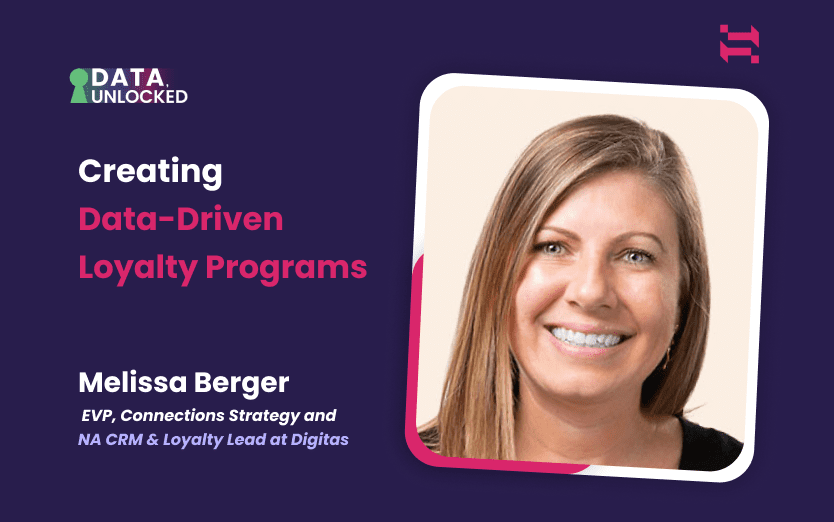
In this week’s episode of Data Unlocked, Jason sits down with Melissa Berger, EVP, Connections Strategy and NA CRM & Loyalty Lead at Digitas.
Melissa has been working in the marketing industry for two decades now. She’s worn many hats throughout those years, from account manager to marketing project manager to email marketing manager.
Today, she’s using her expertise to tailor loyalty programs using data for Digitas.
For those of you who’ve never heard of it (and we are sure you are few), Digitas is one of the biggest media and creative agencies in the world. With fifty offices across thirty countries (and a few thousand employees), Digitas is a leader in all things marketing.
In this episode, Melissa discusses the modern loyalty program. She also talks about the process of implementing data in the creation and tailoring of loyalty programs and more.
Ready to learn?
Let’s dive in.
Digital fatigue is alive and well.
This statement is especially true after the pandemic we’ve been through. We’ve been so connected to the world around us that now, we just want to unplug a bit.
And, whether you like it or not, this has an effect on your business.
In this day and age, digital marketing doesn’t cut it anymore. Everyone wants to disconnect a bit, and we need to get used to that.
One way we can change with the times and adapt is through direct mail marketing, which is exactly what we’ll be talking about today.
In this week’s episode of Data Unlocked, Jason sits down with Christina Louie Dyer, the Head of Social Impact & Sustainability of Lob and our very own Shela Wu, a Senior Data Analyst and the Chair of The Green Network at Simon Data.
Here is what you need to know about Lob: It’s a direct mail automation platform that simplifies workflows by automating the entire direct mail process with end-to-end analytics and campaign attribution.
In its client roster, you’ll find big international names such as Expedia, Twitter, and Booking.com.
As for Simon Data, well, you already know us, so there’s no need to reintroduce ourselves.
In this episode, Christina and Shela discuss what brands can do to offset their carbon footprint, how direct mail can be part of your overall marketing strategy, and more.
Ready to learn?
Let’s dive in.

Today, more than ever, school teachers and students need our help.
Public schools are underfunded. Public school teachers are underpaid and overworked, and yet, they still keep on.
Most teachers need to pay for their classroom materials, which are not always cheap. And that’s exactly why working towards equity in schools and donating to nonprofits that can help public school teachers is essential.
Someone who understands this struggle and wants to help is today’s guest on the podcast, Alix Guerrier.
In this week’s episode of Data Unlocked, Jason sits down with Alix, the CEO of DonorsChoose.
Alix started his career as a teacher. But, he wanted to do more for the world, and to him, working alongside nonprofits was the way to do that.
That decision led him to becoming involved in many NGOs that work to support children and their families, such as Kinspire, Financepeer, and now DonorsChoose.
DonorsChoose is the number one nonprofit education funding site for public school teachers in the US. It helps educators by supporting their classrooms and donating all sorts of school materials.
In this episode, Alix discusses the importance of data driven equity, how DonorsChoose works, measuring equity, and more.
Ready to learn?
Let’s dive in.

It’s rare that anyone in business, be it marketing or otherwise, ever feels they have done all that needs doing. In the market's give and take, we always ask ourselves what else we could do to strengthen our brands. When markets turn for the worse, this drive takes on an even keener edge. With such external and internal pressures, the first reaction is to just do more. But you only get so far with pure hustle before you run out of hours in the day. Time is the limiting factor and, consequently, your most valuable resource.So how do we ensure what little time we do have is put to best use? Some areas of waste will be obvious, e.g., your classic meeting that could be replaced by an email. But other time sinks are more insidious. Chief among these is complexity. As with so many systemic issues, the harmful effect accumulates slowly, then all at once. Like a favored pair of running shoes, changes are subtle, even beneficial at first. The uppers become more supple, the insoles fit your foot better, and you have that all-important patina of road grime that proves you’re a genuine road warrior. Fast forward 300, 400 miles in, and suddenly “shoddy” comes more readily to mind. All at once, things happen. Shoelaces snap. Uppers tear at the outside corners. Interior linings rip out. So far, no big deal. But keep going, and the unseen effects of this wear and tear will suddenly and disastrously show up: plantar fasciitis, IT band syndrome, or even a stress fracture. Ask any runner. The road to recovery from these conditions is long and frustrating. And they all wish they had seen the warning signs sooner.Unfortunately, like wear and tear on a pair of shoes, complexity is a natural trend of any evolving process - unless you specifically and proactively fight back. But it’s hard to prioritize when you’re in the race for market share, neck and neck with competitors. When you need more from less, however, this neglected corner of “operational debt” is a sure-fire place to start. In a previous life as a management consultant, I worked with a top 5 bank in the UK to help make sense of their marketing workflows. Despite enormous investment in a leading marketing cloud suite and an army of permanent tech consultants to run it, it took ages to run a simple campaign. And the root cause was complexity.Their customer data lived across three different orgs each with their own priorities and goals. Communication between teams required formal escalation and prioritization processes between orgs. And the big, shiny marketing cloud didn’t play naturally with their home-grown database.To get an audience for a test campaign, a marketer would send a request through a chain of 19 people, taking on average six weeks – just to see the list. Sometimes it came back too small - as in a case where the team was considering a highly targeted motorcycle insurance product. Six weeks gone and nothing to show. But while this sluggish pace was caused by complexity, the true problem was a lack of awareness. Just like the miles on a worn pair of running shoes, the org had grown used to the labyrinthine and tedious processes of launching a campaign. They were desperately bolting on new data sources, vendors, and strategies to boost outcomes, all the while failing to address the accumulating inertia of complexity and its stranglehold on their teams.If some of this feels familiar - the pressure to do more with less, an array of marketing tools and data that don’t quite seem to be living up to the hype - then it’s well worth the investment of some time to revisit your priorities and ensure your marketing stack and processes are getting you there efficiently.
Take Time to Evaluate Your Tech Stack
While complexity hidden among a MarTech stack can take many forms, I’d suggest a few signals to help you sniff out the areas needing the most attention:
- Can you, in any one place, see the entirety of what you know about a customer?
- How many hours does your marketing team spend in meetings with IT to ensure they have clean, usable data?
- Does it take too many meetings or multiple manual steps to get data and content in one place?
- Are there data inconsistencies across your marketing tools?
- Does it just feel “too hard” to push a new campaign?
- Are customer acquisition costs too high or rising?
- Do campaigns fall short of expectations and no one can agree why? How well can you even measure campaign performance?
All of these and more are signs of little eddies of complexity in your company’s marketing & data operations - areas where broken data connections, incentives, or org structures add unnecessary heartache and distraction to your business.Once found, now what? Solutions will vary significantly based on context, but the exact approach to attacking complexity is not as important at the end of the day. What is critical is that you, as a leader, are habitually reviewing and iterating your operations and tooling from all levels. It is easy to get lost in the hustle at ground level and assume the frenetic activity must be improving outcomes. But taking the time to step back and review the whole picture, you will often see where “hard work” is running up against complexity and wasting ever more precious time.Authored by Ben Walker

Many don’t think much about the people and processes that affect data. They assume what’s important is the data itself and what it tells us.
Well, many would be wrong.
Data stakeholders are at the heart of good (or bad) data. From the people who collect the data to the processes they use to move it around, everything that touches your data affects it.
And that means that if the technology or processes used are not fast, efficient, and easy to understand, your data might be skewed. And that is what affects your numbers and your business’ growth.
So, how can we make sure that doesn’t happen?
This is the exact question we try to answer in the episode above.
In this week’s episode of Data Unlocked, Jason sits down with Chad Sanderson, the Head of Data Platform at Convoy.
Early in his career, Chad worked in big data with some well-known international names such as Microsoft, Subway, and Sephora.
For the last 3 years, Chad has been working in Convoy, a digital freight network (more on that in the episode) that focuses on owning the entire data pipeline for a complex freight life cycle. And that means everything, from events instrumentation to data storage to applications building.
Convoy has worked with leading enterprise brands like Unilever, P&G, and LG Electronics.
In this episode, Chad discusses the challenges around how data is applied. He also talks about how businesses can make the most out of their data, data stakeholders, and more.
Ready to learn?
Let’s dive in.

Last week, to highlight the Simon Data Partner Program, our blog series looked at how Agency Partners work with Simon Data. In this blog, we’re taking a deep dive on the Technology Partners side of our program.As a marketer in today’s omnichannel world, it’s no wonder that in the recently released MarTech 2022 Replacement Survey, the top two reasons marketers have replaced systems are cited as seeking better integration capabilities and data centralization. With customers expecting to be met where and when they want, it can be a marketer’s nightmare to keep up with all the tools that are required. But if you get it right, and can leverage the right data through the right channel, it can mean the difference between a lost customer or one that is retained for years.At Simon Data, we partner with a comprehensive technology ecosystem of best-in-class channel and integration partners to drive value for our customers in a streamlined way that produces better results with less manual effort. By sitting on top of a Media Data Cloud like Snowflake, Simon’s orchestration CDP can centralize all your data, facilitate segmentation, and then allow you to take action through our native channel integrations and APIs.
Why is this so important?
Well for a marketer, it means the most up-to-date and correct data comes into a single platform from all your data sources, and that your marketing tools are coordinated and integrated around a central hub CDP. It means a more direct way to create campaigns and journeys across all channels and touchpoints using technology vendors you’re probably already working with - like Attentive, Airship, and Lob. And for your customers, it means they’re getting the most informed, effective, and efficient marketing messages based on your data-driven decisions.Our commitment to working with the best technology partners ensures custom solutions based on your goals and needs. A leading enterprise home goods retailer was looking for a better way to reach unidentified customers who were visiting their website. Made possible by Simon's partnership with FullContact, the retailer deployed Simon's native identity resolution functionality to increase reach by 26% and generate a 7x ROI in the first three weeks.
The Value of Centralized Data
"Simon has been an incredible partner, with a team as committed as we are to making this partnership a success. By partnering with Simon, FullContact can deliver even better data solutions for clients and a valuable, world-class experience for the end customer," says Ben McVay, VP Product & Solutions at FullContact.When data is centralized and integrations simplified, the possibilities for success on both traditional and emerging channels are endless. These partnerships are core to marketing infrastructure and take significant strides toward unlocking the most valuable client use cases.“Simon Data has proven to be a great partner, understanding our joint value very well and always acting in a very collaborative way,” says Patrick Mareuil, VP of Global Partnerships at Airship. “Mobile apps are the center of digital experience today and thanks to our robust bi-directional integration, brands can now orchestrate Airship’s mobile app experiences alongside traditional marketing channels, as well as action on the rich, real-time customer data within Simon Data.”For marketers looking to streamline efforts and save time while maximizing the value of data, Simon’s alignment with technology partners ensures customers are seeing maximum returns. With data and cross-channel orchestration in a single platform, our omnichannel solutions help you work faster with cutting-edge, no-code tools that enable personalization, complex experimentation, and the delivery of connected customer experiences on any channel.
Learn more about the companies we partner with
To learn more about Simon’s Technology Partner Program, visit this page.If you’re a technology company looking to learn more, or have a client interested in CDPs, we want to hear from you! Our partners are carefully selected so that they may receive the most value from the program while matching the needs of our mutual clients. Upon submitting an application, your dedicated partner manager will meet with you to discuss the best direction of the partnership and put in place a plan for success and growth. Learn more and fill out an application today.

The US (and much of the world, if we’re being honest) is teetering on the edge of a recession. The pandemic started the crisis we’re currently living through and the war in Ukraine has only made it worse.
Inflation is at an all-time high and, like it or not, it is affecting all of us.
Business strategies absolutely have to change during this recession. Customer behavior changes, their buying power changes, and we have to change our marketing tactics to reflect that.
So, what does that look like? And how can businesses survive in this new market? This is exactly what Jason discusses with today’s guest.
In this week’s episode of Data Unlocked, Jason sits down with Wendi C. Sturgis, the CEO of cleverbridge.
Wendi is a (super) proud New Yorker who’s been working in the marketing and technology space for the last two decades.
A passionate tech entrepreneur, she has been building companies and supporting great marketers for over fifteen years now.
For the last seven months, Wendi has also been at the head of cleverbridge, a company that provides global billing solutions for digital goods, online services, and SaaS companies in B2C and B2B markets.
In this episode, Wendi discusses the consequences of the dollar rising, pricing strategies, building companies in Europe, and more.
Ready to learn?

Our last market downturn came almost 15 years ago when I founded my previous startup. We had completed a round of financing and this was the advice given to us by our board. I was in my twenties at the time, and this mostly meant putting in incredibly long hours. While we all learned a ton, we generally lacked sleep and had a work/life balance that was unsustainable. At the end of the day, we were able to do a bit more and we certainly had less. But our success came through sheer hustle and not through efficient (or smart) ways of getting things done.Fast forward to today. We’ve been on a steady crescendo requiring us “to do more” over the past couple of years. First, COVID forced rapid digitization as everything shut down. A rapid back-to-normal sprint then followed post-vaccine, only to once more slow down in the wake of the Omicron outbreak. We’ve seen unprecedented disruptions in supply chains affecting inventory levels, quality control, and shipping delays. And on top of all this, Google decided to deprecate third-party cookies, Apple introduced sweeping privacy changes with massive data implications, and Facebook performance has taken a nose-dive. So, we’ve all been doing a lot more over the past two-plus years. Enter 2022, and we’re officially in a bear market with strong signs of a recession. Budgets are cut, headcounts slashed, and there's an expectation to do *more* - but with a lot less.Time is now our most valuable resource - and while we all need to work harder & put in more hours, ultimately the only way to achieve your goals is by working smarter.This brings me back to my previous startup - and how hustle plus working harder can only go so far. Ultimately efficient ways of working are the only real ways of scaling your time. When I founded Simon Data seven years ago, I was drawn to what was perhaps the biggest source of organizational inefficiencies that I saw as a life-long data scientist and entrepreneur.
Enter Simon...
Data is hard. Data is complex. Data is messy. Data is slow! And for many marketing & business stakeholders, working with data is a highly inefficient and time-consuming process. We set out to build an application that would change all this. This vision started with streamlined access with fast & efficient workflows that required less effort - and ended with transformative outcomes to redefine brands, enable next-generation personalization, and drive incrementally more revenue.Many who look at my background will assume that Simon Data does this via data science, advanced AI, and other forms of rocket science. While they aren’t (completely) wrong, the secret sauce behind unlocking data at Simon starts with re-thinking how you work with your data. It’s all about re-defining workflows and putting the breadth & power of your customer data at your fingertips. Imagine a world where data operations requires to affect fine-grained segmentation, 1-1 personalization, and channel coordination could be complete in a few hours instead of the days or weeks it takes today. Imagine a world without the constant struggles to wrangle up the right data, to get your martech stack to do what they said it would, or to play peacemaker between your data, IT, and marketing teams.
This is the vision behind Simon - and here’s how it works:
Simon enables you to work faster with the data you already have. Perhaps the most frustrating & inefficient aspect of data is that you have the data already, somewhere within the four walls of your organization - yet you’re unable to easily access it. Simon solves this problem by integrating with your existing data & data systems. This starts with your data warehouse, includes real-time data from your web & mobile experiences, API data from your pricing or inventory systems, and data that’s siloed in Shopify, Zendesk, survey tools, or any other SaaS application. For us, data enablement means eliminating the Jira tickets, cross-functional meetings, and days or weeks of time required to extract data fields into your martech tools.Simon enriches your data to drive incremental revenue. This is where rocket science comes into play. Our machine learning capabilities make sense of the complexities of your data to drive results across the entire customer lifecycle - from acquisition propensity to churn probabilities and beyond. And with third party cookie changes and increasing pressures around acquisition costs, our Identity+ offering can stitch anonymous & known customer data together to increase conversion rates and drive incremental revenue - seamlessly into the Simon Data platform all with minimal time.Simon enhances your existing channels to maximize engagement. It plugs into all your channels from acquisition to retention, including owned, digital, and offline. Simon also transforms the segmentation, personalization, and targeting within existing systems - bringing them next to the data with incredible precision. What good is data if you can’t take it the last mile to drive highly engaged messaging?
My Challenge for You
Times like these are demanding for all. While we should accept that we all need to work a little harder, we must not forget that just working more hours won’t cut it. Time is your most valuable resource, and it is finite. I’d challenge every one of you to use these times to create more efficient processes & systems - and level up to a smarter way of working.

A price increase? In this economy?! Earlier this month, Klaviyo announced changes to its pricing. The news has been met with frustration and spurred a lot of conversation within the marketing community who think they pay enough for their technology.And we get it. Times are weird, the economy is on the fritz and many marketers already feel like their budgets are being squeezed by rising customer acquisition costs, increased COGS and fulfillment prices. Now, we’re adding software costs to that as well?Moreover, the process of evaluating, purchasing and implementing any new marketing technology requires a lot of time and effort. Klaviyo customers might feel caught in a catch-22: do you accept defeat and focus your efforts on pounding the table for more budget? Or do you start the process of evaluating new tech? If you're considering the latter, we encourage you to reframe this as an opportunity. It’s a chance to channel your inner Marie Kondo and clean up your marketing stack and set your business up for long-term success. Keeping true to our promise of helping D2C marketers find the right partner and platform – whether that’s Simon or any other solution – we’re diving in.
Here are six things you should consider when shopping for a new ESP + CDP in 2022.
- Ease of Migration
- Capabilities
- Ease of Use
- Support
- Integrations
- Innovation
1. Ease of migration
We're marketers, too. We understand that you can't can’t afford any downtime when switching to your new tool. When evaluating new ESP and CDP providers, it’s crucial to understand how they can quickly and efficiently help you move off your previous technology and on to the new platform.Questions to ask:
- How long does it typically take new clients to launch initial campaigns? What’s the average time to value?
- What services are included during initial setup and implementation?
- Is there a dedicated integration resource or consultant?
- Is there any training?
- What resources or technical support are clients/brands expected to provide during onboarding and migration?
- Will there be any lapse in performance?
- What is the vendor’s ability to support and run IP warm-up?
The IP warm-up process is critical as it ensures deliverability doesn’t take a hit as you move between systems. At Simon, we offer dedicated sending infrastructure that is just for your brand rather than operating off of shared IPs. This ensures you’re not sharing your sending reputation with other senders.Simon Mail customers work with our in-house deliverability experts who directly oversee and monitor the IP warm-up process. Furthermore, our experts guide their teams through the implementation process, including setting up email authentication. They also help utilize the data you already have to craft highly targeted segments for deliverability success.
2. Capabilities
If you’re looking for a basic ESP with an intuitive UI and good deliverability, well, there are about a million options out there. What’s more important, in our humble opinion, is that you take care to evaluate whether a vendor can support your strategyacross channels, today and in the future.Questions to ask:
- Can the vendor provide an example of a multi-step, multi-channel journey targeting a particular audience segment?
- Describe how the rules for a segment are managed in the product. Ask for details about what data can be used to create these rules (transaction data, onsite data, CRM data, customer service information, and campaign/content attributes) and if there are any restrictions.
- Are the customer segments dynamic?
- Does it enable triggered campaigns? (welcome, cart abandonment, back in stock, etc.)
- Describe the platform’s content personalization capabilities and predictive modeling.
- Can users build HTML templates?
- What are the platform’s experimentation capabilities?
- Can users easily set up and run A/B and multivariate tests across all channels and journeys?
3. Ease of use
Ease of use doesn’t start and end with a WYSIWYG email editor (though, that is important). We believe marketing technology should empower non-technical marketers to create segments, campaigns, and personalized messaging. Full stop. Questions to ask:
- Ask the vendor to describe its typical business users.
- Do you need to have any technical background to use it effectively?
- Does the vendor have a WYSIWYG email editor?
- Can users directly query customer data to define segments through a non-technical UI?
- Does the platform provide a non-technical UI to conduct multi-channel journey-based orchestration?
4. Support
Consider the type of relationship you want with your new technology vendor.Questions to ask:
- What does the team surrounding the platform look like?
- Is the same level of support provided for all clients?
- Does the vendor provide any strategic advisory or best practice instruction?
- How frequently do clients meet with their customer success manager?
- Are there any additional costs associated with support and strategic advisory?
- Describe the additional support provided during migration, onboarding, and implementation.
- Ask the vendor to detail how they provide ongoing support once implementation is complete. Be sure to ask about details about key contacts, advice about best practice, issue reporting and escalation and notice of product enhancements.
- Ask the vendor to describe communication channels that you have access to for support. This can include Slack, email, calls, Zoom and more.
5. Integrations
The MarTech world will continue to change and grow. As that next new channel or new MarTech darling comes on the scene, does the new provider have the capabilities to integrate this into your marketing ecosystem easily?Questions to ask:
- Does the vendor have the ability to activate data, trigger campaigns, and personalize content in all major end channels (SMS, push, on-site, customer service and advertising channels)
- Can the vendor integrate with all your data sources – such as customer data warehouses, eCommerce platforms and data management platforms?
- Does the vendor integrate with your in-house solutions such as custom e-commerce platforms or data warehouses?
- Can the vendor ingest custom data science models and algorithms?
- Does the vendor have two-way integrations with BI tools like Tableau or Looker?
6. Innovations
Finally, when looking for a replacement tool, it’s important to understand all the ways the company is actively investing in its platform.Questions to ask:
- Ask the vendor to share their product roadmap.
- What features and innovations differentiate the vendor’s product from competitors?
- Ask them to describe the key areas of investment within their product, how this will enhance its capabilities, and how it will benefit you.
- Understand how they’ve responded to recent changes in the space around iOS 15, GDPR, CCPA and, of course, the deprecation of third-party cookies.
- Describe the significant developments the vendor expects to see in the coming years relating to the CDP or ESP space. How will its solution be positioned to support these?
Change is never easy - but it doesn’t have to be painful. As Leaders in the CDP and ESP spaces, we’re here to talk if you want to discuss. Sign up for a demo here if you want to learn more about the Simon Data platform.
