Blog

Unlock true customer 360
Seamlessly unify and activate customer data from your cloud data warehouse and beyond.



.webp)


Power 1:1 personalization
Deliver hyper-personalized customer experiences to forge deeper connections and transform casual customers into loyal advocates.

.webp)
.webp)
.webp)
.webp)


.webp)


.png)


Boost your bottom line
Discover the industry's latest tips, tricks, and trends to elevate your customer marketing strategies.





.webp)


.png)

.webp)
.webp)
.png)


.png)


A watertight customer experience strategy keeps customers from leaking out of the marketing funnel at each touchpoint. In a world where any marketer can make enough noise to buy a single touchpoint, developing a customer experience strategy isn’t just a good idea — it’s an essential differentiator.
However, a customer experience strategy that puts the customer at the center of every interaction isn’t easy to implement; that’s why using one to drive marketing will set you apart.
This guide teaches you how to create an effective customer experience strategy and build a playbook that drives lasting relationships.
What is a customer experience (CX) strategy?
Customer experience strategy determines what value you deliver to shoppers at every touchpoint of their journey. This means you can reel customers in from the awareness stage and keep them returning.
This strategy requires the whole team: marketing, sales, service, and support. A communicative team on the same page ensures the brand is consistent and resonant.
In short, a customer experience strategy proactively manages customer perceptions when interacting with your business. With strategy, we can ensure that customer perception is positive!
Why a customer experience strategy matters to brands
Operating by the same undifferentiated playbook as every competitor is what leaves you undifferentiated with an audience. Customers expect more than a product or service these days; they expect an experience. An experience is more personalized, and it aligns with a customer’s values — it leaves an impression.
When done right, an intentional customer experience strategy:
- Increases customer satisfaction
- Reduces churn
- Improves customer lifetime value (CLTV)
- Boosts revenue
- Encourages positive word-of-mouth
- Builds a competitive advantage
In other words, a customer experience strategy significantly moves the needle on KPIs many brands track. Though the impact of this strategy can’t be precisely measured (as you can measure direct response campaigns), the result will pay itself forward in all aspects of business.
The building blocks of a customer experience strategy
Following some inspiration from McKinsey, we can break customer experience strategy down into its three essential pillars: inspiration, transformation, and enablement.
1. Inspiration: Research your strategy
As McKinsey puts it, “Leaders start talking about customers, not financials.” Your inspiration for better strategy lies with the customer. Like all good user research, test your assumptions with users and empathize with their needs, desires, and pain points.
If you’re a lone marketer, this is where it’s clear that customer strategy is a team effort. Other departments will have a wealth of customer information in the forms of surveys, calls, emails, and so on. A lot of inspiration comes from feedback.
By diving deep into customer motivations and behaviors, you can design experiences that resonate on a personal level.
2. Transformation: Baking good CX into practice
The best CX strategies are highly collaborative. This means transforming your business to be cross-functional.
Your company should consider customer feedback for all decisions and use data analytics to predict user behavior, identify and measure customer interaction, and assess the potential impacts of your marketing decisions.
Transformation isn’t building something entirely new; it’s ensuring that all your operations and output drivers align with your brand’s promise.
3. Enablement: Ensuring long-term CX gains
This step is about seeking long-term improvement. You’re here to enable the marketing team’s future success by researching new tools and methods to improve customer experience.
We live in an exciting time where technology transforms quickly. This means we have new opportunities for better customer experience. However, many of these will fall through the cracks if we aren’t keeping a finger on the pulse of change.
The playbook to customer experience strategy
Like all good strategy decisions, your approach depends on many factors impacting your brand. Your exact playbook is unique. However, following this framework will give you the path to developing your unique customer experience strategy.
Audit your current strategy and resources
If you didn’t think you already had a CX strategy, you do — but it could be more intentional.
Before improving your customer experience, you need to understand where you currently stand. This is where inspiration comes from, recalling the building blocks of CX strategy. Assess what your surrounding teams have in place and your observations.
These are some key questions to ask as you audit your resources:
- Are we meeting customer expectations across all touchpoints?
- What does customer feedback reveal about our brand?
- Where are there opportunities for better customer communication?
- Which touchpoints do which teammates oversee?
Gather/conduct customer research
To flesh out the CX strategy, gather customer research and fill in the gaps in the questions above. Hopefully, you have already found a treasure trove of helpful resources with the earlier step. But if you didn’t, put your research cap on and talk to customers.
Use a combo of qualitative and quantitative methods to get the complete picture. Both are worth the work. These would be the insights and resources you’re looking to gather:
- Personae: Build detailed customer personas that capture demographic data, behaviors, motivations, and challenges. (Hopefully, you already have these! If not, it’s not too late to start.) These will be useful for further marketing segmentation.
- Stakeholder insights: Talk with key organizational stakeholders, including customer service, product development, and sales teams. Their frontline experience can provide valuable insights into what customers want.
- Customer call recordings/survey data: Review customer calls and surveys to identify recurring issues and opportunities for improvement. This will help you see your brand through your customers' eyes.
Build a customer journey map
Now you have the resources. Use them on a customer journey map to visualize how a customer interacts with your brand end-to-end. From initial awareness to purchase to retention, a journey map identifies key touchpoints with your brand. It will help you find gaps, places where paths branch, or where your strategy overcompensates.

Be sure to map out:
- Customer path to purchase: Where do customers first encounter your brand? What drives them to purchase? Often, this is the longest part of the customer journey map since we attempt to accrue several touchpoints with shoppers to turn them into customers.
- Purchase experience: What’s the checkout process like? Is it frictionless? Every click matters here, so detail is essential.
- Post-purchase touchpoints: What’s your support or follow-up communication? Are customers satisfied with the product or service?
If you have a CDP like Simon Data (and a Cloud Data Platform like Snowflake) that aggregates customer data into one place, a tool like Simon Journeys can help you visualize customer experiences.
Correct misalignment in the customer journey
After building a journey map, address any gap between your brand’s goals and the customer experience. This is the most important step. We can’t give many specifics because this is where your strategy will be personalized to your brand. But we have some pointers:
Are there bottlenecks or touchpoints where customer expectations aren’t being met? Are there missing steps where you notice users typically fall off? And what’s more, do you have unnecessary touchpoints where customer engagement is nonexistent?
Build a sustainable plan for CX
While employing all this work to better CX, you’ve likely noticed practices that aren’t futureproof. There may be gaps in team knowledge or communication, faulty processes, and under/overinvestment in specific channels.
Find tools and training to futureproof your company's CX strategy and keep everyone on top of the plan. The best CX strategy requires continual learning.
Focus on long-term scalability:
- Investing in the right tools (hint: a CDP like Simon can make gathering customer insights in real-time a cinch)
- Grow with your team and share information
- Document the processes in place so you’re never caught reinventing the CX wheel
Iterate!
One of the marketing buzzwords: iterate. Now’s your chance to lather, rinse, and repeat.
As long as you have customers, you’ll have new feedback to learn from. CX strategy is not a one-and-done process — if it were, many of us would be out of a job.
So, prove your CX strategy is worth the time! Encourage customers to share their experiences and use this feedback to drive continuous improvement.
Conclusion
Think about your most recent online interactions with companies. Were their ads attractive, their service helpful, and their messaging personalized? Or were they instead bothersome, intrusive, and poorly timed? CX strategy is still a key differentiator for businesses, so it’s a great time to double down on it.
By following this playbook — conducting research, mapping the customer journey, building a plan, and iterating — you can use CX to power marketing. Customer-centric marketing is always best!

Black Friday and Cyber Monday (BFCM) offer significant opportunities for brands, but standing out in crowded inboxes is challenging. Simon Mail, Simon Data's email service provider (ESP), enables a targeted approach to BFCM campaigns.
By focusing on smart segmentation, personalization, and multi-channel coordination, you can create campaigns that engage customers and foster long-term loyalty. Here’s how to leverage Simon Mail to deliver impactful, personalized BFCM campaigns:
Build smart segmentation and personalization
Instead of sending generic emails to your entire list, use an ESP like Simon Mail to implement data-driven segmentation. By analyzing first-party data, you can tailor emails based on customer preferences, browsing behavior, purchase history, and engagement levels.
For example, you can segment your audience by loyalty tier or past purchase categories. Offer personalized product recommendations or exclusive deals to high-value customers, increasing relevance while maintaining lower overall email value.
Create pre-BFCM engagement
Pre-season BFCM is more important than ever. Build anticipation before the holiday kicks off by offering loyal customers early access to BFCM deals. Use Simon Mail to create targeted campaigns for select audience segments, providing them with exclusive previews or special discounts.
You can send an early access email to engaged customers who’ve purchased items during previous BFCM events, offering them a 24-hour head start on sales. This tactic improves customer engagement and loyalty while reducing the risk of spam complaints and unsubscribes.
Use distinct design and clear messaging
In a sea of Black Friday emails, clear messages help your brand stand out. Simon Mail's A/B testing features allow you to optimize various elements of your emails, such as using minimalistic layouts and vibrant colors to capture your audience’s attention.
Using A/B testing features, you can optimize subject lines, experiment with preheader text, CTAs, and visual elements to see which versions resonate most with your audience.
Offer value beyond discounts
Not all customers are motivated solely by price cuts, so create campaigns offering more than sale prices. Consider delivering additional value, such as loyalty points, exclusive content, or even an opt-out option for those not interested in BFCM promotions. This keeps your messaging aligned with customer needs and reduces fatigue.
For instance, you can use an ESP like Simon Mail to create post-purchase flows that offer vouchers or loyalty points redeemable in the new year to foster long-term relationships and drive repeat purchases beyond the holiday season.
Make the most of multi-channel coordination
BFCM isn’t just about email. Using Simon Mail, you should integrate your email campaigns into other channels (SMS, push, and in-app messaging, for example). Your emails should provide detailed, long-form content, while SMS and push are best for time-sensitive promotions.
Here’s an example: send a detailed email showcasing your BFCM deals, followed by an SMS reminder just before the sale starts. This dual approach can increase engagement and conversion rates.
By coordinating across multiple channels, you can meet your customers where they are and keep them engaged throughout the entire BFCM period. Cross-channel orchestration ensures your messaging is consistent and timely, driving better engagement across all touchpoints.
Focus on customer retention
Use BFCM as an opportunity to attract new customers and drive retention. In your ESP, set up an automated email campaign for new customers acquired during BFCM:
- A welcome email
- Product care tips for the product they purchased
- Product recommendations based on their purchases
- An exclusive offer for their next purchase
This type of strategy encourages repeat purchases and customer loyalty, and, with Simon Mail’s automation in place, you can easily create journey flows that track customer behavior over time to better deliver personalized offers that keep customers coming back long after BFCM is over.
Monitor performance and optimize in real time
Effective BFCM campaigns require constant vigilance and the ability to adapt quickly. An ESP’s analytics and reporting features allow you to monitor campaign performance in real time and make data-driven adjustments.
Create a dashboard to track key metrics like open rates, click-through rates, and conversions for each BFCM email segment. If you notice a particular segment underperforming, you can quickly adjust the content, offer, or sending time to improve results.
Leverage an ESP like Simon Data for BFCM success
By leveraging Simon Mail’s capabilities in data segmentation, personalization, and cross-channel coordination, you can create impactful, personalized BFCM campaigns that resonate with your audience. The key is to focus on quality over quantity to build long-term relationships and ensure your brand stands out in the crowded holiday market.

We’re thrilled to announce that Simon Data, a leading Customer Data Platform (CDP) for enterprise marketing teams, has been recognized as a Leader in the CDP category in Snowflake’s 2025 Modern Marketing Data Stack report.
As marketers navigate the rise of generative AI, the convergence of ad and martech, and growing privacy concerns, it’s more important than ever to have the right technology stack in place. Snowflake’s report highlights the essential technologies marketers leverage to build robust data and martech stacks today.
By analyzing the usage patterns of approximately 9,800 customers, Snowflake identified 10 key categories that organizations prioritize when constructing their marketing data infrastructure. These categories include:
- Data integration & modeling
- Consent management
- Business intelligence
- Analytics & data capture
- Data enrichment & hygiene
- Identity & onboarding
- Customer Data Platforms
- Marketing & customer engagement
- Programmatic solutions
- Measurement & optimization
This recognition builds upon Simon Data’s previous success as a Leader in Snowflake’s 2024 Modern Marketing Data Stack report.
"Being named a Leader in the Customer Data Platforms category for a second year is a testament to our team's hard work and dedication. We're proud to be recognized as a trusted partner for Snowflake and for businesses seeking to leverage the power of customer data,” said Jason Davis, CEO & Co-Founder of Simon Data.
Simon Data’s CDP empowers businesses to:
- Unify customer data: Break down data silos and create a single, unified view of every customer across all touchpoints
- Activate deeper customer insights: Gain a deeper understanding of customer behavior and preferences to drive smarter marketing decisions
- Deliver hyper-personalized experiences: Personalize every customer interaction across all channels, from marketing campaigns to customer service
- Optimize marketing ROI: Maximize marketing campaigns' return on investment (ROI) by delivering the right message to the right customer at the right time

Since its recognition by Snowflake in 2023, Simon Data has continued to innovate and expand its CDP platform with hundreds of new features and functionalities, including:
- Advanced journey orchestration tools that help customers create impactful customer journeys across multiple channels
- AI-powered tools that help marketers create rich, personalized content within Simon Mail and other communication channels
- Enrich existing customer data with Match+ by syncing additional hashed emails (HEMs) and mobile ad IDs (MAIDs) from our identity graph providers, increasing match rates and optimizing ad spend
“Customer experience is the new battleground for brands, and Simon Data provides the foundation for companies to deliver exceptional experiences at every touchpoint,” said Jason. “We are committed to helping businesses leverage the power of customer data and technology to build stronger customer relationships and drive business growth.”
"We're thrilled to once again recognize Simon Data as a Leader in the Customer Data Platforms category,” said Denise Persson, Chief Marketing Officer at Snowflake. “Their commitment to helping marketers deliver personalized experiences aligns perfectly with Snowflake's mission to mobilize the world's data. Simon Data's CDP provides businesses the tools to extract maximum value from their customer data and deliver exceptional customer experiences."

Remember the last time you got a text from a friend? Chances are, you read it within minutes. Now, imagine harnessing that same instant connection for your brand. That's where SMS marketing can help your brand shine.
SMS is personal, direct, and incredibly effective. With a staggering 97% of messages read within 15 minutes, SMS is a direct line to customers' attention.
But here's the kicker: it's not just about sending texts. It's about sending the right message, to the right person, at the right time. Let's dive into how you can make SMS marketing work for your brand.
Why use SMS for marketing?
SMS marketing is one of the most effective channels in a marketer’s arsenal. Our customers have seen:
- Strong engagement rates: SMS boasts an impressive average open rate of 97% and an average click-through rate (CTR) of 20 to 35%. This means that nearly every text message your brand sends is likely to be read, and a substantial percentage of those customers will click on a link, making SMS a reliable way to reach your audience.
- Consumer preference and intent: 75% of consumers say they have purchased due to SMS marketing. Additionally, 68% have said they only sign up “for text message communications from brands that I’m confident I want to buy from within the next year.” Consumers who opt-in to receive a brand’s SMS marketing messages are doing so with the intent of purchasing at some point, which makes these opted-in SMS audiences highly valuable.
- Extensive reach: In 2023, there were 6.92 billion smartphone users globally. That number is estimated to reach almost 8 billion by 2028. SMS has a broad audience which allows brands to connect with their customers wherever they are, at any time, with the reach expected to grow exponentially.
- Business impact: Beyond consumer preference for SMS as a marketing channel, marketers also recognize its potential for delivering favorable business outcomes. Almost 96% of marketers with SMS as a marketing strategy say this channel has helped them drive more revenue. Nearly 60% of marketers say SMS has significantly boosted their revenue.
Both consumers and marketers are recognizing the benefits of SMS marketing. With impressive engagement rates, strong consumer preferences, broad reach, and positive results on businesses, SMS is quickly proving itself to be a marketing powerhouse.
If your marketing team isn’t using SMS as a channel now, it’s something you should look into. It is going to become a must-have channel in the near future.
Personalizing SMS marketing communications
We’ve broached the topic of marketing personalization many times. By now, it’s no surprise to any marketer that consumers expect tailored content from brands.
Leveraging SMS can drive revenue and enhance your marketing efforts by enabling your brand to connect with customers meaningfully. Sending generic SMS marketing messages is sufficient, but personalization will unlock SMS marketing’s true potential. This means maximizing the use of a channel with high engagement rates and broad reach by ensuring the marketing message is specifically for the individual it was meant for.
What personalization can look like in SMS marketing
Have you ever received a text message from a brand that started with your first name? How about one that reminded you to finish purchasing an item you were looking at? You received a personalized SMS marketing message if you answered “yes” to either of these.
Personalization in SMS marketing involves customizing messages to the individual customer based on the data you have on them. Ideally, you could send each customer a unique message based on the data you’ve collected about them. Thanks to AI, this is now a reality. Here’s the data we can use when creating a text message with AI:
- Customer name: Starting “Hi, [FirstName]” can make the message feel much more personal, whether receiving a simple welcome message or a purchase confirmation
- Demographic: This can be used to send promotions based on collected demographic data. For example, sending your Southern California customers promotions specific to your Southern California stores
- Purchase history: You can suggest new products or services based on the customer’s past purchase(s)
- Other behaviors: Utilize browsing history to suggest products or nudge the customer to complete their purchase. Abandon cart or abandon browse campaigns fall under this category
- Birthday: Acknowledge and celebrate the customer’s birthday with an exclusive promotion
- Interests and preferences: Tailor messages based on what you know about customer likes and dislikes. For example, send an SMS promoting a new loine of athletic wear to customers who frequently purchase workout gear
- When they’re most likely to take action: Analyze data to identify when customers are most receptive to messages
- How frequently they buy from you: Adjust the frequency of messages based on purchase patterns. Loyal customers might appreciate exclusive offers or early access to sales, while less frequent buyers could benefit from re-engagement campaigns
Now that you’ve collected all of this data with AI, you can reach your subscribers more effectively and increase the conversion of your campaigns. Brands leveraging Attentive’s AI tools see up to 120% more clicks and 117% more revenue.

Maximizing personalization in SMS with CDPs
Personalization’s primary ingredient is “actionable customer data.” Unfortunately, obtaining this data is a challenge many marketing teams face. Many brands have customer data that is siloed, messy, and complicated to use, or both.
Customer Data Platforms (CDPs) like Simon Data help marketers tap into valuable customer data for SMS marketing by providing a unified customer view and improving segmentation strategies. This enables marketers to understand and optimize the full customer journey from end to end.
While a CDP’s primary purpose is to enable marketers to use customer data for personalized marketing, it also has other benefits, such as allowing you to A/B test, automate cross-channel campaigns, and govern data. SMS Marketing is a powerful tool best used with your general omnichannel strategy.
At Simon, many of our customers use our CDP to execute the following SMS marketing strategies:
- Lifecycle marketing messages: At each customer journey stage, you can use SMS marketing to complement other channels. For example, you can deliver a text message to welcome or onboard new customers, remind users that they’ve abandoned their cart or browsing session, or re-engage inactive but previously active customers.
- Notifications, alerts, or transactional messages: You can use SMS messages to inform customers about important updates, events, or changes, such as sending a text message for order confirmation, shipping update, appointment reminder, subscription renewal reminder, or price drop alert.
SMS marketing can be used across industries to enhance the customer experience and improve customer satisfaction. Examples include:
- Hospitality: check-in and check-out updates, customer feedback/survey
- Healthcare: appointment reminder or prescription refill notification
- Real estate: property updates, viewing appointment scheduling
- Education: campus emergency alerts, event invitations
- Health & Fitness: class appointment reminders, membership renewals
- Financial Services: transaction alerts, payment reminders
SMS campaign performance metrics
To ensure the success of your SMS campaigns, it’s essential to know which Key Performance Indicators (KPIs) to track.
- Delivery Rate: The percentage of SMS messages that are successfully delivered. This indicates a clean contact list and that your messages are reaching their intended audience
- Open Rate: The percentage of delivered SMS messages that are opened. SMS marketing tends to have a high open rate compared to other channels, such as email, but it’s still important to monitor
- Click Through Rate (CTR): The percentage of users who clicked on a link. This helps marketers identify how engaging and compelling the overall content and call to action is
- Unsubscribe (Opt Out) Rate: The percentage of recipients who opt out of your brand’s SMS marketing. Monitoring the unsubscribe rate will help you identify if your audience is healthy and engaged. A spike in opt-outs, for example, could mean you need a better audience segmentation strategy or updated content
Compliance and regulations for SMS Marketing
SMS marketing tends to complement email marketing strategies. However, they are governed by different regulations to ensure consumer privacy and prevent spam.
SMS marketing is more heavily regulated due to its direct nature. It falls under the Telephone Consumer Protection Act (TCPA) in the United States, which requires businesses to obtain explicit written consent from consumers. Violations could result in fines.
In contrast, email marketing is regulated by the CAN-SPAM Act. While it’s not a best practice, we recommend that the CAN-SPAM Act does not require businesses to obtain explicit written consent like SMS marketing regulations do.
To avoid legal risks and build consumer trust, marketers should consider the following compliance best practices:
Obtain explicit consent (opt-in): Your consumer must explicitly express consent for your brand to send informational and promotional marketing SMS messages. Due to strict regulatory requirements for SMS marketing, many brands use double opt-ins.
Provide a precise opt-out mechanism so there’s a straightforward way for customers to opt-out. Typically, this involves adding a line at the end of each text with instructions such as “Reply STOP to unsubscribe.” It goes without saying, but brands must honor the opt-outs.
Be mindful of time restrictions. Certain countries, including the US, restrict marketing messages to specific time windows. For example, TCPA mandates businesses to send SMS messages between 8am-9pm in the recipient’s local time zone.
Document and maintain consent records. TCPA requires businesses to maintain records of SMS consent. Keeping these records may also be helpful if any complaints arise. Most CDPs, including Simon Data, have built-in features that help businesses comply with data privacy regulations.
Avoid over-messaging. Consider frequency caps to avoid over-saturating your customers with messages. This also prevents spamming and encourages sustained engagement.
Be mindful of the message. Avoid misleading messages or exaggerated claims using deceptive tactics. TCPA emphasizes clear, honest communication.
Please note that this information should not be relied upon as legal advice. We recommend consulting with your business’ legal counsel to finalize an SMS compliance strategy.
Conclusion
SMS marketing has emerged as a powerful tool to help brands reach their audience effectively, immediately, and personally. Businesses that integrate SMS into their marketing strategies are well-positioned for the evolving consumer landscape that relies on texting as their primary means of communication.
Whether in retail/e-commerce, healthcare, hospitality, finance, or another sector, SMS marketing can provide the direct line to your customers that other channels may struggle to deliver. If SMS is not part of your marketing strategy, now is the time to explore this channel. Meet your customers where they are: on their phones.

Buckle up, marketers — BFCM is coming! Whether you’re a seasoned BFCM pro or new to the fray, our checklist is the ultimate BFCM tool you need to thrive during the holiday rush. Ready to make this year your most successful BFCM yet? Remember to:
1. Start early: The earlier you begin your BFCM preparations, the better prepared you'll be to handle the complexities and demands of this critical sales period.
2. Stay agile: Be flexible and ready to adapt your strategies based on real-time data and customer feedback.
3. Focus on the customer experience: Prioritize providing a positive and memorable customer experience throughout the BFCM journey.
Want this checklist in spreadsheet form? You can download it now!

Prep your customer data and CDP
- Ensure your Customer Data Platform (CDP) is up-to-date and properly integrated
- Clean and deduplicate customer data
- Set up custom segments based on previous BFCM behavior and year-round purchasing patterns
- Create a unified customer view by integrating data from all touchpoints
- Test data flows between CDP and other martech tools
- Refine your customer segmentation further:
High-value customers: Identify those who made significant purchases during previous BFCMs or throughout the year. Prepare exclusive offers and early access to reward their loyalty
Lapsed customers: Create a segment of customers who haven’t purchased in 6+ months and target them with personalized win-back offers featuring strong deals
New customers: Have a plan to nurture and convert them into repeat buyers
Prospects: Segment into engaged (opened email within last 6 months) and non-engaged (no open in 6+ months); send engaged all emails and non-engaged only the strongest
- Use predictive analytics to anticipate customer behavior during BFCM. This will enable you to address potential issues like inventory shortages or shipping delays proactively
- Ensure you have robust data backup procedures to safeguard against any unforeseen data loss during the high-traffic period
Optimize your martech stack
- Review and update integrations between all martech tools
- Ensure your email marketing platform is optimized for high-volume sends
- Set up and test SMS marketing capabilities
- Configure web and mobile push notifications
- Verify that your e-commerce platform can handle increased traffic
- Check your inbox delivery rates and sender reputation for all email domains. Come November, you want inbox providers to regard you as a trustworthy sender. This will help ensure that your emails don't get sent to spam
- Set up real-time analytics dashboards
- Conduct thorough stress testing on your entire martech stack to verify its capacity to handle the anticipated surge in BFCM traffic
Plan your marketing campaigns
- Define BFCM strategy, including key offers, products, and goals
- Conduct an audit of your past performance to identify what worked well in the past and what didn't
- Check out your competitors' BFCM messages from last year for ideas on what to do and avoid
- Create a cohesive omnichannel campaign strategy that spans all customer touchpoints (email, SMS, social media, website, etc.). Ensure a consistent and seamless experience for customers across all channels
- Create a content calendar for pre-BFCM, BFCM, and post-BFCM periods to ensure you stay on track and don’t miss any important deadlines
- Review the calendar with Creative early and align on schedule for creative briefs (increased volume may require earlier delivery of briefs to get ahead of launch dates)
- Develop the creative. Make sure it’s eye-catching and attention-grabbing. This includes your email templates, landing page templates, and social media graphics
- Design email templates for different campaign types (e.g., teasers, leading offers, abandoned cart)
- Wrap up any A/B testing. Now is the time to pick and confirm your winners with one last test
- Prepare SMS messages for crucial campaign moments
- Plan social media content and ad creatives
- Set up retargeting campaigns across channels
- Consider launching early bird offers or exclusive previews for loyal customers to generate excitement and capture early sales
- Develop curated gift guides to help customers navigate your product offerings and simplify their shopping experience
Ensure cross-functional alignment
- Publish calendar for all partners: engineering, customer care, inventory and warehouse planning
- Review plans with engineering to avoid conflicts with promo launches and site change black-out days
- Coordinate email, SMS and paid media campaign drops with engineering to avoid overwhelming servers
- Educate customer care team on BFCM offers, and product assortment, and work with them on anticipated BFCM-specific issues
- Prepare contingency plans for potential outages or technical glitches. Have alternative communication channels (e.g., social media, SMS) ready to reach customers in case of email disruptions
- Review offer schedule with finance to avoid last-minute concerns about margin or deeper-than-normal discounts
- Lock-down shipping dates with Warehouse and fulfillment (last date ordered to receive in time for Christmas)
- Set up communications for all internal partners, with clear point people on all teams
Segment and personalize campaigns
- Define key customer segments for targeted campaigns
- Prepare tailored offers based on customer lifetime value (richer offers and rewards for higher-value customers)
- Create personalized product recommendations based on customer data
- Ensure that browse and purchase data updates are real-time
- Implement real-time personalization to deliver dynamic content and product recommendations based on customer behavior during their BFCM shopping journey
- Leverage customer data to identify opportunities for cross-selling and upselling complementary products or services
- Set up dynamic content blocks in email and on-site
- Configure personalized landing pages for different customer segments
Automate using AI
- Configure AI-powered product recommendations
- Implement chatbots for customer service during high-volume periods
- Set up automated social media responses for common queries
- Configure predictive analytics for inventory management
- Use social listening tools to monitor conversations and sentiments about your brand and BFCM campaigns. Address any customer concerns or issues promptly
Optimize your website and mobile app
- Perform load testing on your website and mobile app
- Optimize site speed and mobile responsiveness
- Set up and test BFCM-specific landing pages
- Implement easy navigation to deal pages and top products
- Finalize and lock down any testing or updates to the checkout process by November 1
- Prioritize mobile optimization, as a significant portion of BFCM traffic will come from mobile devices
- Ensure your CTAs are prominent, compelling, and easy to locate
- Showcase UGC-like reviews and social media posts to build social proof and encourage purchases
Consider legal and compliance needs
- Review and update privacy policies if needed
- Ensure all marketing materials comply with relevant regulations (e.g., GDPR, CCPA)
- Verify that all promotional terms and conditions are transparent and legally sound
- If running any contests or sweepstakes, ensure they comply with all applicable laws and regulations
- Discuss all of the above with legal team
Manage inventory and fulfillment
- Sync inventory data with your CDP and e-commerce platform
- Set up low stock alerts and automated reordering
- Prepare warehouse and fulfillment centers for high volume
- Set up clear communication channels with logistics partners
- Maintain adequate safety stock to avoid stockouts during the BFCM rush
- To cater to different customer needs, offer various shipping and delivery options (e.g., free shipping, express delivery)
- Provide clear order tracking information to keep customers informed about the status of their purchases
Deliver excellent customer service
- Set up additional support channels (e.g., live chat, social media support)
- Create FAQ pages for BFCM-related questions
- Prepare response templates for common BFCM inquiries
- Consider offering extended customer service hours or 24/7 support during the BFCM period to accommodate increased customer inquiries
- Proactively communicate shipping delays or any other potential issues to manage customer expectations
Review analytics & dashboard metrics
- Set up real-time dashboards for key BFCM metrics
- Configure alerts for significant changes in key performance indicators
- Prepare post-BFCM analysis templates
- Set up A/B testing for key landing pages and email campaigns
- Set up robust attribution modeling to accurately measure the impact of different marketing channels on BFCM sales
Implement a post-BFCM marketing strategy
- Plan retention campaigns for new customers acquired during BFCM
- Set up post-purchase nurture sequences
- Prepare “thank you” campaigns for high-value customers
- Plan inventory clearance strategies for unsold stock
- Collect customer feedback through post-BFCM surveys to gain insights and improve future campaigns
- Leverage loyalty programs to reward repeat customers and foster long-term relationships
Align your marketing team
- Schedule regular team briefings for BFCM strategy and execution
- Assign clear roles and responsibilities for the BFCM period
- Set up a communication plan for real-time updates during BFCM
- Ensure that contact info is shared among team members for communication as necessary
- IMPORTANTLY, acknowledge and reward your team's hard work during and after the BFCM period!!!

As we approach the holiday season, marketers are gearing up for two of the most significant events in the retail calendar: Black Friday and Cyber Monday (BFCM). This period presents immense opportunities and unique challenges for businesses of all sizes.
Because customers crave experiences tailored to their wants and needs, simply offering discounts is no longer enough to capture attention and drive sales. Successful BFCM campaigns require a strategic approach that leverages data, personalization, and multi-channel engagement.
This guide explores essential marketing strategies to help your brand stand out during the BFCM rush. We'll explore how Customer Data Platforms (CDPs) can enhance your campaign effectiveness, improve customer targeting, and create meaningful 1:1 interactions with your audience.
Expand your communication frequency
The holiday season provides a unique period on the communications calendar when a more aggressive frequency can increase engagement. Consumers are on high alert for deals and promotions during the holiday season, making them more receptive to frequent emails. Email providers also tend to ease their spam rules during this time, understanding that inboxes will be more crowded than usual.
Focus on delivering value with every email. Whether it’s a special promotion, exclusive content, or helpful tips for the holiday season, each email should offer something unique and meaningful.
However (and this is important), this doesn’t mean you should indiscriminately flood your customers’ inboxes. Avoid bombarding your customers with generic or repetitive messages, leading to disengagement or higher unsubscribe rates.
Instead, focus on delivering value with each email. Whether it’s a special promotion, exclusive content, or helpful tips for the holiday season, each email should offer something unique and meaningful.
Monitoring your email performance and ensuring your messages reach your audience is still important. Regularly check your email metrics, such as open rates, click-through rates, and unsubscribe rates, to gauge the effectiveness of your campaigns and make adjustments as needed.
Increase relevance with segmentation and targeting
Targeting the right customer with the right content at the right time is the cornerstone of effective CRM marketing, and that remains true during the holiday season. You can increase relevance and engagement by tailoring your messages to specific audience segments.
Segment customers by interests and purchase history
Start segmenting your audience based on their purchase history and engagement with specific product categories. For example, customers who have previously purchased electronics might be interested in deals on related accessories. At the same time, those who frequently shop for fashion items respond better to promotions on clothing and accessories.
Remember that customers will often shop for other people during the holidays, so you’ll want to mix targeted category promotions with other popular items.
However, it’s important to remember that your customers will often shop for other people during the holidays, so you’ll want to mix targeted category promotions with other popular items.
One way to achieve this is to lead with a featured category targeted to each customer but include two other popular categories further down the email. You can create these dynamic content modules in most CRM platforms, mainly if they are powered by a CDP with all the relevant data.
Re-engage lapsed customers
The holiday season is also an excellent time to re-engage lapsed customers (no purchase in the last six months) and non-openers (no email open in the previous 90 days). While these customers haven’t interacted with your brand in a while, the promise of holiday deals and exclusive offers can entice them to re-engage.
Consider creating a special win-back series targeting these segments and showcasing compelling incentives such as your best holiday offer and most popular products. And don’t miss the opportunity to personalize those offers by tapping into sales history (via a CDP) to feature categories they’ve purchased before.

Make promotions unique to set your brand apart
During the BFCM window, every retailer vies for attention with flashy discounts and promotions.
To stand out, your offers must have personality and a unique angle. Consider incorporating humor, storytelling, or a strong brand voice into your promotions to differentiate them from the competition.
To stand out, your offers must have personality and a unique angle. Consider incorporating humor, storytelling, or a strong brand voice into your promotions to differentiate them from the competition.
Identify what makes your brand unique and be creative in translating that into your offers. Whether it’s a quirky bundle deal, a fun BOGO promotion, or a limited-edition product, adding a touch of personality will make your promotions more memorable and effective.
With that consideration in mind, here are some promotional concepts to consider:
Mini-loyalty events
To sustain engagement throughout the holiday season, consider turning the holidays into a four-week event where the customer earns a reward if they spend a certain amount by a specific date.
The reward could be a discount coupon for a future purchase or the ability to choose a free item from a unique selection of products. While executing this type of promo will require customer-level calculation of sales over time, your CDP should easily enable that tracking.
These threshold-based events incentivize repeat purchases and create ongoing excitement and engagement to set your brand apart.
Brand-centric gift guides
Holiday gift guides are a compelling way to engage your customers while showcasing your products creatively. You can start with traditional groupings like "Gifts for Her," "Gifts for Him," or "Gifts for Kids," but you should also have fun with categories such as “Movie-lovers,” “Outdoorsman,” or “Home Chefs.” The specifics will vary with your brand, but if you have fun with the merchandising, your customers will also.
BOGO and bundle deals
Deals that promise “Buy One, Get One” at a discount (or free) are particularly popular during the holiday season because they offer customers perceived value and the opportunity to purchase multiple gifts simultaneously. These promotions can effectively drive sales, especially when paired with limited-time availability or exclusive products.
Daily deals
Daily deals are a great way to keep your audience engaged throughout the holiday season. Consider starting them in the week of Black Friday and running them through December 15th, creating a daily dose of excitement and news.

Just one word of advice: since there will be daily communication, you’ll want to provide a separate email to unsubscribe from that program so that folks can opt out of those communications without unsubscribing from all emails.
Limited-time products
Introducing limited-time products during the holiday season can create a sense of exclusivity and urgency. These products could be special holiday editions, co-branded collaborations, or temporarily available new items.
Promoting these products in your emails as “limited-time” or “exclusive” can drive quick action and increase sales. Just be sure to communicate the limited nature of the offer to ensure that customers understand the urgency.
Leverage all marketing channels for BFCM
While email is critical to your holiday marketing strategy, you’ll want to employ all available channels to create a cohesive and powerful brand experience.

Use SMS and push notifications for time-sensitive offers or last-minute reminders, while you can rely on email for more detailed content and promotions. By coordinating these channels, you can ensure that your messaging is consistent and that as many customers see your offers as possible.
In addition to CRM channels, consider using paid media to amplify your holiday campaigns. Social media ads, Google Ads, and display advertising can help you reach a broader audience and drive additional traffic to your website.
Use similar visuals and messaging to ensure that your paid media campaigns align with your email strategy. This creates a consistent brand experience, increasing the combined impact of the channels.
Lastly, the holiday season is an opportunity to create memorable brand moments even after a purchase has been made. Consider how the in-home delivery of those purchases can reinforce your brand and create a positive customer experience.
This could include holiday-themed packaging, personalized thank-you notes, or even small gifts included with the order. These touches are substantial ways to build customer loyalty and encourage repeat purchases.
Plan across functions to optimize customer experience
To ensure a seamless customer experience, coordinate your efforts across different teams within your organization. And do so early.
Inventory and logistics team
Work closely with your inventory and logistics teams to ensure that products are available and that shipping timelines are communicated clearly to customers. This is especially important during the holiday season, when demand can be unpredictable, and shipping delays can significantly impact customer satisfaction.
Customer care team
Customer care teams should be well-informed about your holiday promotions calendar and prepared to handle any issues that may arise, such as offer questions, technical glitches, or delivery delays.
By ensuring that your customer care team is aligned with your marketing strategy, you can provide a better overall customer experience and resolve any issues quickly.
Engineering team
Finally, coordinate with your engineering team to make sure they support your email and SMS send schedule accounts for potential traffic surges.
The holiday season often sees a significant increase in website traffic, and ensuring that your infrastructure can handle the load is essential to prevent any technical issues from impacting your customers' shopping experience.
Making BFCM a success for your brand and your customers
Black Friday and Cyber Monday have become the Super Bowl weekend of the eCommerce calendar, with competition for holiday shopping eyeballs and dollars fiercer than ever.
However, a thoughtful, data-driven approach to your marketing strategy will help your brand stand out, creating meaningful, relevant experiences that engage customers and drive sales throughout the season.
By planning early and embracing all channels at your disposal, you can deliver a powerful customer experience that will capture attention and build loyalty well beyond the holidays.
For more on making BFCM more than a four-day window, check out our multi-week approach to holiday marketing guide.

The holidays are just around the corner, and we know you're gearing up for one of the biggest shopping events of the year.
But the secret sauce to effective campaigns lies in thoughtful audience segmentation that drives repeat purchases and customer loyalty. Let's dive into a powerful template that'll help you create customer-centric campaigns that really resonate.
Audience segmentation: The marketer’s secret sauce to success
The key to marketing success lies in understanding your customers. By breaking down your audience into specific segments, you can tailor your messaging and offers to match their unique needs and preferences.
But knowing where and how to start segmenting your audience can be difficult — especially during the holiday season.
We've created a template to help you think through your audience segmentation. Before diving into audience segmentation, consider your high-level marketing strategy and the specific (and measurable!) goals.


Once you’ve set your goals, decide on the best segmentation audiences for them. Each segment will have differentiators, motivations, attributes, and personalization tactics.
Let's use a practical example of boosting repeat purchases from new customers during the holidays (and beyond!) to show how it's done.
How to boost second purchases from new customers
Initiative: Second purchase engagement for new customers
Goal: Increase engagement among new customers to drive a second purchase within the first 30 days after their initial buy

Now, let's break this down into two distinct audience segments.
Audience type 1: New product finders
Who are they?
New product finders are customers who have made their first purchase within the last 30 days AND have bought products added to your catalog within the past 60 days.
What sets them apart?
They're all about the latest and greatest products.
What drives them?
They want to impress friends and family with trendy items.
Key attributes to consider:
- New user status
- Referring channels
- Search keywords
- Conversion source
- Purchase history
How to personalize their experience:
- Send dynamic emails and SMS featuring new products
- Customize their homepage to showcase the latest additions
- Create targeted ads highlighting your newest offerings
Audience type 2: Single-minded shoppers
Who are they?
Single-minded shoppers have made their first purchase within the last 30 days and have at least three sessions browsing a specific product or category.
What sets them apart?
These buyers are laser-focused on a particular product or category.
What drives them?
These shoppers want to save time by quickly finding and buying a known product.
Key attributes to consider:
- Category preferences
- Price point preferences
- Last viewed product or category
- Coupon usage
- Email and SMS engagement rates
- UTM tags
How to personalize their experience:
- Send targeted emails and SMS based on their product interests
- Create replenishment campaigns for items they might be running low on
- Customize their homepage with related or complementary products
- Develop ads promoting add-ons or similar items to what they've bought before
Put this template to work for your marketing campaigns
Now that you've seen how it works, it's time to create your own segments. Use this template to brainstorm with your team so you can:
- Define your initiative and specific goal
- Identify distinct customer segments
- List what makes each segment unique
- Pinpoint their motivations
- Note key attributes to track
- Brainstorm personalization ideas

By following this process, you'll create targeted campaigns that speak directly to your customers' needs and desires. The result? Higher engagement, more sales, and a very merry holiday indeed!
Take your marketing strategy to the next level with Simon Data
Ready to supercharge your segmentation efforts? Simon Data can help you:
- Build a complete picture of your customers by unifying data from your cloud warehouse and all your marketing tools
- Create sophisticated audiences with our user-friendly interface and sync them to your marketing channels in real-time
- Craft the hyper-personalized campaigns you've always dreamed of to boost engagement, retention, and lifetime value
- Get up and running in as little as 45 days, ensuring you're ready to crush your marketing segmentation goals
Reach out for a personalized demo and discover how Simon Data can transform your holiday marketing strategy.
Want to use our template?

The holiday season, particularly Black Friday and Cyber Monday (BFCM), marks one of the most lucrative periods in the retail calendar. These shopping events are synonymous with significant discounts and a consumer frenzy that drives massive sales.
However, it's essential to recognize that while the season may be defined by Black Friday and Cyber Monday, maximizing the holiday shopping window involves much more than focusing solely on these two days. It's a multi-week engagement opportunity that starts well before Thanksgiving and extends into the New Year.
To make the most of this extended period, let's break down the three key promotional phases of the season and explore strategies marketers can use to engage customers and boost sales within each window.
BFCM Pre-season: Start early to build excitement
The old rule was that the holiday shopping season begins the week of Thanksgiving, but savvy marketers know that’s no longer true. Starting campaigns in early November can build excitement and anticipation, capture early sales, and create momentum for the more significant events.
Offer early bird specials and sneak-peek exclusives
Use this window to build anticipation with early bird specials and holiday previews. Offering a select group of products on sale or teasing new holiday products can whet your customer’s appetite for more.

Alternatively, you can make last year’s holiday products available, winding down inventory while keeping this year’s new products ready for the BFCM peak. The key is to make these immediate sales opportunities, capturing early revenue while priming the pump for peak season engagement.
Promote customer loyalty through early access
This is also the time to do something special for your best customers or most loyal subscribers. Offer them more generous discounts or “exclusive” early access to new holiday products. This strategy boosts early sales and strengthens customer relationships, making your most valuable users feel appreciated.
Peak Season: Making the most of prime-time BFCM
As the two pillars of the holiday shopping season, Black Friday and Cyber Monday have effectively merged into a four-day block that drives the most intense promotional activity of the year, kicking off the height of the holiday shopping season.
This window usually continues through December 15th, the most common date eCommerce retailers use to promise that orders will be delivered in time for Christmas when customers use standard shipping.
As you'd expect, this three-week block is the most competitive time for holiday revenue, with brands rolling out their best deals, aggressive campaigns, and the largest ad spend. You’ll also want to lead with your best offers while ensuring you stand out.

Effective strategies to consider include:
- Creating urgency: Consider limited-time offers of 24 or 48 hours to develop a fear of missing out (FOMO) on the best offers. You can also use countdown timers in emails or on-site to heighten deadlines
- Merchandising waves: Stagger the release of new products or sales items. Start weekly in the build-up to BFCM and then go daily at the height, creating “new news” to increase engagement with your emails and texts
- Product recommendations: Increase the 1:1 relevance of your promotions by using your product recommendation solution to highlight key products on sale for each customer
Shipping dates are also crucial during Peak Season. Unless your product is digital (think streaming services, audiobook purchases, or video games), you will have a cut-off for guaranteed delivery by Christmas.
Identify your cut-off date early and promote it aggressively to avoid surprises for your customers. This date also provides an opportunity for “Last Chance to Receive for Christmas” communications that can boost late Peak Season sales. The folks at eBay have dubbed this date Green Monday, the last Monday with at least 10 days before Christmas, and it is regularly their most significant day of the year.
Post-Peak: Finish strong and start strong
Even after Peak Season, there’s still additional revenue to capture. Depending on your operational capabilities, you may offer two-day or overnight shipping at an additional fee to the customer, creating a few extra days for Christmas delivery.
Last-minute gift-giving campaigns
An equally important opportunity is Last-Minute Gift-giving via online gift certificates. These can be delivered directly via email or printed at home, and they become solid solutions for your customers while teeing up post-holiday engagement (and potentially new customers) when the gift cards are redeemed.
Treat yo’self gifts
Another successful post-holiday promotion is the “Give Yourself a Gift” concept. After weeks of shopping for others, customers appreciate the opportunity to purchase something for themselves.

This can be as simple as a special discount they can use on any item in the store. To create extra relevance and excitement, personalize the opportunity by highlighting an item from their wishlist or a product recommendation from your CDP.
Create a brand connection moment with “Year in Review”
Want to bring this personalized reward to life? You can include the offer in a “Year in Review” email personalized to each customer.

Popularized by Spotify with their annual Wrapped promotion, this concept is a terrific opportunity to remind your customers of the value they received from your brand over the past year by highlighting things like their most frequently purchased category, highest-rated items, and savings for the year. Your CDP can generate and dynamically integrate this data into your communications.
Look beyond BFCM
Lastly, think about New Year’s and early January. While November and December are the most significant revenue months of the year, you can start the next year strong with both existing customers and, more importantly, new customers acquired during the Peak Season push.
New Year’s resolutions often drive interest in specific categories, such as fitness gear, healthy (or adventurous) eating, self-improvement books, and organizational tools. Having engaging communications and promotions ready in early January can set the stage for solid sales for the first quarter.
The holidays come but once a year
Making the most of the holiday shopping season requires careful planning, creativity, and a well-orchestrated effort with new promotions throughout the season.
By embracing the opportunity as a multi-week event, anchored by Black Friday and Cyber Monday but rich with various promotions and communications before and after, you’ll be able to drive continued customer engagement, maximize end-of-year revenue, and ensure that your brand stands out from the rest.

As a marketer, you’re facing a real challenge: customers demand 1:1 personalized experiences across every touch point, but your martech stack is probably making this more complicated than it needs to be.
You may be juggling multiple platforms, struggling to make sense of your customer data, and trying to create cohesive campaigns across channels. You’re also being asked to do more with less. It's a lot to manage, isn't it?
We get it. That’s why we created Simon Data, a Customer Data Platform (CDP) built on top of Snowflake that helps you activate real-time customer data so you can focus on what you do best: connect with your customers.
Inside our platform, we also offer Simon Mail, an email service provider (ESP), which empowers you to simplify your tech stacks and deliver highly personalized omnichannel experiences — all while maximizing the value of your first-party data.
In this article, we'll walk you through how Simon Mail can transform your marketing efforts, streamline your workflows, and drive real results for your brand.
Connect first-party data to tangible results with Simon Mail
With deep integration into Snowflake, Simon Mail is uniquely positioned to transform how businesses leverage customer data. What does this mean?
We keep your data in Snowflake safe until you are ready to use it. When you are ready to activate it, you can run campaigns faster, cut down on delays, and avoid the headache of copying data all over the place.
The bottom line: you can use your first-party data quickly and precisely to create marketing campaigns that speak to your customers.
The three pillars of Simon Mail that drive success
Simon Mail delivers results by focusing on three essential elements:
- Unified platform: With Simon Mail, you can manage both your email and omnichannel marketing strategies within a single platform. This integration streamlines your workflows and reduces operational complexity, allowing you to focus on what matters most: creating impactful campaigns.
- First-party data activation: In today's privacy-focused landscape, leveraging your own customer data is more important than ever. Simon Mail empowers you to fully capitalize on your first-party data, driving highly targeted campaigns that enhance customer engagement and boost ROI.
- Scalable pricing: Business needs evolve. Our pricing model is designed to scale with you, offering transparency and flexibility as your marketing efforts grow and expand.
By focusing on these three elements, Simon Mail provides a robust solution that adapts to your marketing needs while maximizing the value of your customer data.
Powering marketing growth with precision and flexibility
Let's talk about what matters in marketing today: the ability to adapt quickly and grow effectively. We've built Simon Mail with this in mind. Would only launching data-driven campaigns that connect with your audience with the usual headaches be great?
Marketers often need help with issues like ensuring consistent email engagement, managing fragmented data across platforms, dealing with manual workflows, and communications that lack effective personalization.
We've designed Simon Mail to smooth out those bumps in your email marketing workflows to drive marketing email ROI, reduce costs, and streamline your operations, whether you're aiming to boost your email deliverability, roll out personalized campaigns to thousands of customers, or create seamless experiences across different channels.
Why Simon Mail is the clear choice for maximizing ROI
Simon Mail goes beyond the standard feature set of typical ESPs or marketing clouds. It is purpose-built for enterprise clients who prioritize data-driven insights and first-party data activation to drive real business value.
By leveraging Simon’s CDP as the foundation, Simon Mail provides unmatched personalization, high deliverability, and throughput, making it a high-performance solution for maximizing your marketing ROI.
Unlike other ESPs, Simon Mail allows businesses to fully activate their first-party data with granular precision, resulting in more relevant campaigns that increase engagement and conversion rates. The ability to harness first-party data more efficiently translates into higher ROI by reducing wasteful marketing spend and ensuring that every campaign is optimized to meet the right audience at the right time.
Leverage customer data for smarter email deliverability
In addition to its personalization features, Simon Mail empowers businesses to optimize deliverability using their own first-party data. This allows you to focus on meeting your audience where they are, whether that’s on mobile devices, specific email clients, or at optimal send times.
By analyzing data on how different segments engage with your content, Simon Mail allows you to experiment with send times, content types, and device targeting to improve the performance of your campaigns.
Unlike traditional ESPs that rely on generic best practices, Simon Mail offers data-driven insights that help you optimize your campaigns based on real user behavior, ensuring higher deliverability and engagement.
Power data-driven experiments to learn your audience
Simon Mail provides the tools to run data-driven experiments, allowing marketers to unlock value from underutilized segments of their audience. By experimenting with content and engagement strategies based on first-party data, you can discover what resonates most with specific customer groups, enabling you to tailor campaigns more effectively.

This approach lets you capture value that might be overlooked with one-size-fits-all solutions. Instead of relying on marketing “tips or tricks,” Simon Mail helps you leverage the power of your own data to drive better campaign performance, creating more meaningful interactions and maximizing the return on your marketing investment.
Maintain a long-term focus that’s scalable, efficient, and cost-effective
Looking ahead, Simon Mail continues to evolve as one of the most composable and data-centric ESPs on the market. Its deep integration with cloud data warehouses like Snowflake allows businesses to maintain greater control over their data, executing campaigns faster and more effectively.
As customer demands evolve, Simon Mail provides a scalable, efficient, and cost-effective solution, enabling technical enterprise clients to deliver consistent marketing performance while reducing unnecessary overhead. This unique combination of efficiency and scalability ensures your marketing team can continuously maximize ROI in a dynamic, data-driven world.

Every customer’s click, interaction, and purchase is a signal — your customers constantly communicate their needs and preferences. But are you capturing and leveraging these invaluable insights in your marketing strategies?
The key to unlocking these insights is using behavioral data, which ultimately means assuming what your customers want and knowing it.
So, how do you collect and activate behavioral customer data to supercharge your marketing efforts? And how does your Customer Data Platform (CDP) come into play? Let’s dive in.
Understanding behavioral data: The what, why, and how
Behavioral data is a digital footprint your customers leave behind as they interact with your brand. The trail of actions, preferences, and decisions tells the story of their journey with you. This data often includes:
- Website interactions (pages visited, time spent, clicks)
- Purchase history
- Abandoned cart and abandoned browse sessions
- Email and SMS engagement (opens, clicks, conversions)
- App usage patterns
- Customer service interactions
- Social media engagement
Why is behavioral data so valuable? Because it gives you real-time insights into what your customers are doing, not just what they say they'll do.

You can collect behavioral data with your CDP, which acts as a central hub by collecting and unifying behavioral data from various sources.
It then creates a comprehensive view of each customer (a customer 360), allowing you to see the complete picture of their interactions with your brand.
The role of behavioral data in customer engagement
Behavioral data provides crucial insights into your customers' actions and preferences. By analyzing their behaviors, you can better understand your customer's needs and motivations, enabling you to make more informed decisions about engaging with them effectively. You can:
- Predict future behavior: By analyzing past actions, you can anticipate what a customer might do next
- Identify pain points: See where customers are dropping off or struggling in their journey
- Personalize experiences: Tailor your messaging and offers based on individual preferences and actions
- Segment audiences: Group customers with similar behaviors for more targeted marketing
- Measure engagement: Track how customers interact with your brand across different touchpoints
For example, behavioral data might show a clothing retailer that a customer frequently browses its website's summer dresses but never purchases them. This insight could prompt you to send them a personalized email with a summer dress lookbook or a special offer on dresses.

The many benefits of using behavioral customer data in marketing
Incorporating behavioral customer data in your marketing strategy transforms your customer relationships. The top benefits we’ve seen from our customers include:
An improved customer experience
Understanding customer behavior empowers marketers to create more relevant, timely, and helpful experiences. By analyzing patterns in how customers interact with your brand, you can anticipate their needs and preferences.
This insight enables you to tailor your communications, product recommendations, and overall customer journey to each individual, resulting in a more satisfying and personalized experience that resonates with your audience.
Increased conversion rates
Let’s face it: the more personal the marketing, the more powerful it is. Personalized marketing based on behavioral data typically sees higher conversion rates than generic campaigns. When you present customers with offers, content, or products that align with their demonstrated interests and past behaviors, they're more likely to engage and purchase.
When you engage prospects at the right time on their preferred channels, you're more likely to turn them into customers and casual browsers into loyal buyers.
Better customer retention
Anticipating customer needs and preferences helps keep them engaged and loyal to your brand. By using behavioral data to understand what keeps customers returning, you can proactively address potential issues, reward loyalty, and create experiences that strengthen the customer-brand relationship. This approach not only reduces churn but also increases the lifetime value (CLTV) of each customer.
More efficient marketing spend
Behavioral data allows you to target your marketing efforts more precisely, reducing waste on irrelevant messaging. You can optimize your marketing budget by focusing your resources on the audiences most likely to respond positively to specific campaigns. This data-driven approach ensures that every dollar spent will more likely generate a return, improving overall marketing ROI and ROAS.
Deeper customer insights
Behavioral data provides a more nuanced understanding of your customers, informing marketing, product development, and customer service strategies. These insights can reveal unmet needs, emerging trends, and opportunities for innovation.
By aligning your entire business strategy with these deep customer insights, you can stay ahead of the competition and continually evolve your offerings to meet changing customer demands.
Businesses can use behavioral and customer data to create a cycle of improved experiences, increased satisfaction, and stronger customer relationships. This data-driven approach enhances marketing effectiveness and drives overall business growth and customer loyalty.
As you implement behavioral data strategies, remember that the key to success lies in consistently using these insights to deliver value to your customers at every touchpoint.
How Simon Data (and CDPs in general) use behavioral data
The Simon Data CDP is a central hub for processing and utilizing various data sources, such as Snowflake. It efficiently collects, organizes, and analyzes data from multiple touchpoints to generate actionable insights. It transforms zero- and first-party customer data into valuable information that drives marketing strategies and improves customer experiences.
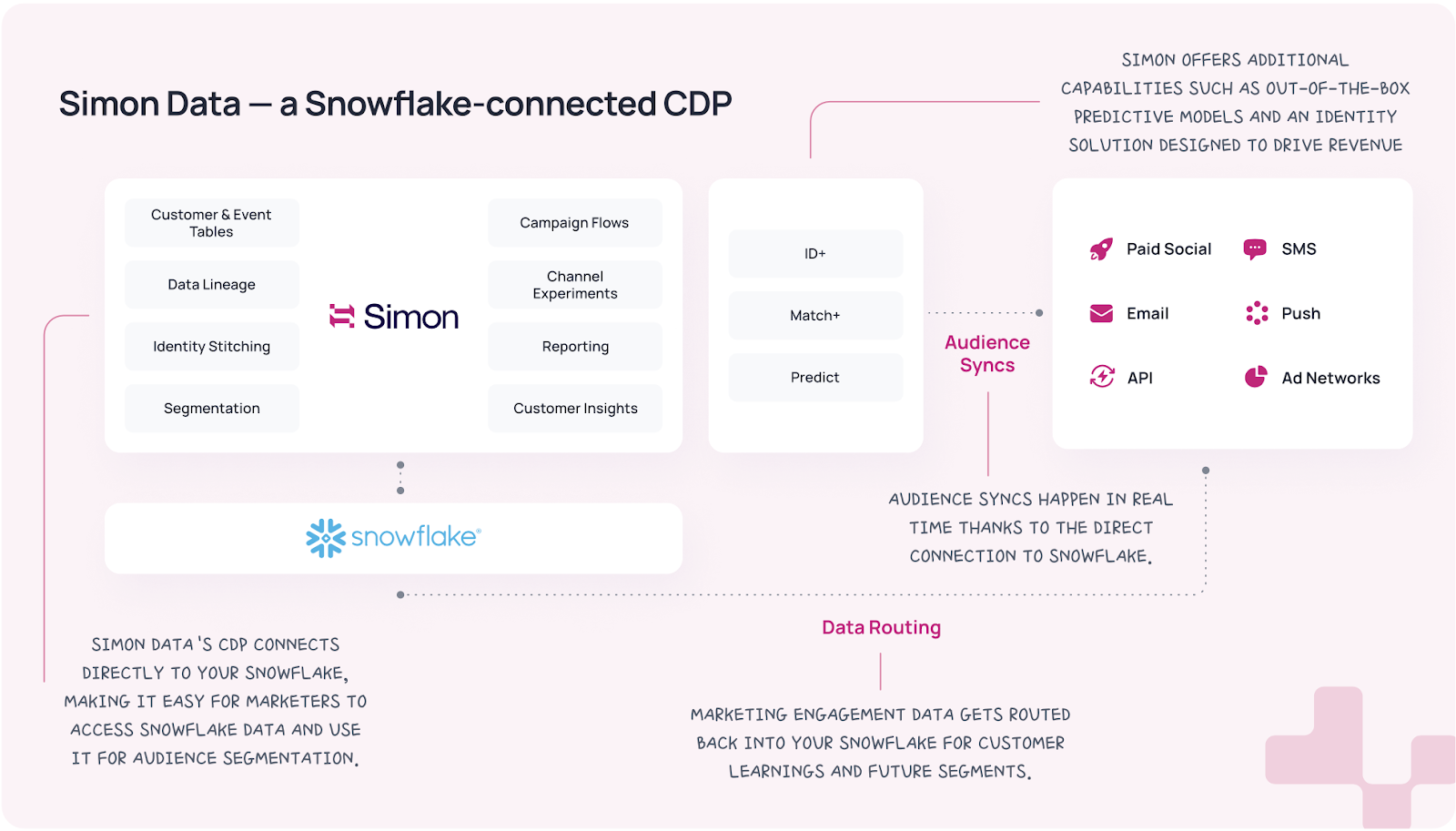
Here's how it works:
- Customer data collection: The CDP gathers behavioral data from multiple sources — your website, mobile app, email platform, in-store POS systems, and more
- Data unification: A CDP then combines this data with other customer information (like demographics and purchase history) to create a unified customer profile
- Analysis: The CDP analyzes this data to uncover patterns and insights
- Personalized customer segmentation: Based on the analysis, marketers can create detailed and customized customer segments
- Activation: Finally, a CDP makes this data and segments available to your marketing tools for targeted campaigns.
Let's say you're a sports equipment retailer. Your CDP might notice that a customer has been browsing running shoes on your website, has purchased running gear in the past, and recently downloaded your fitness tracking app.
It would combine all this information into a single customer profile, potentially segmenting this customer into a "running enthusiast" group. This segment could then send targeted emails about new running shoe arrivals or local running events sponsored by your brand.
Strategies for using behavioral data in personalized marketing
Now that we understand behavioral data and how a CDP uses it, let's explore ways to use it in personalized marketing efforts.
Behaviorally triggered emails
Set up automated emails that trigger based on specific customer actions. For instance, if a customer abandons their cart, send a reminder email with the items they left behind. If they've been browsing a particular product category without purchasing, send them a curated selection of top products.
Dynamic website personalization
Use behavioral data to customize your website for each visitor. If a customer frequently browses men's shoes, ensure the category is prominently displayed when visiting your site. If they've shown interest in sale items, highlight your current promotions.
Cross-sell and upsell recommendations
A CDP helps analyze purchase history and browsing behavior to suggest complementary or upgraded products. If a customer buys a camera, it can recommend camera accessories separately or in a bundle.

If they've been looking at premium versions of a product they already own, send them upgrade offers that provide a better customer experience while increasing average order value.
Behavioral segmentation for ad targeting
Create customer segments based on behavioral patterns and use these for targeted advertising. For example, create a segment of "high-value customers who haven't purchased in 3 months" and target them with a special "we miss you" campaign on social media.
Personalized app experiences
If you have a mobile app, use behavioral data to customize the in-app experience. If users frequently check the status of their orders, make the order tracking feature more prominent in the app interface.
Lifecycle marketing
Marketing teams can use behavioral data to identify where customers are in their lifecycles and tailor their marketing accordingly. Send welcome series to new customers, loyalty rewards to frequent shoppers, and win-back campaigns to lapsed customers.
Content personalization
Customize your content marketing based on customer interests indicated by their behavior. If a segment of customers frequently reads your blog posts about sustainable products, create more content on that topic and ensure it reaches them.
Best practices for leveraging behavioral customer data
While the benefits of using behavioral customer data are clear, you must implement your behavioral strategy thoughtfully and responsibly. By following these best practices, you can maximize the value of your behavioral data while maintaining customer trust and adhering to ethical standards. Let's explore each practice in detail.
Respect behavioral data privacy
Transparency in data collection and usage is more critical than ever. Always inform customers about what data you're collecting and how you plan to use it. Adhere strictly to data protection regulations like GDPR and CCPA.
Give customers control over their data by providing clear opt-in/opt-out options and easy access to their information. This approach ensures legal compliance and builds trust with your audience.
Focus on value exchange
Use behavioral data to give customers genuine value, not just increase sales. Every interaction based on this data should aim to enhance the customer's experience, whether through more relevant recommendations, personalized content, or improved service. Customers who feel they're getting value in exchange for their data will likely continue engaging with your brand.
Test and learn
Continuous experimentation is key to optimizing your use of behavioral data. Regularly test different approaches to personalization, segmentation, and targeting. Measure the results of these experiments rigorously, and be prepared to pivot based on what you learn. This iterative approach ensures your strategies evolve with changing customer behaviors and preferences.
Combine behavioral customer data with other data types
While behavioral data is helpful on its own, it becomes even more effective when combined with other types of customer and business data. Integrate behavioral insights with demographic information, stated preferences, and historical data to create a more comprehensive customer profile.
To sharpen insights, take it further and combine it with financial, ERP, or industry-specific datasets. The true power of behavioral data is unlocked when fully unified with the full breadth of data available in an organization’s data cloud. This holistic view enables even more precise and effective marketing strategies.
Enhancing customer insights and activation
Unifying behavioral data in your cloud data platform is a significant step to unlocking the actual value of behavioral data and ready to boost marketing performance, but it’s only the first step. For example, with Snowflake's and Simon's native genAI and machine learning capabilities, behavioral data ingested and unified within the platform can be analyzed to identify patterns, segment customers, and predict future actions more accurately.
A CDP like Simon Data can then seamlessly use this enriched data to create valuable audiences and run consistent campaigns across channels. Combining Snowflake's powerful data processing and Simon Data's robust marketing tools allows organizations to deliver personalized, contextually relevant experiences, driving higher engagement and improved customer retention.
Keep behavioral data in real time
The power of behavioral data lies in its immediacy. Ensure your systems can collect, process, and act on this data in real-time or near-real-time. With a cloud data platform like Snowflake and a CDP like Simon Data in place, you can respond to customer actions and needs as they happen, creating more relevant and timely interactions.
We’ve seen that real-time responsiveness can significantly enhance customer experience and increase the effectiveness of your marketing efforts.
Don’t overdo marketing personalization
While personalization can significantly enhance customer experience, it's important to strike a balance. Too much personalization can feel intrusive or "creepy" to some customers. Aim for a level of personalization that feels helpful and relevant without crossing into uncomfortable territory. Respect your customers' boundaries and give them control over how much personalization they receive.
Clean and validate your customer behavioral data
The quality of your insights depends on the quality of your data. Regularly clean and validate the behavioral data you're collecting to ensure its accuracy and relevance. Implement processes to identify and correct errors, remove duplicates, and update outdated information. This ongoing maintenance is crucial for maintaining the integrity of your data-driven strategies.
By implementing these best practices, you can create a robust and responsible framework for using behavioral customer data. The goal is to use this data to benefit both your business and your customers.
Review and refine your practices to stay current with evolving technologies, regulations, and customer expectations. With a thoughtful approach, behavioral data can become a powerful tool for creating meaningful, valuable, and lasting customer relationships.
Driving ultimate personalized customer experiences with Simon Data
Today’s customers demand more. For marketers, understanding customer behavior is no longer a nice-to-have — it's a must-have. By leveraging behavioral data through a powerful CDP like Simon, you can create marketing experiences that resonate.
Remember, the goal isn't just to collect data but to use it to create meaningful, valuable interactions with your customers. When done properly, behavioral data-driven marketing doesn't feel like marketing at all. It feels like a brand that truly gets you, anticipates your needs, and is there with the right message at the right time.
So, are you ready to use your customer behavior data? Your CDP is waiting, and your customers will thank you for it. Happy marketing!

Peak holiday sending season is just around the corner and you are most likely already making your preparations. If not, there’s still time to make sure your peak season sending is a success. Whether you are ready and raring to go or just now starting to prepare, this guide will make sure you are both set up for success and prepared to address any holiday surprises along the way by identifying the email marketing and email deliverability challenges you are facing, the risks that come with those challenges, and the tools you have available to address them.
The challenges of email deliverability during peak season
The massive increase in global email volumes during the holiday season puts stress on both mailbox providers and recipients. In order to accommodate this extra volume of incoming messages and also protect their users from mail that looks like spam, mailbox providers become less trusting of messages in general and more reactive to signals of spam–i.e. spam complaints, delivery attempts to bad addresses or full inboxes, and sender volume increases that presents as atypical.
The influx of messages from all manner of brands and senders can similarly tax the patience of recipients and lead to increased spam complaints.
Whatever signals a particular mailbox provider is reacting to, the typical consequences are one of two outcomes:
- Suspicious mail is refused for delivery and is blocked or
- Suspicious mail is quarantined to the spam folder or junk folder.
While neither outcome is good, and both mean your message didn’t get to the recipient, the good news is that negative email deliverability outcomes almost always have the same general causes:
- Delivery of messages to people that report them as spam,
- Delivery of messages to high volumes of recipients that are not positively engaging with your email, and/or
- Delivery to addresses that otherwise indicate the sender is not adhering to permission-based email marketing best practices such as sunsetting old, unengaged addresses and only sending to directly opted-in recipients.
The three levers for email deliverability control
As you continue developing your holiday marketing strategy, building in mechanisms that help you control for those key causes of negative email deliverability outcomes will lower your stress, prevent disaster, and empower you to deliver successful holiday results.
As a sender, there are essentially three general levers that you can ‘pull’ to prevent and repair deliverability problems:
Lever 1: Who you send to
Recipients mark messages as spam when they don’t feel like they’ve signed up for the messaging they are receiving from the sender they are hearing from. Sending relevant messages to recipients that have opted in directly to hear from your brand is the best way to limit spam complaints and ensure that your audience is engaged.
Lever 2: What you send
Messages that are relevant with clear calls to action and accessible, simple designs encourage positive engagement over time and helps to prevent spam complaints.
Lever 3: How often and for how long you send to recipients
A quick way to harm your sending reputation and your ability to get mail to the inbox is to send too much mail to recipients and/or too many messages to recipients who are not engaging with the mail. Make sure your sending frequency to individual recipients matches the freshness and relevance of your content. Also, limit sending to any addresses that have gone a long time without engaging. It is suggested to never send to an address that has gone more than a year without engaging positively with your email messages.
The remaining sections of this guide are designed to prepare and equip your email deliverability strategy for using the three deliverability levers to safely manage any anticipated sending period where volumes and/or results can be more volatile than normal.
What to do before the holidays
First, take inventory of your current email program and evaluate your email deliverability health.

Look at your email deliverability stats over recent weeks and identify any mailbox providers or domains where your results are out of line compared to other providers. For apparent inboxing/spam filtering problems, reduce your sending volume to the impacted provider(s) by adjusting targeting so that only your most engaged recipients receive from you until you see over performance. If you see issues where mail is not being delivered, look into bounce reasons for context on why and how to mitigate the issue.
Evaluate your templates to make sure the HTML is as tidy as it can be, that the designs are accessible for all audiences, and that your links are secured with HTTPS.
Avoid spiking your volume suddenly during the holiday season. Plan a few larger than normal sends prior to crunch time so that you never more than double your volume in a single day compared to your highest volume day in the last 30 days.
Next, create a sending calendar and outline goals for your campaigns. Build in breaks/off days where you are not sending anything. Things outside of your control can and do happen. Having off days allows you more flexibility to react to sending emergencies without overly endangering your reputation by sending too much mail.
Identify any relevant ‘deadline’ dates such as shipping deadlines and try to plan your content accordingly to avoid last minute “shipping deadline” campaign creation and sending.
“Warm up” your audience by teasing or previewing what to expect from you during the holiday season. Even when your mail reaches the inbox, having recipients actively anticipate your messages helps keep them from getting lost in all the other messages.
Define what success looks like and how you’ll measure conversions. It’s not sufficient to measure success by open and click rates because, as we know, those are not accurate indicators of marketing success.
Measuring conversions or other first party data points and comparing the results across mailbox providers can provide extra insight into whether performance issues are problems with conversion or with email deliverability.
What to do during the sending frenzy
Continually optimize the things you can control.

Targeting
While there can be a lot of pressure to drive the raw number of conversions upward by simply sending more emails, that practice also harms your ability to get future messages to the inbox as it increases the negative impact of sending to unengaged recipients.
If you must send to recipients who’ve gone a long time without either hearing from you or engaging with your messages, try to at least limit how often you target those recipients compared to your core, engaged audience.
It is suggested to never send to an address that hasn’t positively engaged with your email in over 12 months.
Content
Use your data to send more compelling, personalized content and offers.
The more tailored your content is to your recipient’s interest, the more likely they are to convert and to create positive email deliverability signals.
Send timing and recipient frequency
Don’t send exactly on the hour. Schedule your campaigns to start sending at times that are not exactly on the hour or the half hour. It can help your messages avoid high traffic congestion at mailbox providers like Gmail and Yahoo to have your campaigns begin sending at a time such as 9:12am rather than at 9:00am.
Schedule sends strategically
For example, instead of simply scheduling your campaign to begin sending at 9:00am, you could try sending to your VIPs/most engaged recipients first at 8:43am, your somewhat engaged recipients at 9:07am, and then finally to your lesser engaged recipients at 9:30am.
This means those most likely to want and engage with your messages are more likely to get them quickly and to generate positive signals. Those positive signals will help the remaining messages deliver more successfully and will help to postpone the bulk of negative signals mailbox providers see until the end of your sending.
Keep track of recipient messaging frequency
Ensure recipients are not being over-messaged as this drives spam complaints.
Pro Tip: Sign your personal address up for your own marketing.
Don’t expect zero latency delivery
Craft CTAs that are not overly time-bound as the time it takes for a message to reach a recipient from the moment your campaign begins sending can vary based on many variables – the size of your campaign and audience, any dynamic content, your sending reputation at each mailbox provider, and even technical issues that can occur on the mailbox provider’s side.
Monitor Vital Signs

Hard Bounces
Elevated rates of hard bounces tend to point to problems with your list hygiene. Are you sending to a lot of old addresses? Could you have a signup form that is being attacked by bots? The main goal is to address the source of the bad addresses as these are often accompanied by other addresses that also cause problems like complaints.
Soft Bounces/Blocks
First, look at bounce reasons for clues as to why the messages are being rejected. While not all bounce reasons are easy to read or even helpful, it’s often the case that ones related to your sending reputation or behavior will have language referencing ‘blocked,’ ‘blocklisted’ or ‘blacklisted,’ ‘spam,’ ‘spam content,’ or ‘reputation.’
Oftentimes, if you need to contact a third party to resolve the blocking issue, there will be a link to instructions in the bounce reason. Each third party has its own process for ‘delisting’ a blocklisted or blacklisted IP or domain.
Increasingly, reputation-based blocks require a change in behavior on your part before delivery issues automatically resolve. Adjust who you are sending to so that you are not sending to addresses that are likely to complain or have not engaged with your mail in a long time.
Low Open Rates
Seeing open rates significantly lower at some mailbox providers compared to others most often indicates increased filtering of messages to spam at the impacted providers. Target those mailbox providers with adjusted targeting that identifies only the most engaged recipients with the goal of reducing the volume by half or more until you see results begin to overperform.
Seeing open rates consistently low across all providers does not necessarily mean mail is going to spam. Sometimes, messages do reach the inbox but simply don’t generate many opens. Other times, there can be issues that obscure open tracking such as disable images or technical issues. If you feel most all mailbox providers are filtering your messages to spam, it’s critical that you make significant changes to how addresses are collected and who you are targeting so that you prevent spam complaints and only send messages to recipients that want them.
Spam Complaints
Seeing recipients mark the one of the first few messages from you as spam indicates recipients are receiving mail they don’t feel like they signed up for. Make sure everyone you send to has opted in directly and specifically to receive mail from the brand in the form information of your message.
Seeing spam complaints increase for recipients who have been receiving from you for some time often indicates that you are sending too much mail or that your messages have become irrelevant to recipients. Adjust how often and how long you send to unengaged recipients to limit the negative signals your mail is generating.
Gather insights
Understand Subscriber Intent
Be able to identify recipients that become new subscribers during the holidays as you may want to message them differently, especially after the holiday season.
Let subscribers take a break
If recipients are bothered by the amount or the content they are receiving from you, it is much better to honor their wishes and temporarily pause or reduce their frequency compared to them registering a spam complaint or unsubscribing permanently.
Document as you go
Keep records of your email deliverability stats by day or week so you can look back at them to understand:
- What types of offers/campaigns performed the best
- What types of volumes you were sending and how that impacted results
- How different mailbox providers treated your mail
- What types of sending tactics generated high complaint rates vs those that performed well
- Make note of any deliverability challenges and how you addressed them
What to do after the holiday season
Take time to recover and repair
If you ramped up holiday volumes and frequency over the holiday sending period, it is likely that your sending reputation across the different mailbox providers is not as healthy as it was pre-holidays.
Plan for a period of time in your marketing schedule to allow for more conservative targeting strategies that reduce your volumes somewhat while targeting your most engaged recipients. Focus your content and CTAs to be as compelling and engaging as possible.
Remember that recipients are tired, too.
Re-permission holiday addresses and newly reengaged addresses
It is likely that your subscriber list grew over the holiday season. However, not all of these subscribers are ones who are engaged with your brand year around.
Consider special messaging to those recipients that collects information about their interest. Offer an option to pause their email subscription until the next holiday season or just around holidays. If you see elevated rates of complaints among the cohort of new addresses, consider sending them a campaign asking recipients to take action to confirm their interest in receiving email from your brand.
Start preparing for next year
Write down what you learned, what worked, what didn’t work, and any other notes about the holiday sending season. Add those to a file along with your stat tracking and deliverability results. It’s amazing how helpful that will be in seven months when it is time to repeat all of this.
Consider what data points would’ve been nice to have going into this season and begin collecting them now.
Identify the point in the next year where you will begin your preparations for the 2024 holiday season while your perspective is still fresh.
Happy holiday sending!

Tis almost the season when the ghosts of past, present, and future roam the landscape, weaving their timeless tales of transformation and reflection.
The holidays are truly a magical time of the year, not only for consumers but also for brands and their marketing teams. For marketers, it’s the big dance - the final chance to increase sales before the end of the year. It’s also a golden opportunity to enhance your brand visibility, and engage with your audience in more meaningful ways. However, there's a catch – every brand knows this. With an avalanche of promotions, offers, and sales inundating the market during the 12 weeks between Indigenous Peoples Day and January 1, standing out is a challenge.
This is where behavioral targeting comes to the rescue. It's the modern-day equivalent of those spirits, guiding marketers to deliver the right message, in the right channel, to the right person, at the right time. In this blog, we'll explore how these strategies unfold, much like the lessons of the spirits from Charles Dickens' timeless classic.
What is behavioral targeting?
Before we get into the strategies we need to define behavioral targeting. It's a tactic that delves into the past, keeps an eye on the present, and even peers into the future – much like the spirits haunting Mr. Scrooge. Behavioral targeting involves tailoring your marketing strategies based on a user's behavior - past, present, or predicted.
Customer behavior can be defined by a range of activities, including website visits, searches, social media interactions, and purchase history. By analyzing these behaviors, e-commerce brands can gain valuable insights into their customers' preferences, needs, and intentions. During the holiday season, understanding and effectively utilizing behavioral targeting can be a game-changer for reaching your intended audience and driving the action you want them to take.
Behavioral targeting based on historical data
Targeting holiday shoppers broadly
Nearly every ecommerce brand has a list of customers acquired in the previous years’ holiday season and haven’t engaged with the brand since, OR are known to only shop during peak season. By tracking how customers have interacted with your holiday promotions in the past, you can create targeted campaigns based on preferences and include personalized offers, product recommendations, and trending holiday promotions. Be sure to warm up this list in the weeks leading up to Black Friday and Cyber Monday to avoid any deliverability issues.Recommended read: Simon’s 2024 email deliverability do's & don'ts during the holidays
Interest or wishlist-based campaigns
You can measure customers’ interest in a certain product or category based on a number of behaviors including product or category page views within a certain time frame, wishlist additions, engagement on social with product-specific content and even recent purchases. We suggest creating cross-channel campaigns that dynamically feature exclusive promotions on the products or categories that your customers have shown an interest in.
- Feature products they’ve engaged with multiple times on your site within the past 6 months
- Personalize discounts by featuring high price items that they’ve added to their ishlist
- Create a personalized shopping list featuring dynamic product recommendations inspired by previous browsing behavior, purchases and engagement.
We’ve seen this strategy deployed effectively in holiday countdown campaigns - i.e. 8 days of Hanukkah or 12 days of Christmas - where each day reveals a sale item tailored to a customer’s past product engagement.
Targeting customers based on their location
While not a behavior per se, location-based marketing uses a user's known location to inform a brand's interactions with them. The location data can be gathered across past interactions with the brand. The execution of this strategy can vary during the holidays, and often depends on the brand, the type of campaign, and individual user or cohort.Location-based targeting can offer a ton of value to brands with brick and mortar stores. For instance, you can set a geofence around a store location and trigger a push notification to customers in the surrounding area with a special offer to entice them to stop by. You can also use customer location to personalize the content of your email. DonorsChoose did a very effective Holiday email with a subject line and link that was dynamically personalized based on the customer’s location, within a certain radius. The email below was sent to customers within a 30-mile radius of the Boston area.

Use weather data

Similar to the previous strategy, you can use a weather API, such as WeatherAds, to personalize email, SMS, push and even paid social promotions to dynamically feature weather-appropriate products based on the customers location, or even trigger weather-specific campaigns. Your website is a great channel to deploy this strategy because it doesn’t require any dependence on 3rd party cookies. Pairing Simon's CDP with on-site personalization tools like Dynamic Yield enables our clients to further personalize the website experience with weather-specific imagery, and thus deploying a consistent strategy across all their digital marketing channels.
Targeting based on loyalty
Rewarding your most loyal customers is an excellent way to show your appreciation and keep them engaged with your brand. Build a segment of customers with the highest customer lifetime value and offer them exclusive discounts, free gifts, or early access to holiday sales. Optimize your outreach to these customers by analyzing their channel engagement across SMS, email and push and prioritizing the channel that they prefer.
Targeting trendsetters
Build a segment of customers that frequently engage with items marketed as new or popular. Send them targeted communications across email, SMS and paid social featuring hot or trending items, holiday gift guides and influencer-generated content to provide social proof.

Behavioral targeting using real-time data

Ensure your abandonment flows are optimized for holiday shoppers
In an e-commerce context, the definition of abandonment is relatively simple: did the shopper make a purchase, or did they leave your website? But if you dig deeper into the customer journey leading up to a purchase, you can quickly uncover that “abandonment” is an oversimplification of a much more complex set of customer behaviors along the path to purchase. This is especially true during the holidays.
Consumer behavior is fickle and oftentimes the abandonment trends you see during peak holiday shopping season can differ compared to other seasons. Recommended read: what behavioral economics and psychology says about customers during peak seasonThat said, abandonment events - abandon cart or abandoned browse - are a critical moment for brands. Most buyers who abandon a purchase right before hitting the payment button can be brought back via targeted communications. Here are a few strategies to consider:
Abandon Cart Strategies
- Shorten the time delays for abandoned cart notifications during Black Friday, Cyber Monday or any other major promotions.
- During BFCM, move the SMS touchpoint higher up in the journey to create more urgency.
- Use SMS to send any last minute updates, including end-of- sale or shipping deadlines.
- Overcome uncertainty by leveraging social proof and influencer generated content to encourage customers to come back and complete their purchase.
Abandon Browse Strategies

- Again, shorten the time delays for abandoned browse notifications during Black Friday, Cyber Monday and other time-sensitive promotional periods.
- Create a segment of frequent browsers - customers who have viewed a product detail page or category page multiple times. Send targeted communications featuring these products in the days leading up to and over the course of BFCM.
- Use flash sales. Alert customers who have previously viewed items of same-day flash sales on similar brands or products. Include low-inventory messages to double-down on urgency.
Optimize your post-purchase experience
Getting the customer to convert is great, but one-off orders don't make for great brand longevity.
Brand loyalty is not built on products anymore - and many brands fumble the ball when it comes to post-purchase experience - the whole journey from that first purchase to the moment your customer holds the product in their hands, to the next time they engage with your communications. The path towards becoming a loyal customer hinges on how you speak to your customers, how you make them feel, and what you do to keep that connection alive after that first deal is sealed.
Use SMS

According to Crazy Egg, SMS messages have a 98% open rate within the first 90 seconds of sending. This means if you're not using SMS in your post-purchase experience, you should. Here are some strategies to incorporate SMS into your post-purchase journey:
- Shipping alerts are highly effective during the holidays when customers will be stressing about ensuring their gifts arrive on time. Use SMS to let customers know when their order has been shipped and when it is out for delivery.
- Share relevant content to help customers get more value out of the product they purchased.
- Invite customers to your loyalty program and offer them credit towards their next purchase.
- Recommend relevant add-on products based on recent purchases.
Create a separate post-purchase experience for gift purchases

Source: BarkBox via Really Good Emails[/caption]If a customer places an order in during the month of December, adds a gift note, and ships it off to an address that's not their own - they're practically screaming "I'm sending a gift!" from the rooftops. And when brands treat these gift orders like any old regular purchase, they miss an opportunity to craft an experience that is truly relevant.Our suggestion? Create a unique segment and cross-channel journey for gift orders. But to do this, you need to first define what indicates a gift order.
- The order is for a gift card or gift subscription
- The customer has selected gift wrapping or added a gift note
- The customer has sent the order to a different shipping address
- The order is for a gift bundle created specifically for the holidays
- The purchased products were all part of a gift guide collection or gift-specific emails
Your first email should include a reference to the fact that their purchase was a gift. You may want to include relevant information about returns if there are any complexities there. Your next touch points - regardless of channel mix - should encourage the customer to shop for themselves and offer additional discounts. Brands that do this well offer customers a chance to indulge themselves. When they bite, that's your opportunity to show them the full shebang: the products, the experience, everything they missed out on the first time around.
Behavioral targeting using predictive analytics
Here we are in 2024, and it seems like everyone has suddenly become an AI expert - pontificating about its potential impact on business, marketing, and consumer behavior.
There's no denying AI's prowess in sifting through oceans of data and uncovering the dazzling patterns within has given brands newfound abilities to anticipate customer needs. But let's not get sidetracked by endless rhapsodies about AI's potential.
Regardless of what's to come in the future, the holidays are looming and marketers have a job to do now. Leveraging predictive models and algorithmic personalization enables you to deliver a customer experience that is--or damn-near close to--1:1. We've seen predictive models used effectively in the following ways:
- Recommend products - leverage predictive models to sort through customer profiles, engagement, behaviors and purchase histories. By uncovering patterns within this data, you can recommend products, or bundles of products to certain cohorts of customers that are likely to buy them.
- Target your best customers - If you know who your best customers are - be it based on attributes, lifetime value, AOV or a combination of these data points - leveraging lookalike models can help you attract more of the same, thereby lowering acquisition costs and increasing all the metrics that follow. (Pstt here's more information on how to optimize your ad spend with a CDP.)
- Pinpoint at-risk customers - Churn propensity models can predict the likelihood that a customer will churn by analyzing a variety of datapoints, including customer behavior, transaction history, demographics, and more. Once you've identified who's at risk, you can take proactive measures to retain them by offering specialized promotions.
In conclusion
As the 2024 holiday season approaches, remember that the magic of effective marketing is simple: by understanding your customers on a deeper level, you'll be able to connect with them in more meaningful ways. Behavioral targeting is a critical marketing strtegy for deploying data to unlock the potential of the holiday shopping season, allowing brands to create impactful experiences and memorable connections. As you embark on your holiday marketing planning, we hope you find these tips useful and and that they help you set the stage for a successful holiday season.
