Blog

Unlock true customer 360
Seamlessly unify and activate customer data from your cloud data warehouse and beyond.




Power 1:1 personalization
Deliver hyper-personalized customer experiences to forge deeper connections and transform casual customers into loyal advocates.

.webp)
.webp)

.webp)
.webp)


.webp)


.png)


Boost your bottom line
Discover the industry's latest tips, tricks, and trends to elevate your customer marketing strategies.






.webp)


.png)

.webp)
.webp)
.png)


.png)


Whether you're strolling by shops, navigating the labyrinth of online retail, or succumbing to the gravitational pull of TikTok's scrolling vortex, price-based promotions are inescapable. Discounts are a ubiquitous marketing tool, applied across all types of products and industries.
The allure is clear, even to the casual observer: consumers have a soft spot for a bargain. On the surface, the equation is simple: lower the price, and a stampede consumers will surely follow. It's the capitalist dream, isn't it? More sales = more money. But of course we know when prices dip too low, they start circling the drain toward zero. So while discounts may seem like a foolproof strategy to grab a larger slice of the market, most businesses harbor a faint hope of turning a profit at some point.
This begs the question: what is the optimal discount? Furthermore, how does price influence a customer's decision to buy, and how does it stack up against other motivating forces? To solve this riddle, marketers must turn to consumer psychology and behavioral economics.
The three types of prices
First, it’s important to define price in the context of discounts and promotions. There are three important types of prices that contribute to a consumer's purchase decision: reference price, reservation price, and asking price.
Reference price
This is a nebulous benchmark occupying your customers' minds as they consider a product. Some items have a specific reference price, while others summon a more generalized or vague idea.
Imagine, for example, the coffee you order every morning from the same café. You might have a strong reference price based on your past experience. You might also have a strong reference price when evaluating products you’ve researched extensively - such as cars, appliances, and houses.
But when you buy produce at the grocery store, however, your reference price may be more vague—a bag of clementines usually ranges between $1 and $1.50 per pound. If you see But when you buy produce at the grocery store, however, your reference price may be more vague—a bag of clementines usually ranges between $1 and $1.50 per pound. If you see clementines listed at $2.20 per pound, you might feel that they’re overpriced.
If you see clementines are listed at $0.25 per pound, you might have the thought that clementines are a great deal this week. Reference price is the lodestar by which consumers navigate their purchasing journeys. Yet, it can be problematic - derived from imperfect knowledge, incomplete information or misapplied context. Your past coffee orders have sculpted a firm reference price - you know that coffee shouldn’t cost any more than $2-$3 per cup.
'But then you find yourself at a specialty coffee store or chain, lured in by your desire to see if the pumpkin spice latte is actually worth the hype. Upon ordering your dairy delight, this misapplied reference price plunges you into a realm of sticker shock and may cause you to change course.
Five strategies to address consumer reference price when framing your discount:
- Show the original price when offering a discount.
- Include one very expensive item of the same category alongside more popular, reasonably priced items
- Include the price of similar products from more-expensive competitors
- Order items from highest price to lowest (e.g., on a menu board)
- Display the price near a larger number for perspective.
Reservation price
Reservation price is defined as the maximum amount a customer is willing to pay for a product or service. When a reservation price is well-known, it often converges with the reference price.
But reservation prices are influenced by many factors. That’s because consumers don't make purchase decisions based on price alone, but rather on their perception of the utility of the purchase. Utility is driven by the customers budget (the reservation price), expectations (the reference price), and cost (the actual or asking price, discussed next). But utility is also defined by the total value extracted from the purchase. This can be hard to quantify.
Additionally, there are other factors — convenience, desire, craving, available energy, and processing capacity among them — that might cause a customer to accept an asking price that is above their preconceived reference and reservation prices.
Because this is dependent on so many factors, increasing it is difficult — but here are some additional strategies to navigate around it
- Emphasize the quality of the product or service
- Differentiate the product or service with a compelling unique selling or value proposition
- Bundled items, features, or services to add additional value to the purchase
- Use social proof messages to increase the amount of satisfaction a customer expects
- Increase perceived urgency by making the product scarce or limiting the time a discount will be available

Asking price
As we already mentioned, the third type of price is the actual asking price. This is the price that the business demands for the product or service. Obviously, this is the price that marketers have the most control over. However, constantly lowering the asking price will eventually lead to a product priced at or below margin. Lowering the asking price has several other undesirable effects on consumer attitudes and behaviors towards the product and the brand.
The important thing to keep in mind in the context of promotions, is that how you price your products communicates volumes to your customers. A product that is priced below all other competitors sends a signal that it may be cheaper, but is likely of lower quality.
A product that is perennially discounted will ultimately change your customer’s reference prices for the product. A common product that is more expensive than competitors without a clear unique selling proposition will seem overpriced. However, shift the value proposition and all of the sudden, your price may suddenly seem reasonable and appropriate.
None of these effects are inherently bad. Rather, they simply illustrate the influence price has on consumer perceptions and the importance of determining price and planning your promotions with intention.

What behavioral economics says about discounts & consumer behavior
So by now you know the 3 types of prices: reference price, reservation price, and asking price. Based on these definitions, it’s clear that a customer's perception plays a critical influence on their understanding of price, value and therefore, willingness to purchase.
There are a ton of academic studies on this evolving dance - all driven by behavioral economics. Behavioral economics is a field that combines insights from psychology and economics to understand how people make decisions - including buying decisions. There are many principles Anchoring suggests people often rely on the first piece of information they receive when making decisions.
When setting discounts, the reference price (anchor) can heavily influence your audiences’ perception of value. For example, showing a higher original price before displaying the discounted price can make the discount appear more significant.

Loss aversion: People tend to weigh potential losses more heavily than equivalent gains. When offering discounts, framing the discount as a way to avoid losing money or missing out on a deal can be more effective than framing them as gains. For instance, "Save $50" can be less persuasive than "Don't miss out on a $50 discount."
Scarcity and urgency: A psychological cousin to loss aversion! Creating a sense of scarcity or urgency can prompt customers to take action. Limited-time offers, countdown timers, or statements like "Limited stock available" can tap into this principle. Customers may feel compelled to buy sooner to avoid missing out.
Endowment effect: People tend to overvalue items they already own. Offering a discount can make customers feel like they are "gaining" something, even if they are just paying less for it. Emphasizing the potential ownership or use of the product can capitalize on this principle. Probably the most iconic example of the endowment effect at play is the mattress industry’s broad application of offering 100-night free trials to new customers. By the time the trial ends, customers feel an attachment to the product, making them more likely to keep their purchase.

Social proof: People often look to the behavior of others to guide their own decisions. Highlighting customer reviews, testimonials, or the popularity of a product can influence potential buyers, particularly when faced with many items to choose from. Leveraging social proof can be as simple as relying on influencer-generated content for social media ads, as seen in the below example. Another tactic that draws on this principle would be featuring "Best Selling" items or "Customer Favorites." For higher priced items, using social proof effectively can also raise a customer’s pre-conceived reference price.

Decision fatigue and choice overload: If you offer too many choices, customers will become overwhelmed and are mostly likely to not purchase anything at all. Combat this by offering a limited number of well-structured discount options to reduce decision fatigue and make it easier for customers to choose.
Processing fluency is distantly related to choice overload. This principle says when it is easy for people to understand and interpret information, it makes them feel better about the product they are considering. In the context of promotions, this means that discounts that are easy to understand (and mentally calculate!) leads to happier prospects that are more likely to purchase. Some common tactics for this include ordering prices such that the lowest are on the left and the highest are on the right to make the series easier to read. Using color or text effects to support easy comparisons, and increasing the size or visual salience of important information to make it stand out.
Bundling: Combining products or services together and offering a discount for the bundle can make the overall purchase more appealing. This approach leverages the principle of perceived value and can encourage customers to buy more.

Gamification: Adding elements of gamification, such as loyalty programs, rewards points, or referral bonuses, can encourage repeat purchases and customer engagement. These strategies tap into the pleasure customers get from achieving goals and earning rewards.
The battle between dollars and percentages
We know that how a discount is presented can significantly impact its perceived value. A common question is whether price promotions should be presented as an absolute discount (e.g., "$2 off") or a proportional discount (e.g., "20% off").
Framing discounts in terms of percentages can make them seem larger and more attractive. Research has found that both of these approaches increase sales. Getting into the nuances of the studies reveals that discounts expressed as percentages may be more effective overall, but dollar-based promotions have more sway over discount-hungry customer segments. Ultimately, this is something you should test heavily among different customer cohorts and across different types of promotions before concluding one way or another.

The path forward
Look at any online purchase journey and you'll immediately note that there are often many behavioral economics principles at play at the same time. Applying the optimal combination of behavioral economics principles requires further research and disciplined testing to understand what motivates different sets of customers to make a purchase.
It's important to note that the effectiveness of the application of these principles can vary depending on the specific context, audience, and product. We always recommend testing and analyzing the impact of different behavioral economics principles through A/B testing, customer research and feedback to refine your approach over time. In the end, discounts are a powerful tool when wielded effectively, but their impact goes beyond just lowering prices.
It's about shaping consumer perceptions, influencing purchase decisions, and ultimately, building lasting relationships with customers. Marketers that have a deep understanding of customer behavior, have planned carefully, and have a library of experiment data to inform their discount strategy will be better equipped to thrive in their category.

We’re thrilled to announce a brand-new integration between Simon Data and The Trade Desk, powered by Snowflake.
Now, Simon customers can use our no-code application to create segments using customer data in your cloud data warehouse and then send those segments to The Trade Desk for programmatic activation. The results are lightning-fast integration without relying on third parties for identity syncing and matching, increased acquisition rates, and better spend efficiency, further boosting the outcomes of your segmented campaigns.
So why does that matter?
The Trade Desk is a leading advertising technology platform that helps businesses reach their audience online. They boast a marketplace of over 400 partners providing premium inventory from the biggest broadcasters, publishers, and supply-side platforms. For example, they can reach over 150M households through Connected TV alone. This allows companies to buy digital ads in real-time, targeting the right people at the right time to maximize the effectiveness of their advertising campaigns.
Using first-party data is more essential than ever for effective paid advertising. Using data from your best customers helps you find similar prospective customers for your campaigns. By applying exclusion lists of known customers, you can have confidence that your acquisition budget is spent on finding new customers, not engaging existing ones, and wasting ad spend.
Simon Data now makes it easier than ever for marketers to onboard first-party data to The Trade Desk’s Unified ID 2.0, and we even handle the legal paperwork required by The Trade Desk, further accelerating time to market.
Within hours of setting up the integration, first-party data fed from Simon Data can create seeds from known customer segments like your most engaged or highest LTV customers faster than any other solution.
“The Trade Desk <> Simon Data integration was a huge unlock for both our lifecycle and growth teams at Bonafide. Before the integration, we were manually hashing and importing our lists into The Trade Desk on a weekly/monthly basis. Now, we’re live with 10+ audience streams (syncing daily) to The Trade Desk for lookalike, exclusion, and hyper-targeted strategies...and it took just under 10 minutes to deploy! This integration is yet another beautiful example of how Simon Data can play a central role in supporting all functions of an e-commerce business.”
- Tyler Hill, Sr. Specialist Lifecycle Marketing @ Bonafide Health
Digging deeper into The Trade Desk partnership
Simon has long supported acquisition use cases by passing first-party data audiences to all major paid media platforms.
With the Trade Desk being such an innovative platform, we decided to take a creative approach to data onboarding. Utilizing a snowflake-based integration allows us to pass data at latencies that are out of reach for partners that use API-based approaches. Additionally, this approach limits data movement over APIs. In North America, Simon Data signs theUID2 paperwork on behalf of the customer, eliminating significant legal hurdles and facilitating smoother client adoption.
This deep access to first-party data significantly enhances customer acquisition strategies on the Trade Desk platform, driving higher value from campaigns. It is also required to unlock future opportunities through the Trade Desks AI solutions, Kokai, and Galileo.
But the first-party data journey doesn’t end here. With TradeDesk’s REDS (Raw Event Data Stream) product, customers can now access impression, click, and conversion data per customer across their Trade Desk campaigns, and this data is immediately available for use in the Simon CDP.
With it, you can better analyze attribution on spending across your paid and owned marketing and understand how customer segments respond to various advertising campaigns. You can then use this information to more effectively target your strategy, unlocking a data flywheel that will drive a sustainable return to your business.
.png)
Taking the data further with Simon Match+
If you have experience using tools to onboard first-party data onto advertising platforms, you know how vital match rates can be to achieving your goals. This is especially critical when deploying suppression use cases, where ROAS directly relates to one's ability to match a customer in the downstream tool, but it’s also essential for retargeting and lookalike use cases.
If you’re new to match rates, no worries. It's pretty straightforward, and here’s a quick introduction.
How is match rate defined?
Match rate % = (# of customers in downstream advertising audience)/(# of people in the audience in the CDP or tool hosting the first-party data).
How does this help me?
A higher match rate generally indicates a healthier and more effective integration. And by that measure, our integration with the Trade Desk looks good. With The Trade Desk’s UID2 network, we see match rates of over 60%. However, by leveraging our Match+ product, we see match rates of 80-90%! To see how that can impact ROAS (Return on Ad Spend) check out this example of a targeted promotion for new customers:
By using Match+ to amplify the size of your exclusion audiences, you can ensure that the money you spend on acquiring new customers targets actual new customers on these more expensive channels. The result is a direct increase in your ROAS.
.png)
Ready to get started?
If you’re an existing Simon customer, contact your Account Manager and ask about our new integration with The Trade Desk.
If you are not a Simon customer but are interested in learning more, request a demo here.
Recipe!
If you’re an existing Simon customer and have been onboarded to The Trade Desk, check out this recipe:
Goal:
Maximize performance in The Trade Desk by passing an audience of high LTV customers as a lookalike seed.
Prerequisites:
- The Trade Desk integration
- Segment building knowledge
- Flow building knowledge
Step 1: Create a segment of high LTV customers
You can do this by selecting a property filter of that segment.

Step 2: Create a new Flow for this segment
Select The Trade Desk as your destination.

Step 3: Save then launch the Flow
It will be ready in The Trade Desk in less than 24 hours. To further increase your spend efficiency, get Simon Match+ to enrich your audience with additional identifiers and increase your match rates by over 20%!
.webp)
Why another CDP roundup?
When talking to customers about selecting a CDP, the first question that stumps most buyers is: How do I compare all these options?
According to the CDP Institute, there are over 175 vendors worldwide. With that many options, it's natural to be overwhelmed. No one wants to read a comparison of 175 CDPs, so we took a different tack: covering popular CDP use cases and highlighting a vendor that excels in each business use case.
Tealium: Best for data collection and pipelines
Born from a tag management background, Tealium is a flexible platform for enterprise organizations looking for a CDP to help them with data collection. The core application is focused on collecting quality data and then moving that data to an end application, whether a marketing channel, ad network, or cloud storage option.
Over time, Tealium has expanded its offering to focus on other in-session personalization and data enrichment use cases, complementing its strong ability to move customer data.
Tealium also supports a wide range of connectors and integrations with other applications, making it easier to access customer data from a locked-away system and into somewhere it can drive value.
Many of the reviews on G2 discuss event listening and streaming use cases favorably, and companies looking to unify customer event-level data and then move it to other systems would be wise to evaluate Tealium.
However, others call the system complex and complicated to learn, highlighting the need for a more technical user. Reporting is also highlighted as something that is limited with Tealium.
Treasure Data: Best for multi-brand customers
Treasure Data started first as a Data Warehouse application. Its history provides the application with the scalability to handle massive amounts of data within its application. This is especially important for large multi-brand companies that collect multiples of data across their multiple organizations.
As a standalone CDP, Treasure Data requires all customer data to be brought into their internal data warehouse, which could benefit organizations that don't have an extensive data infrastructure or don't want to manage the data layer.
Businesses that would rather control access to sensitive customer data must look at a different type of CDP. Storing all customer data natively within the Treasure Data system creates a separate source of truth from a company's existing data warehouse, leading to data duplication and potential inconsistencies.
G2 reviews for Treasure Data lean toward the technical user, especially data engineers. While there are fewer connectors than Tealium, and the number of integrations is called out as a con, many users highlight being able to connect to their primary marketing tools.
mParticle: Best for mobile and real-time
Real-time has always been the name of the game with mParticle. It offers a robust SDK, allowing companies that depend on real-time in-app experiences to leverage mParticle as their CDP of choice. This flexibility for real-time use cases is important for transactional and short-decision transactions, which is why a company like Burger King uses them in their tech stack.
The tradeoff is the inability to manage large amounts of batch or other enterprise non-streaming data. If your organization needs to build segments of activities and events that just happened, then mParticle might be worth looking at.
Still, when you want to layer in a deeper understanding of customer profiles, demographics, and complex segmentation, you might struggle to get what you want out of mParticle.
G2 highlights strong capabilities around tagging and event capture but highlights caution around integration challenges, limitations in data management, and customization.
Hightouch: Best for technical DIY
Reverse ETL (rETL) is a term that describes extracting data from a data warehouse, transforming it, and loading it into some other business system. That process alone can be beneficial, but it's not enough to be a full-fledged CDP, and that's the core offering that Hightouch offers the market.
Hightouch has published controversial articles (The CDP is Dead and Friends Don't Let Friends Buy a CDP) covering this topic. Yet, only over the last couple years have they started building more and more functionality to gain parity with other CDPs, including the ones on the list.
Suppose your organization is mature and adept at managing a cloud data warehouse and needs a simple tool to move data out of the warehouse. In that case, Hightouch might be the perfect application. It's a cost-effective way for data engineers to move data around.
G2 reviews are often focused on Hightouch's ability to connect two systems, but there are many issues and complaints around syncing, which is supposed to be the core offering. So, while using Hightouch might save your data team time, the business value of a full CDP might be missing from this choice.
Simon Data: Best for marketers
Obviously, we can't have a CDP roundup without including our product — it’s practically in the laws of the SaaS blogosphere that we include ourselves. But like the other CDPs on this list, we're not the right choice for every situation.
Simon Data is built as a campaign-focused CDP that sits on top of a customer's cloud data platform and unlocks the value of that enterprise data for the marketing teams.
When organizations invest in cloud data warehouses like Snowflake, the business value of consolidating enterprise data is compelling. But having the ability to activate that customer data for marketing personalization is challenging.
Simon brings that help through a marketer-friendly interface that doesn't require data teams to give up access or control, which is a win for both teams.
Focusing on the campaign side, Simon allows teams to build robust customer journeys, activate data to communication and ad channels, manage complex experimentation and segmentation, and drive personalization.
Organizations who don't want a third-party email platform also look to Simon Data for its integrated Simon Mail application, allowing marketers to build email and SMS content and then deliver it from within the CDP.
G2 reviews from marketers appreciate the bundled approach to email and customer marketing but highlight that more connectors and integrations should be added.
Adobe & Salesforce: Best if you're already stuck with the large marketing clouds
Adobe and Salesforce will never disappear, but that doesn't mean you have to live with them. We know that many organizations consider themselves "Adobe or Salesforce shops,” and that culture alone drives the decision for a CDP.
But going all in on one vendor in a space with enough options to pick what's best for your company is not always the right choice.

How to choose the right CDP?
So, given the information above, how should you choose the CDP that's right for you?
First, download our CDP RFP template. Then, read our CDP Buyer’s Guide or our Snowflake + CDP Guide, which go into more detail about the CDP space and business benefits.
Assuming you already have leadership buy-in (if not, here’s how to convince your boss you need a CDP), be honest about your potential CDP use cases.
Understanding how you plan to use it today and in the future is key, but don't overestimate your needs until you've evaluated multiple options. Shiny objects can have you chasing features you don't need to be successful.
I always suggest an organization talk about what it can't do today first, then talk about what you'd like to be able to do. If you can start filling the gaps in your campaigns and workflows, then the CDP will be an ROI-positive investment much faster than focusing on what you might do in the future.
Finally, book demos and meet the teams. In our experience, many successful implementations come down to finding a team that understands your business and is willing to help you find the path to success.
After all, if you don't connect with them during the demo or they focus only on showing you a flashy art of the possible, will implementation and future ongoing customer support be much different?
Conclusion
Ultimately, the right CDP for your Snowflake-powered enterprise depends on your specific needs, technical capabilities, and long-term data strategy.
Whether you prioritize marketer-friendly interfaces, robust data collection, or seamless integration with your existing tech stack, a CDP solution can help you unlock the full potential of your customer data.
By carefully evaluating your options and aligning them with your business goals, you can choose a CDP that complements your cloud data platform investment and drives tangible business value through enhanced customer experiences and data-driven decision-making.

Social media has often been viewed as a retailer’s marketing channel, but with customers demanding more personalization than ever from D2C brands, social media has become a digital storefront, a customer service desk, and a community hub rolled into one platform. As platforms evolve and consumer behaviors shift, staying ahead requires more than just posting regularly or running the occasional ad campaign.
That’s why robust segmentation, audience knowledge, and personalized customer experiences are more important than ever. This post will dive into key elements of social media strategy that drive results. Whether those purchases happen in-app or on your website, a Customer Data Platform (CDP) can help you build your audience knowledge, design campaigns, and measure your efficacy.
Understand your audience inside out
You wouldn’t launch a product without understanding your target market, right? The same goes for your social media strategy. To start, leverage social listening tools within your MarTech stack to monitor conversations about your brand and industry. What are people saying? What problems are they trying to solve? Analyze your competitors’ social presence to understand where they are winning — and losing — in the market.
Remember: different platforms attract different audiences. The age, gender, estimated purchasing power, and market segment of your target audience will often determine where on social media is best to reach them.
Use platform-specific metrics to understand where to find your audience and how they behave. You may discover your Facebook followers crave detailed product information, but your TikTok followers love behind-the-scenes product videos.
This research, combined with accurate zero-, first-, and third-party customer data and your CDP, will help you create Customer 360s that go beyond demographics. They help gather general insights into your users’ online behavior, preferred social networks, and additional context on their interests and preferences. In aggregate, you can quickly understand whether short video content on TikTok or a strong visual brand aesthetic for Instagram will attract your customers and plan work accordingly.
Once this information is in place, you can create segments accordingly and personalize messaging to each segment. Rather than guess which segments will be interested in your products demographically, you can leverage psychographic information to demonstrate precisely how well you know your customers and serve them only what they are interested in.
Conversely, you may already know where your customers spend their time online but are curious about how to message across those channels to create an omnichannel experience. A CDP can help you tailor your messaging for each platform, and the specific audience you know interacts with your brand on that platform.
Create compelling content for social media marketing
Whether you have a strong following on one platform or customers are split across platforms, you can use a CDP to help determine how to prioritize your channels and when and whether to repurpose content and tailor your approach to each platform.
If you market to Gen Z audiences and have aligned your brand strongly with modern aesthetics, it makes sense to grow an audience on TikTok, where trends most frequently arise, and you can capitalize on them quickly.
Once you’ve created videos, you can also identify secondary markets that fit your persona’s behavior: an effective strategy many retailers have chosen is repurposing TikTok videos to Instagram Reels to reach younger millennials.
This works primarily because of commonalities among users of both TikTok and Instagram — using an example of a fashion retailer, similar content should perform well on both TikTok and Instagram because both platforms prioritize fashion content, and the purchasing habits of both groups indicate that social media plays a large part in influencing purchasing decisions.
Another strategy some take is offering special discounts to your social media followers in exchange for a deeper connection to them, such as providing 10% off first orders when you sign up for an email newsletter or survey.
Harness the power of influencer partnerships
There’s plenty of buzz around influencers — and for good reason. Influencer marketing on social media is a powerful tool when used right. First, look for influencers who align with your brand values and have an engaged audience that matches your target demographic.
Influencer marketing is where you can get creative. Consider product seeding, co-created content, affiliate programs, and account takeovers. For example, you can partner with a skincare influencer to create a 30-day skin transformation challenge using your products.
Here’s where you can get creative. Consider product seeding, co-created content, affiliate programs, and account takeovers. For example, you can partner with a skincare influencer to create a 30-day skin transformation challenge using your products.
If you’re using influencer marketing, measure reach, engagement rates, sentiments in comments, and, most importantly, conversions.
Optimize paid social advertising
Organic channels are essential to any marketing strategy, but to move the needle, consider paid advertising strategies. Every social media platform offers ads as another way of reaching people who fit your target audience but may not necessarily follow you or be aware of your business.
Some successful paid strategies include retargeting users who have shown interest in your products but haven’t converted or recently abandoned their carts or using interest-based targeting to reach users who follow competitors or relevant influencers.
Once you know where your ideal audience lives, you can choose ad formats that showcase your products best on each channel. Video ads can demonstrate product use and results, whereas Instagram Story ads can offer immersive experiences.
Next, get smart with targeting. Using your MarTech stack and CDP, you can identify anonymous and unknown users on your sites, create lookalike audiences based on your best customers, and segment accordingly. Some successful strategies include retargeting users who have shown interest in your products but haven’t converted or recently abandoned their carts or using interest-based targeting to reach users who follow competitors or relevant influencers.
The key is to continuously test your messaging and channels. Compare different ad copy, visuals, CTAs, and landing pages, then let the data guide your decisions. With the right strategies in place, you can track ROAS, take advantage of the boost in visibility from a successful initial campaign, and iterate.
Build a thriving community on social media
Social media goes beyond broadcasting your product. Nowadays, consumers want to be engaged with and entertained by tailored content. Set up systems to ensure timely responses to comments and messages. Some brands rely on chatbots for instant responses to common queries.
Encourage and showcase user-generated content, such as creating a branded hashtag or featured customer stories. This makes your customers feel valued and provides social proof for your brand. Finally, foster engagement with interactive content. Polls, Q&As, and challenges can get your audience engaged, and the more they interact with your brand, the more connected they will feel.
Refine your audience personas
As you build rapport with your target audience using your initial content strategy, your CDP will gather additional data points on their interests. There is a difference between people interested in fast fashion and those who are interested in sustainable fashion, also known as “slow fashion.”
You can use this information to create better-targeted ads. To generalize, someone who shops fast fashion may not be swayed by an ethically sourced and handmade quilt coat like someone interested in slow fashion might be.
If you’re using a Cloud Data Warehouse and CDP together, your customer data will help showcase customer preferences. They can also offer insights into which factors in a user’s life may determine their purchasing habits, buying power, and when they tend to purchase more frequently.
You can use this information to craft personalized content that helps your audience better understand their alignment with your brand, such as emphasizing the cyclical nature of your clothing business to a slow fashion audience or your commitment to stylish clothing made by workers who are paid a living wage.
You can also offer discounts timed for the moments in an audience’s purchasing cycle to incentivize purchases before specific events like weddings, school seasons, or seasonal changes.
Activate and respond to insights in real time with a CDP
CDPs can revolutionize your real-time audience insights. Simon’s identity resolution feature, for example, can help you pair known customer profiles with your website traffic. It allows you to target better and message customers who abandon their carts or have visited a specific product page multiple times.
With this information, you can set rules to trigger pop-ups or emailed discounts when someone has visited a product page more than three times in a month. Simon’s out-of-the-box predictive models can also help you determine who to send such an offer and when to deploy those offers.
You can also nudge a prospective customer into purchasing something they have considered on your site by running ads that feature that specific product. For example, an ad could show someone how to style a garment they’ve been looking into, by either offering styled outfits or videos from influencers you work with, showing how they’ve incorporated the garment into their wardrobe.
A CDP can also give you insights into when campaigns derail. If a campaign reaches an unintended audience, you can rein it back in to protect your engagement data and more accurately measure reach. It can also offer you information about why the campaign derailed — perhaps an influencer in multiple markets cross-posted something, or a common hashtag was repurposed and gained new meaning.
Even if the answer isn’t as obvious, figuring out what does work will be easier with a CDP, as you can access other insights into your customer’s interests and desires to design toward.
Measure and improve social media marketing strategies
Your social media marketing strategy shouldn’t be set in stone. Use your CDP and data to continuously refine your approach. Track key metrics like engagement rate, conversion rate, and customer acquisition cost (CAC). And don’t just collect data — analyze it. Look for trends and insights that can further inform your strategy.
The best part about using a CDP is its all-in-one nature: once you build a campaign, you can track your social media ROI using CDP analytics. For both short-term and recurring campaigns, you’ll build a knowledge base about your customers’ behaviors that is accessible in the CDP and can therefore feed back into your segmentation model.
For example, a cohort of customers that regularly interacts with your social media can be suppressed from ads in their feed. Similarly, you can identify customers with a high LTV and remarket to them easily — and specifically — by designing new programs or offerings that are tailored to their buying habits.
All of this can help reduce your customer acquisition cost and encourage repeat purchases — while your existing campaigns are still running.
Conclusion
Creating a successful social media strategy for your brand isn’t about jumping on every trend or being on every platform — and figuring out where and when your customers are most likely to make purchases doesn’t need to be complicated.
Using a CDP like Simon Data’s can streamline insights into your social media presence by providing a single source of truth about how your customers are interacting with your content, which allows you greater flexibility when designing campaigns and can strengthen your segmentation. This means you can personalize marketing experiences, offer only the most compelling deals at critical times, and iteratively refine your strategy as you learn more about your audience.

Believe it or not, the holiday shopping season is right around the corner, and marketers are under pressure to deliver winning campaigns that drive sales and engagement. Black Friday and Cyber Monday (BFCM) present a unique opportunity to kick off the season on a high note—but only if you have the right data and insights to fuel your strategies.
At Simon, we can help. Our CDP empowers marketing teams to transform their BFCM approach and drive more revenue by unifying offline and online customer data, gather real-time insights, and activating segments that create the personalized experience customers crave.
From leveraging Black Friday purchase history to building smarter audience segments, you'll discover proven tactics to maximize your holiday sales and engagement. This post delves into how Simon Data empowers marketing teams to harness Black Friday's in-store point-of-sale (POS) data and forge it into Cyber Monday's success.
Still marketing BFCM the old way? It's holding you back.
If you're still wrestling with siloed data and sluggish insights, you're fighting with one hand tied behind your back. Siloed information across online and offline channels cripples personalization efforts.
During BFCM, delayed in-store and point-of-sale data limits your marketing responsiveness to critical customer engagement, such as real-time purchases, abandoned carts, and customer trends — a recipe for missed business opportunities and wasted resources.
Unlocking in-store data for actionable insights with Simon Data
We all know the struggle of juggling in-store and online customer data. That’s why we built Simon — it’s a powerful CDP that seamlessly blends your in-store POS information with online customer behavior.
The result? A clear, comprehensive view of your customer's journey that you can actually use. Here are the biggest benefits of using the Simon Data CDP during BFCM.
Real-time data integration
Simon stands out by seamlessly integrating in-store POS data from tools like Shopify’s POS System, with online and other customer data sources, empowering marketers to take immediate action based on the most current customer interactions, both online and in-store.
Unified customer profiles
By creating a single, unified view of each customer, Simon Data CDP enables hyper-personalization at scale.

This comprehensive profile (what we call a customer 360) includes online browsing history, purchase records, and in-store interactions, providing a complete picture of customer behavior and preferences.
Advanced segmentation
Simon Data CDP's advanced segmentation capabilities allow marketers to create laser-focused audience segments based on real-time in-store behavior and online interactions. This granular approach ensures that each customer receives the most relevant and timely communications on their preferred channels during the critical Cyber Monday push.
How to use Black Friday in-store customer data for Cyber Monday personalization
The Black Friday rush can leave marketing teams scrambling to keep up, let alone deliver personalized experiences. But what if you could transform that in-store frenzy into a strategic advantage for Cyber Monday?
With access to accurate in-store data, marketing teams can create highly targeted campaigns that drive engagement and boost sales. Here are some of the ways our customers use the Simon Data CDP during the holiday season.
Creating personalized campaigns that drive engagement
Using Simon’s CDP, customers can easily analyze Black Friday in-store activity to identify customers who've already purchased or wishlisted specific products.
Then, they can craft exclusive Cyber Monday offers that complement these purchases and send out email and SMS campaigns through MarTech tools like Attentive, creating a seamless shopping experience that makes customers feel like VIPs.
Building smarter lists to maximize ROAS
BFCM calls for plenty of spending on paid media. But spending on paid channels without seeing a return is a marketing team’s nightmare. Simon’s CDP helps marketers create precise exclusion lists, ensuring they don’t waste budget on irrelevant ads and Cyber Monday campaigns reach the right audiences with the right messages.
Staying ahead of BFCM with real-time campaign optimization
With Simon, marketers can monitor and adjust Cyber Monday campaigns on the fly. A CDP ensures marketing teams are not just reacting to trends — they’re setting them while ensuring their efforts remain relevant throughout the day.
Tips for advanced BFCM segmentation with Simon Data
Simon Data's advanced segmentation capabilities go beyond basic demographics and purchase history — and even Black Friday. By analyzing customer interactions across channels, our customers create:
Location-based personalization that bridges online and offline customer experiences
With Simon, marketers can target customers within specific radiuses of their physical stores. Brands can promote local inventory, highlight nearby deals, and create a cohesive omnichannel experience that drives both online conversions and in-store traffic.
Make seamless product recommendations
During BFCM, identify customers who browse online but prefer to purchase in-store. Then, deliver email campaigns that seamlessly blend their digital and physical shopping experiences.
Simon allows brands to include additional contact properties or contacts events in content for email campaigns that create a cohesive in-store and online experience for their customers. Here’s an example:
Let’s say a customer purchases a cooking appliance in person in-store. Simon Data then receives an event showing the different SKUs that the customer purchased in-store (i.e., an espresso machine).
Simon then triggers an email that references the espresso machine and surfaces adjacent product recommendations (i.e. espresso kit accessories, such as a tamper and portafilter) for the customer to buy.
Suppress recent purchasers to optimize paid media spend
BFCM can easily lead to wasteful ad spending if it’s not managed carefully. Simon Data’s CDP gives marketers the power to avoid this pitfall by identifying and suppressing recent purchasers from paid media campaigns.
Let's say you notice a spike in in-store sales for a particular product line during Black Friday. Simon's real-time data integration allows you to quickly create an exclusion list of these recent in-store buyers.
You can then apply this list to your Cyber Monday paid search, programmatic acquisition marketing (think The Trade Desk or Criteo), and social media channels like TickTock, Snapchat, and Instagram — ensuring your budget is focused on prospective customers rather than those who have already converted.
This targeted approach not only saves money but also prevents customers from being bombarded with redundant offers. It's a win-win that preserves your marketing ROI and enhances the overall customer experience.
Capitalize on price drops with tailored campaigns
BFCM is a prime time for retailers to offer deep discounts and limited-time deals. However, simply broadcasting these price drops isn't enough — you need to ensure they're reaching the right customers at the right time.
While these strategies are extremely useful for BFCM sales, they’re also valuable year-round, so be sure to implement them throughout your marketing campaigns beyond the holiday season.
Simon Data CDP's advanced segmentation capabilities make this possible. By analyzing browsing data, Simon can identify customers who have recently viewed products that are now subject to price reductions.
You can then trigger personalized email campaigns or retargeting ads highlighting these discounted items, creating a sense of urgency and excitement around the savings.
This level of contextual relevance is crucial during BFCM when customers are inundated with promotional messages. By delivering price drop alerts to shoppers who have already demonstrated interest, you increase the likelihood of driving conversions and maximizing the impact of your limited-time offers.
In addition, Simon Data CDP's advanced capabilities allow you to:
- Group customers based on cross-channel interactions
- Predict high-value Cyber Monday shoppers (and the items they’re looking to buy!)
- Tailor campaigns to customer lifecycle stages
- Focus premium offers on your most profitable segments
- Identify cross-sell and upsell opportunities based on a comprehensive purchase history
While these strategies are extremely useful for BFCM sales, they’re also valuable year-round, so be sure to implement them throughout your marketing campaigns beyond the holiday season.
The bottom line: Transforming your BFCM strategy
Don’t let the stress of Black Friday and the frantic rush of Cyber Monday hinder your marketing strategies. Combining a cloud data platform like Snowflake with a CDP like Simon Data is the secret weapon for turning those chaotic shopping days into a golden opportunity.
Thanks to Simon’s powerful capabilities, marketing teams can gain real-time insights from their online and offline worlds to create the ultimate shopping experience for customers during BFCM and beyond.

For over ten years, Simon AI has always been at the forefront of leveraging data and technology to empower marketers. With the rapid advancements in GenAI, our team wanted to take a thoughtful approach to understand its implications and how to use it appropriately within our platform to provide real value to our users.
In this post, Simon’s content marketing team sat down with Simon AI product designer Hana Kurihara, who shared insights from our recent AI research and discussed Simon’s approach to integrating GenAI into our product strategy.
Hana, can you tell us about Simon AI's recent exploration into GenAI?
Of course! We recently conducted interviews and surveys with our users to understand their needs better. What's interesting is that we intentionally avoided mentioning GenAI at first. We wanted an unbiased view of what marketers are struggling with and how they're using our platform.
That's an intriguing approach. What did you discover?
We found that the biggest challenge for our users is making the most out of their customer data when creating campaigns. It's fascinating because this aligns perfectly with Simon AI's core mission as a CDP and GenAI's strengths.
So how does this finding influence your approach to incorporating GenAI into Simon AI's platform?
It's really shaping our strategy. We're focusing on how GenAI can help marketers better understand and utilize their first-party data. We're first looking at areas like improving data cleanliness and aggregation, which are crucial for getting the most out of GenAI and any data-driven marketing efforts.
Can you give us an example of how GenAI might help?
Sure! Let's consider data cleanliness, for example. GenAI could help identify and standardize inconsistent data entries, like variations in address formats or product names. Aggregation could assist in creating more sophisticated customer lifetime value (LTV) models by identifying patterns in purchase history that humans might miss.
That sounds promising. What AI features are already available on Simon’s platform?
We’ve started integrating GenAI in a few key areas. We currently have a Jinja generator in our template editor. It’s a nifty little tool that helps you assemble Jinja code blocks for email templates to personalize emails. We also have a segment description generator that automatically generates a description for your segment as you build it. Essentially, it gives users a quick, easy way to know who is in the segment. These features are just the beginning, though. We're excited about the potential to do much more!

How do you see AI changing the game for B2C retail marketers specifically?
For retail marketers, I think GenAI will be a game-changer in personalization and campaign efficiency, such as having the ability to quickly generate highly tailored product recommendations or create dynamic content that adapts to individual customer preferences at scale.
A huge plus is the ability to automate and streamline tasks, but we’re looking to go beyond that by using AI to uncover insights and opportunities that might be hidden in your customer data.
Are there any challenges you foresee in implementing AI?
Definitely. One of the biggest challenges is ensuring that the AI models can work effectively with each of our customer's unique data sets. Every retailer has its own product catalog, customer segments, and historical data. We need to make sure our GenAI solutions can adapt to these differences while maintaining accuracy and relevance.
Looking ahead, what excites you most about the future of AI in marketing?
What excites me most is the potential for GenAI to democratize data science for marketers. Not every team has a data scientist, but using GenAI, more marketers can leverage advanced analytics and insights.
I'm also thrilled about our partnership with Snowflake and how it could allow us to process first-party data more efficiently, leading to faster, more personalized insights for our users.
Any final thoughts?
I'd encourage marketers to start thinking about how they can prepare their data for the GenAI revolution. Clean, well-structured data will be crucial for getting the most out of these tools. And stay curious! The field is evolving rapidly, and there will be many exciting developments to come.

Remarketing and retargeting aren’t quite the same thing. Both are marketing strategies that have some overlap, and sometimes their terms are used interchangeably, but the distinguishable differences mark them as two different techniques to reach customers.
Let’s outline these differences so you’re able to retarget and remarket with confidence.
What is remarketing?
Remarketing involves re-engaging customers who’ve already purchased or subscribed to you in order to entice them to return — hence, remarketing. Remarketing campaigns aim their sights and customers who’ve churned or who haven’t recently interacted with your brand.
You may notice this term being used interchangeably with retargeting. For instance, Google Remarketing Services offer retargeting. For the sake of clarity, we can use them distinctly.
How remarketing works
Collecting user data
To start remarketing effectively, consider a place to centralize, normalize, and activate your data. A good Cloud Data Warehouse paired with an even better CDP should give you all the tools to collect user data and use it effectively.
The data collection process is essential. Do you use zero- or first-party data to track user behavior? How about third-party cookies? Do you track campaigns with UTM tags to see who converts? These are all valuable data sources you can centralize in one place to identify users that are ideal for remarketing.
Segmenting audiences
Audience segmentation is key to effective remarketing. Your goal is direct response to your campaign, be that an email signup, a form fill, or a product purchase. You target the right users for each action by segmenting an audience by behavior.
For instance, dormant customers will benefit for an email to reengage them, and you can segment for dormant customers by looking for customers who completed a purchase months ago and haven’t returned. Or, you could interact with a churned subscriber through a paid ad asking them to come back. To do this, you create an audience segment for users who recently unsubscribed.
Creating the right ads
Effective remarketing turns one-time buyers and brief subscribers into loyal customers. This involves multiple touchpoints across several channels to engage customers.
This is where you need to know your customer journey. Where do customers hang out? How do the ads look there? And possibly most importantly, what’s your budget? Answering these questions can help you create standout ads.
Measuring success
Effective remarketing carefully measures each channel’s success. You can tweak campaigns live depending on whether users have taken a desired action.
Remarketing relies on your customer data to gauge effectiveness. Are customers coming back? Which touchpoints are causing a renewal? To create these insights, you have to store customer data correctly.
Who uses remarketing?
Remarketing is an effective strategy if you’re looking to increase customer lifetime value (CLV) and drive repeat purchases. You’ll see these crowds using remarketing often:
- Ecommerce: Ecommerce uses remarketing to promote related products, offer post-purchase incentives, or get buyers back to their page with new sales and discounts.
- Subscription services: Businesses with subscription models use remarketing to upsell additional services to existing subscribers or win their churned subscribers back.
- Event-based businesses: Companies that sell tickets or register attendees for events can use remarketing to follow up with past attendees and encourage them to sign up for future events.
Remarketing examples
There’s no one way to do remarketing. Almost any channel you use for regular marketing can be for remarketing, too. Here are some thoughtful ways to approach remarketing.
Win back strategy
For customers who haven’t interacted with your business in a while, a remarketing email campaign might offer a special promotion or new product announcement to bring them back.

In the case above, remarketing is particularly useful since the customer needs service regularly. So, Jiffy Lube schedules an email to send once a customer has lapsed an oil change for a certain number of months.
Paid ads
Have you ever seen an ad on social media enticing you to resubscribe? Paid media is a good place to keep your brand top-of-mind with users, particularly if your content includes enticing creative that meshes well with the feed:

SMS
Once a customer has given you their phone number, you can message them about exclusive deals. Just don’t abuse this power and text every day.

SMS can be a very effective channel. Most people will drop everything to check a text notification, so with the right incentive, customers might subscribe to texts to see your offers.
Reengagement emails
After a customer makes a purchase, a remarketing email might suggest complementary products or services. After all, the customer liked your brand enough to try it once!

What is retargeting?
Like remarketing, retargeting is a form of online advertising that invites users to return to your product or service. However, retargeting focuses on users who have previously visited your website or interacted with your content but did not complete a desired action, such as making a purchase or filling out a contact form. Conversely, remarketing is for people who are already users of your product.
The primary goal of retargeting is to reengage potential customers and guide them further down the sales funnel.
How retargeting works
Collect user data
Like remarketing, retargeting relies on tracking technology, typically in the form of cookies or pixels, to monitor user behavior on your website. When a user visits your site, a small piece of code (a pixel) is placed on their browser. This pixel tracks the user on your site or app and records their actions. This is essential to find the users who enter their contact info on a sales or subscription page but don’t follow through!
Create retargeting event triggers
Event triggers are essential to effective remarketing; it’s important to strike while the iron is hot. You do this by working with a tool or integration that uses real-time data to identify users who don’t complete an action.
From there, you can tailor particular event triggers that will send the user social media ads, text messages, emails, and so on (though hopefully not all at once!).
Entice users back
Now, with the right triggers in place, your ads can work to entice users back and finish what they’d started. Enticing creative, contextual advertising, and the right incentives help bring users back.
Additionally, don’t underestimate the power of multichannel marketing in winning users back. Try running campaigns on more than one channel.
Optimize for success
Successful retargeting involves several potential points of failure. You’ll need to monitor CRO on the landing page, ROAS on paid ads, and set frequency caps to prevent frustrated users fatigued with ads. A good retargeting campaign requires carefully monitoring data and feedback.
Who uses retargeting?
Retargeting can be used by nearly any industry. Here’s where it’s most common:
- Ecommerce stores: As with remarketing, ecommerce stores benefit greatly from strong retargeting campaigns. Paid media and search ads cater to products with clear imagery.
- B2B marketers: For businesses selling high-value services or products, retargeting nurtures leads that slip through the cracks or aren’t ready to commit to a big price tag.
- Service providers: While you may have to get creative with the promos and messaging you use, service products can use retargeting to stay top-of-mind for potential customers researching their options.
Retargeting examples
Retargeting is tricky; the message is crucial in encouraging a user to finish a purchase. Here are some ways companies can use a multichannel approach to market to users who bounce.
Product-specific SMS
If you notice a customer eyeing a specific product, retargeting for that specific product can be powerful. You could choose to display the product dynamically on paid media, or you could use SMS to send a push notification to allow the customer to pick back up where they left off:

Cart abandonment emails
Email is one of the easiest bits of contact information to obtain. Because of that, many companies opt for email retargeting to get users back:

Display ads
If your user is seeing a product everywhere, chances are they’ll finally reunite with it when they’re ready to buy. Display ads served on the websites they’ll visit give them a small push to reconsider a purchase:

Retargeting vs. remarketing: When to use each
Bottom line, retargeting and remarketing and similar techniques to reach different audience segments. Here’s a quick guide on when to use each strategy:

The right decisions are with the data
Both retargeting and remarketing are what separate passive marketers from agile ones. By understanding the differences between these two strategies and knowing when to apply each, you can create more targeted campaigns.
These techniques require real-time data, audience segmenting, and advanced triggers to work out flawlessly. Consider using a CDP like Simon Data to activate your customer data and get the sales rolling in.

Data composability represents a paradigm shift in data management by emphasizing integrating data-centric applications directly on a cloud data warehouse architecture. This approach contrasts traditional data strategies prioritizing data centralization over application-driven value.
By focusing on the interoperability of data components and their seamless interaction within a composable framework, organizations can achieve greater agility, efficiency, and scalability in their data operations.
But here, I want to delve deeper into data composability so you can understand how a composable CDP enhances these applications and revolutionizes how your organization harnesses data for strategic advantage.
Data composability creates a flexible, scalable, and interconnected data environment where components — like data sources, models, and applications — can be assembled and reassembled to meet evolving business needs.
This approach ensures that your data assets remain dynamic and adaptable, enabling rapid innovation and responsiveness. With data composability, you can be confident that your data strategy is future-proof and ready for whatever changes come your way.
What is data composability, exactly?
Data composability is the data-centric counterpart to application composability, akin to how composable commerce leverages the MACH architecture (microservices, API-first, Cloud-native SaaS, headless). It emphasizes the interactions of data applications built directly on top of a cloud data warehouse architecture.
- Apps are data applications on top of the cloud data warehouse architecture
- Where possible, data remains within the CD, and most apps “bring compute” to the data
- It is composed of a logical pipeline of modular stages with bounded context and robust interfaces
- Extends end-to-end beyond modeling, through data applications, and back to generated data capture
It also fundamentally exposes data to an organization throughout its traditionally CDP-managed lifecycle. Rather than internally processing data opaquely and then exporting it into downstream marketing channels, a data-composable approach allows an organization to power additional, potentially non-CDP, use cases such as inventory management, supply chain optimization, or customer service improvement from each stage of data processing and keep the data within the CDW throughout more of the process.
Data composability principles
Let’s break down the core principles of data composability.
Data proximity: data predominantly remains within the CDW, minimizing data movement. Most applications bring computing to the data rather than transferring data to the computing environment, enhancing efficiency and security.
Modular design: The data processing pipeline is structured as a series of logical, modular stages, each defined by a bounded context with a robust interface. This modularization ensures a clear separation of concerns and facilitates easier management and scalability.
End-to-end integration: The composability extends from data modeling through various data applications to the capture of the data they generate. This comprehensive approach ensures a continuous loop of data utilization and enhancement.
Cross-organizational accessibility: Data is made accessible at all stages of processing and modeling, enabling a wide range of cross-organizational use cases. This openness allows for greater collaboration and innovation across different departments.
Extensible utilization: By exposing data at various stages, data composability supports extensible uses, from advanced analytics and machine learning to real-time decision-making and operational reporting.
How is that different than a traditional SaaS CDP?
In traditional SaaS CDP environments, data is often exported to and processed in a separate system, limiting visibility and control over the data.
These platforms typically use a closed environment for processing, and scalability depends on the provider’s capabilities, which may not always align with your organization’s growth or needs.

Conversely, a data-composable CDP utilizes the cloud data warehouse architecture to keep data centralized and secure within your cloud environment. This approach reduces costs associated with data movement and enhances security by leveraging cloud-native protections.
The flexibility of integration and customization allows businesses to tailor the system to their specific requirements, promoting a more effective and efficient use of data.
Furthermore, the data composable model provides unparalleled transparency in data operations, giving organizations complete oversight of how data is handled, transformed, and utilized.
This open access to data at all stages, coupled with the ability to scale effortlessly using cloud resources, sets the data-composable CDP apart from traditional models, making it a superior choice for businesses looking for agility and deep data integration into their strategic operations.
How is that different than reverse ETL?
Reverse ETL vendors can provide you with a head start in tooling that lets you put together a stage more quickly; however, you’ll find their view is limited to how components work with maybe some illustrative recipes for integrating components into a use case but lacks the broader strategic view of your whole ecosystem.
They place the burden of composability on the user, requiring significant technical skills such as SQL expertise and integration know-how. This can make it acceptable for simpler data tasks but increasingly complex and labor-intensive for more sophisticated data scenarios.

In contrast, a composable CDP is inherently designed to ensure data composability across various stages of data handling without requiring users to possess excellent technical skills.
Thanks to its largely no-code interfaces and AI-assisted functionalities, a composable CDP democratizes data access, allowing users from various backgrounds to engage effectively with data.
It simplifies operations and specifically supports critical business functions like marketing, advertising, and customer support, making it highly relevant and tailored to these domains.
Moreover, while reverse ETL can sometimes struggle with more complex data requirements, composable CDPs are explicitly optimized to handle intricate data scenarios.
This ensures that even the most challenging data workflows are streamlined and efficient, minimizing the user’s effort and maximizing the business value extracted from the data.
Data composability benefits
Data composability offers several benefits:
Cross-org utility
Each module in the pipeline is designed with a bounded context, ensuring that interactions between modules are well-defined and manageable. This design allows different departments within your organization to effectively tap into the data pipeline.
For instance, your data science team can access marketing user profiles or behavioral datasets to enhance their models, applying insights gained within marketing strategies and across various operational realms of the organization.
Security and governance
With data composability, your organization maintains complete control over the security and governance of your data. This control defines who can access the data and what actions they can perform with it.
As the data remains within your CDW, you leverage your cloud environment's inherent security protocols and compliance measures, enhancing the overall protection of your data assets.
Swappable components
The architecture of a composable CDP is inherently modular. Each stage of the data pipeline acts as a distinct module, allowing you to customize your setup by selecting the best components suited to your needs — whether those are provided by your CDP vendor, sourced from leading technologies in the ecosystem, or developed in-house. This modularity fosters innovation and ensures your data architecture can evolve without disruptive overhauls.
Cost efficiency
One of the primary advantages of data composability is the significant cost savings. Keeping data within your cloud data warehouse and minimizing replication saves on storage costs and reduces the operational complexities of managing multiple data copies. This efficiency is financial and temporal, as it streamlines data management processes, saving time and resources.
Theory vs. reality
This diagram lays out many concepts in the straightforward logical pipeline structure I’ve been using to describe data composability. The boxes represent stages of data processing and data applications, and the arrows represent the data interfaces between each.

In reality, there are many other domain concepts and more sophisticated interactions between the stages of data processing.

One strong advantage of selecting a composable CDP to begin tackling powering these data applications for your organization is that you can draw upon the CDP’s applications as well as the data-side artifacts that drive them.
Of course, Simon has expertise derived from years in the market and supporting use cases across a wide range of business models at all stages of data maturity. Simon partners with our clients in a way that goes beyond simply integrating the CDP and instead focuses on your broader composable data strategy.
However, one primary reason to look to a composable CDP to handle your data applications is that your upstream business model likely has a very similar structure.
Though you can likely describe the overall business model succinctly, growing and scaling the business leads to complexities as your product and service offerings increase and your customer base expands in volume, geography, and more.
Hand-selecting the components that best fit your organization from those offered by a composable CDP lets you direct your time, effort, and focus on the most unique and most valuable aspects of your business, all the while ensuring that you have proper structure downstream to enable your marketing, advertising, and support teams.
Selecting a composable CDP means that as you need new capabilities, you have a starting point with its suite of components, so you are never starting from scratch.
Data beyond customer data
In much the same way that a data composable approach keeps data in the cloud data warehouse for easy access by the rest of your organization, the data of the rest of your organization is also more easily accessible by a composable CDP because there’s no need to establish a heavyweight ETL process to get it there.
Gone are the notions of “SQL traits” or “linked audiences” that take a day to backfill and only update every day after that. And there’s no “data refresh” for either the customer or the non-customer data because it becomes available soon after it lands in the CDW.
In a data-composable approach, including non-customer data is a matter of simply joining tables. This can be done throughout the logical data composable pipeline in modeling, segmentation, or personalization.
Care must be taken not to introduce undue or unsupported dependencies between composable pipeline stages nor to violate bounded context or interfaces.
Simon Data provides high-level guidance for data modeling that is not demanding or inflexible. This ensures that it is compatible with any business model and structured just enough to maintain downstream composability.
Data modeling in the Simon CDP
Simon divides the world into four categories of inbound data.

Identity data can arise from anywhere in your organization and only need to provide associations between contact identifiers. It is treated specially, as it is put through rigorous entity resolution to cleanse and deduplicate it due to the sensitivity of identity resolution to bad data.
Additionally, identity resolution is a unique modeling process that not only ensures a model tailored to marketing, advertising, and support use cases but also goes through a rigorous QA process and a versioned deployment framework before being utilized in the downstream pipeline.
Contact data is subdivided into data that maps 1-1 to a contact and many-1 to a contact, primarily designed for modeling contact properties and events. Profiles within Simon are “logical,” only assembled and materialized on an as-needed basis.
However, several data applications (like trait syncing) will materialize the profile and then monitor it for changes. The cornerstone of the contact profile is identity, which is why it receives elevated treatment.
Lastly, non-contact data can be joined to the contact profile on any property, not just contact identifiers like contact data. This permits “enrichment” of the profile with external data like product listing details, fulfillment data, and more, and is generally very use case- or campaign-specific in its application.
The structure and information in this data model are provided to Simon through our identity resolution and schema explorer applications. Essentially, the user offers Simon with enough metadata to power downstream data applications appropriately, and those applications are where Simon truly begins to unlock the value of your Snowflake data.
Conclusion
In this deep dive into data composability, we've explored how this approach can revolutionize your organization's use of data. By centering on data applications and maintaining data within the cloud data warehouse, data composability offers unparalleled flexibility, scalability, and efficiency.
A composable CDP, like Simon Data, is a cornerstone of this strategy. Providing a framework for data modeling, integration, and application development empowers organizations to unlock the full potential of their data so that businesses can be well-positioned to thrive in the data-driven economy.

The secret to improving customer experience is in understanding that it is not a single event. It is, in actuality, a collection of interactions over the lifetime of the customer’s engagement with your brand, each with a different objective for the customer and (hopefully) a unique brand experience responding to it.
How, then, do you ensure that you are making the most of each and every customer moment? How do you guarantee that you are both answering your customer’s needs and delighting them in the process?
A strong solution is customer journey mapping.
Customer journey mapping involves mapping out the entire experience a customer goes through when engaging with your brand, from the first point of contact to post-purchase interactions to ongoing engagement.
This helps companies visualize and understand their business from the customer's perspective, identify pain points, and find opportunities for improvement.
The benefits of mapping the customer journey
We’ll walk through how to develop a customer journey map in a moment, but let’s start with some specifics on why the exercise is worth the time. There are several ways it will help you optimize your marketing efforts. Here are six of the biggest:
1. Identify customer pain points and gaps
Customer journey mapping helps in identifying pain points and gaps in the customer experience. In fact, they will likely become apparent as soon as you start walking through the experience and cataloging steps and touchpoints.
Don’t worry, every brand has these pain points. By understanding where customers face difficulties, you can develop targeted solutions to address these issues, leading to improved customer engagement, revenue and loyalty.
What’s more, if you extend the exercise cross-functionally, the journey map provides a structured approach for idea generation. It allows teams to brainstorm specific improvements at each touchpoint, leading to more focused and actionable ideas.
2. Create a more consistent customer experience
As brands and companies grow, it is amazing how often messaging becomes disjointed across channels and customer life stages. Beyond simple messiness, this inconsistency weakens customers’ perception of the brand, eroding long-term engagement and loyalty.
Customer journey mapping helps ensure that all channels within a life stage convey the same message and tone, reducing the risk of confusion and strengthening brand engagement.
Once addressed, you can leverage your Customer Data Platform (CDP) to operationalize that consistency by centralizing and standardizing communication strategies for each customer segment and life stage.
3. Expand your multi-channel marketing strategy
Beyond driving consistency of messaging, journey mapping helps identify cross-channel opportunities and ensures that all channels and platforms are being brought to bear throughout the customer experience.
It highlights untapped channels that can be leveraged to reach and engage customers more effectively. This is true not just of digital channels such as paid media, email and SMS, but also channels such as direct mail and customer care.
In fact, if your brand includes physical products (rather than digital-only), one important touchpoint to remember is the physical delivery — the package that arrives at your customer’s home.
You’ll have 100% open rate on that package, so thinking through the inserts, surprise-and-delight bonuses, and on-package messaging can be a big unlock for the customer experience.
4. Optimize all aspects of customer lifecycle
A key benefit of journey mapping is that it provides a holistic view of the customer lifecycle, from the user’s very first visit through long-term usage and loyalty. Consistency of voice and experience is important here also.
While it’s crucial that customer communications evolve over time (as the customer learns more about the brand and the brand learns more about the customer), the user should never feel like they are suddenly engaging with a different company. A full journey map will highlight those inconsistencies with eye-opening clarity.

Similarly, by mapping out the entire customer journey, businesses can ensure that all aspects of the customer lifecycle receive focus for improvement. This includes often overlooked stages like gift-giving, and advocacy/referral. Investing a little time and attention in these stages can enhance revenue, base growth and loyalty.
5. Increase “always on” marketing
An effective customer journey map will identify key moments for triggered and automated journeys, often referred to as "always on" marketing. These automated journeys can provide timely and personalized interactions that keep customers engaged and moving forward in their journey.
For example, “win back” efforts can be triggered when someone hasn’t visited or purchased in three months, and can consist of a series of automated communications designed to re-engage the customer and get them purchasing again. A CDP enables automated journeys based on real-time customer data and behavior, creating greater efficiency than weekly campaign-based blasts.
6. Amplify personalization
Thinking like the customer allows businesses to spotlight key moments for personalization. This can include customized messaging, relevant content, and product recommendations based on the customer's behavior and preferences.
Personalization enhances the customer experience and increases the likelihood of near-term conversion and long-term loyalty. In providing a detailed view of all the touchpoints in the customer experience, journey mapping is the perfect exercise to find and enhance the moments that deepen customer personalization throughout the customer experience.
How to create a customer journey map
There are many approaches to customer journey mapping, and ultimately there is no right or wrong answer. However, having led journey mapping exercises at a few different brands, I can share what I have found to be most effective, for both process and output.
Step 1: Choose a customer persona
To begin, choose the customer persona that represents your typical or ideal customer. Depending on how expansive you are with your personas, you may be inclined to run this exercise with two or three of them, but I’d suggest starting with your primary target, to provide focus. The objective is to keep that customer top of mind to experience your brand from their perspective.
Whenever possible, this persona should be based on real data and insights about your target audience. They should include demographic information, behavioral patterns, motivations, and goals. (Your CDP is indispensable here, as it collects and unifies data from various sources, enabling the creation of precise and dynamic personas that reflect actual customer behaviors and preferences.)
Step 2: Identify key life stages
Next, identify the key life stages your customer advances through. These life stages are significant phases in the customer's interaction with your brand, such as:
- Prospect
- First-time purchaser
- Repeat purchaser
- Brand advocate
- Lapsed user
If your brand has a subscription component (as is often the case these days with direct-to-consumer brands), you’ll want to break out “subscription purchase” from “one-time purchase” (sometimes called “a la cart”) and also include “cancel subscription.”
Lastly, you’ll want to identify any meaningful micro-journeys, such as “gift purchase” or “refer-a-friend”. Understanding these stages helps in creating a detailed and accurate map.
Step 3: Build a catalog of all touchpoints
This is the heart of the exercise: you’ll want to walk through the user experience for each life stage and catalog (screengrab) each touchpoint along the way.

Depending on the life stage, these can include paid ads, social media, website experience, app experience, emails, SMS, and even customer care and direct mail. Your CDP helps with this step by providing a centralized view of most interactions, making it easier to identify and document touchpoints.

This is also where you’ll want to represent the physical delivery experience, if that applies to your brand.
Step 4: Create a visual map for each life stage
Now that you’ve got the touchpoints cataloged, it’s time to bring the customer journey to life with a visual mapping for each life stage. This comprehensive view is a crucial component of the journey mapping exercise since it illustrates both the evolution of the customer experience and its consistency (or, often, lack of consistency) between life stages and across channels.
There are many software tools available that can help create and manage customer journey maps. These tools can provide templates, data integration, and visualization capabilities, making the mapping process more efficient and accurate. Many of these tools integrate with CDPs, allowing for real-time data updates and insights.
However, for a more immersive experience, you can create a temporary “Customer Journey Room.” This is an actual physical room where the touchpoints are taped on the wall. (I like to use a conference room that I can temporarily block off for a week or two.)

This physical space allows team members to walk through the journey, engage with the touchpoints, and better understand the customer's perspective. It also serves as a collaborative environment for the next step.
Step 5: Brainstorm opportunities and prioritize initiatives
Invite cross-functional participants to review and brainstorm on the customer journey. What gaps do people see in the experience? What opportunities do people see to expand engagement or better connect with customers?
These sessions benefit from multiple fresh perspectives, leading to more comprehensive insights and innovative solutions. Consider incorporating teams like growth marketing, lifecycle marketing, product management, customer care, creative, and product development into these meetings. Different departments will provide unique viewpoints that might not be considered otherwise.
After identifying pain points and gaps during the review sessions, document and prioritize the opportunities. Determine which issues need immediate attention and which ones can be addressed later.
This prioritized roadmap helps in creating a clear action plan for improving the customer journey and is critical for ensuring that the customer journey mapping will bear fruit in an improved customer experience.
Your map to improved customer engagement
Customer journey mapping is at the heart of understanding and improving customers’ engagement with your brand. By taking the time to assess and refine the customer journey, you can ensure a thoughtful and evolving experience that resonates with users.
Additionally, a well-executed journey map, empowered by a CDP, fosters cross-company alignment, driving interdepartmental collaboration and uncovering new opportunities for growth and improvement.
Investing in a customer journey map not only benefits the customer but also strengthens the overall business strategy, leading to sustained success and competitive advantage.

When it comes to customer data, your organization has likely significantly invested in centralizing it — likely by using a cloud data warehouse like Snowflake.
While this has yielded clear benefits in areas like data analytics and business intelligence, other departments, like marketing, are still struggling to realize the full value of this investment.
Despite adopting best-of-breed tools, your MarTech team faces integration challenges and untapped potential in customer data utilization. Additionally, there’s still “dark data” outside of your warehouse, representing critical information about customer engagement and your marketing efforts.
This article introduces the concept of data composability as a solution to these challenges. We’ll explore how a composable data strategy differs from traditional ones, the key aspects of a successful composable data strategy,
Traditional data strategies vs. composable data strategies
A traditional data strategy centers on centralizing and managing customer data. It establishes best practices around governance, architecture, management, and quality, focusing primarily on the process of getting data into a central location.
However, it often places less emphasis on how your organization will unlock value from the data once it’s centralized.
In contrast, a composable data strategy is driven by what you will do with your data. The primary goal of creating and modeling data is to power downstream applications.
While you likely have a clear understanding of your analytical and predictive use cases, the data needs for CDP use cases — such as customer retention in marketing, acquisition in advertising, customer relationship management, and customer support — might not be as well-defined.
Key pillars of a composable data strategy
There are four key pillars of a composable data strategy:
- Data creation
- Data centralization
- Data modeling
- Data applications
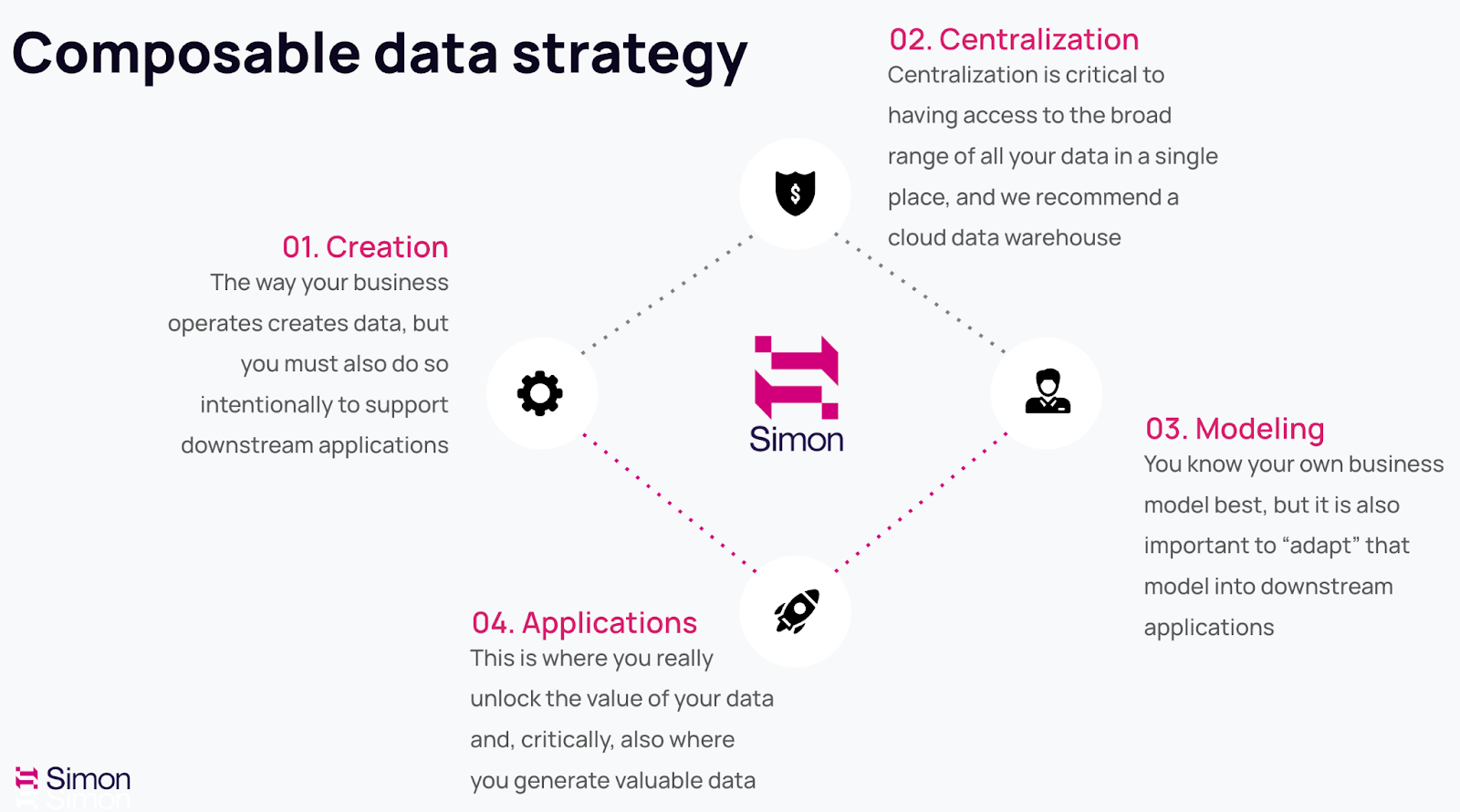
Let’s dive into each pillar.
Customer data creation
While not the central focus of a CDP like Simon Data, data creation is critical. Instead of treating data as mere “exhaust” from business operations, we need to align data creation with CDP requirements.
The Simon team can clarify these requirements, offer out-of-the-box data creation capabilities, and recommend best-in-class partners, like Snowplow, to optimize this stage of the data strategy.
Data centralization
Centralizing your data is about more than just moving it into a cloud data warehouse like Snowflake. It’s about ensuring that all relevant data — whether customer behavior, transactional records, or marketing interactions — is aggregated in a way that supports your broader data strategy.
This centralization enables better data governance, easier access, and a stronger foundation for downstream applications.
Data modeling
Data modeling involves two key components:
- Organization-wide domain model
- Specific customer model for your CDP
The challenge is creating a data model that acts as a compatible “adapter” between your complex business model and the focused CDP model. This enables your CDP to support high-value data applications without being locked into a rigid or incompatible framework.
Applications
The real power of a composable CDP emerges when you apply your data. These applications span retention, acquisition, relationship management, and support.
This composable approach allows you to adapt your data model to fit specific needs while feeding generated insights back into your data creation and centralization processes.
Why a composable data strategy and composable CDP work
You typically create, centralize, and model data on your own. However, a composable CDP plays a crucial role in adapting your data model to meet the specific needs of high-value applications.
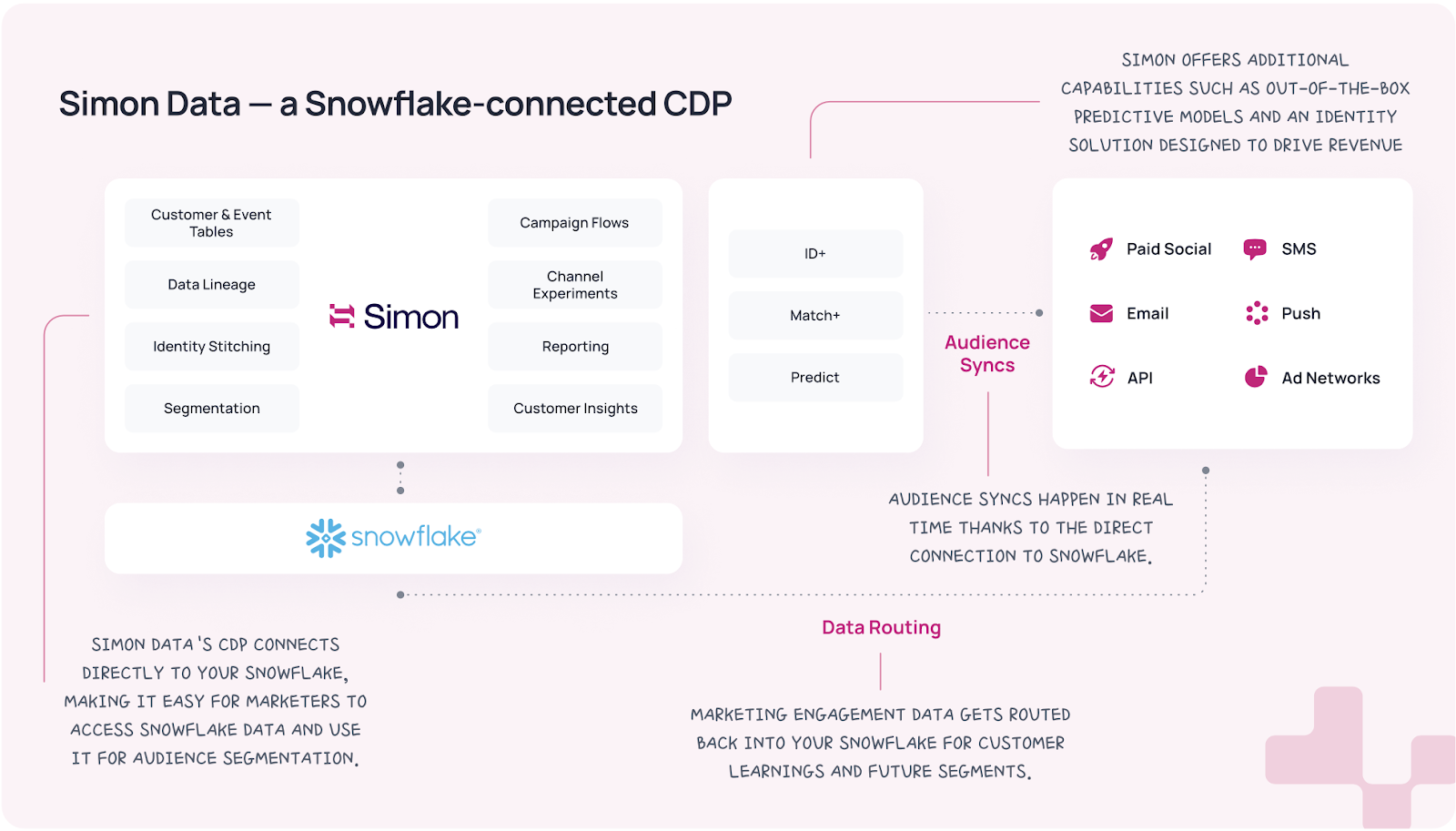
It also ensures that valuable data from these applications is captured and fed back into your data creation process — data that would otherwise be missed without a CDP integrating your marketing, advertising, and support teams into your overall data strategy.
Data interoperability
Now, let’s discuss data interoperability — how data is exchanged, communicated, and used between systems — between traditional data workflows and composable ones.
Raw data alone cannot power meaningful use cases; it needs to be adapted for downstream applications.
Data interopability in a traditional CDP vs. a composable CDP
In a traditional CDP, this modeling work is typically done only after exporting data into the CDP itself, making it specific to CDP use cases and effectively “locking in” that data, preventing it from being used beyond the CDP.
Data that flows into the CDP includes:
- Raw events: Capture real-time actions and behaviors of users across various touch points
- OLTP data: Includes critical transactional and user data, such as purchases, account details, and user interactions
- Product catalogs: Information about the products or services your organization offers, including inventory levels, descriptions, and pricing
- Fulfillment data: Tracks the status of orders, deliveries, and any logistics-related information
- Scored predictive models: Pre-computed insights and predictions, such as customer lifetime value or churn risk, help with segmentation and personalization
Data flowing back to the CDW includes:
- Segment membership: Information on which users belong to specific segments based on behaviors, attributes, or predictive scores
- Personalization: Data related to personalized content, product recommendations, and messaging tailored to individual users
- Campaign metadata and execution: Details about marketing campaigns, including objectives, targeting criteria, and execution data, such as send times and delivery status
- Downstream channel engagement: Data capturing how users interact with marketing efforts across channels, including email opens, ad clicks, and website interactions
But in a composable CDP, all data is in the CDW. This includes:
- Unified data hub: All data, whether it’s incoming raw events or outgoing segment memberships, remains centralized within the cloud data warehouse
- Flexible utilization: Because all data is housed in the CDW, it’s not locked into specific applications or use cases. It’s adaptable and accessible for a wide range of applications — from CDP use cases to advanced analytics, artificial intelligence, machine learning, and beyond
- Seamless integration: With Simon’s composable architecture, the modeling and enrichment work happens in the CDW, enabling the same datasets to power various applications without duplicating effort or data
The differentiated value of Simon’s composable architecture lies in its flexibility: you can perform all of this modeling work within the CDW. The benefit? You can leverage your data not only for CDP use cases but also for broader organizational needs, breaking free from the limitations of traditional CDPs.
The most important aspect of a composable data strategy: data applications
Let’s address the most critical aspect of a composable data strategy: the data applications you need to unlock with the data you’ve centralized within the cloud data warehouse.
As I said earlier, some data applications are more immediately accessible, given the state of the tooling ecosystem around the CDW and your organization's traditional team structure and skills composition.
For instance, your data science team is likely deeply embedded in your Snowflake instance. They’re not only directly accessing your data through SQL, but their traditional workbench of Jupyter notebooks controlling and evaluating predictive models, seamlessly slots into the CDW via capabilities like Python for Snowpark and Snowflake’s baked-in support of tools like notebooks and DataFrames.
You’ve likely already given them deep access to Snowflake, a computing budget, and perhaps even governance training and specific tooling workshops to further enable their interaction with your data.
Beyond BI and predictive modeling, there are additional high-value applications that are crucial to a composable data strategy. These applications often fall under the purview of marketing, advertising, and customer engagement teams.
- Segmentation: Create precise customer segments based on centralized data, enabling targeted marketing efforts that resonate with specific audiences. Segmentation within a composable CDP ensures consistency across all platforms and channels.
- Personalization: Deliver personalized experiences at scale by utilizing customer data stored in your CDW. Personalization is driven by accurate, up-to-date profiles that reflect the latest customer interactions, ensuring relevance and engagement.
- Activation: Activate customer segments by syncing them with various marketing channels, ensuring that campaigns are data-driven and optimized for performance. Activation leverages the CDW's real-time capabilities, ensuring that data is fresh and actionable.
- Orchestration: Coordinate complex, multi-channel customer journeys that are responsive to real-time data. Orchestration within a composable CDP ensures that all customer interactions are harmonized, creating a seamless experience across touch points.
The future of customer data management is composable
As organizations look to maximize the value of their data investments across departments like data, marketing, and sales, data teams need to adopt a composable data strategy.
By leveraging a cloud data warehouse like Snowflake and a composable CDP like Simon Data, data teams can unlock the full potential of its customer data.
A composable data approach allows you to:
- Unify your data in a central hub
- Adapt your data model flexibly to various use cases
- Power high-value applications across your organization
- Ensure consistent data utilization across all teams and tools
The result? A more agile, efficient, and effective data ecosystem that drives real business outcomes. But remember that a composable data strategy is not just about technology. It's about aligning it with your business goals, breaking down silos, and fostering a data-driven culture across your organization to drive the ultimate customer experience.

Have you ever bought more to save more? Many companies are built on this principle. You walk out of the store, spending way more than you intended because the sales were too good to miss!? That’s why even if bundling is not one of your primary business propositions (like it is for Costco), it should be in your repertoire.
BOGO is such a common bundle deal that it has its own acronym. Many customers have taken advantage of bundle pricing to save money, much to their benefit and your monetary gain. Using psychological principles and customer data, bundling can be turned into a discount strategy that wins sales.
Bundling transforms product perception. By using zero and first-party customer data, you can tailor bundles to meet specific preferences and personalize them so there’s something enticing for each persona that shops with you. Let’s tap into the psychology that makes this tick.
The psychology behind product bundling
Bundling relies on simple psychological principles to draw us in. Any good marketing technique uses psychology as its backbone, and this is no different. A good bundle will attract customers with these factors:
- Enhanced value perception
- Simpler decision-making
- A completeness factor
- FOMO
Value perception
A two-pack of multivitamins for 20% less than two at full price is a good deal, right? You’ll buy another bottle next month anyway, so you might as well stock up.
Customers see bundled products as having better value than individual items. This value-add drives successful bundling strategies. By presenting a bundle at a discounted price compared to the sum of individual prices, you make customers feel they are getting more for less, which boosts repeat sales and customer loyalty.
We mentioned this earlier, but Costco is the king of perceived value. The average Costco shopper spends $100 twice a month at the warehouse on megapacks of toilet paper, BOGO deals on pastries, and bulk grocery buys.
This marketing machine works because Costco knows its customers: affluent shoppers who have the excess money to buy in bulk. The company obsesses over research, customer data, and putting customers at the forefront of strategy.
Costco has plenty in its marketing toolbelt (like membership tiers and the $1.50 hot dog), but bundling definitely makes shoppers feel like the store adds value to their grocery run.
Simple decision-making
No one is surprised to learn that convenience is a key factor in most purchasing decisions. Bundling simplifies decision-making for customers.
When faced with too many choices, customers can experience decision fatigue. This can lead shoppers to look elsewhere for a product, or, if everything feels too inconvenient, they may abandon their purchase altogether.
Product bundles reduce the number of decisions a customer needs to make. This is essential if you’re selling something with a barrier to entry, like a product that requires specialist knowledge.
For instance, a starter bundle or essentials kit simplifies consumer decisions. Someone just starting a hobby is probably wondering where to start and what they need.

An amateur photographer, for example, is likely wondering which camera accessories are essential, which camera to buy, and even how invested they want to be in the hobby in the first place. A starter kit for a budding photographer might include:
- A camera body
- Memory card
- Basic lenses
- Carrying case
- Tripod
- Extra batteries
Voila! You’ve solved multiple problems with one bundle — and, if you’re savvy, you’ve priced it at a discount. The shopper doesn’t need to hit another store for a tripod, read reviews on other lenses, or spend even more time shopping around with competitors.
Completeness factor
The completeness factor taps into the human desire for completeness. Why buy one piece of a collector’s set when you can purchase the whole thing?
Customers are more likely to buy a bundle that meets all their needs in one purchase rather than piecing together separate items. An example of this is in the skincare industry.

Skincare brands espouse that products work best together when bought from a single brand with specific product routines. Rather than researching and buying products for individual concerns, you can purchase a bundle tailored to your skin type or based on your skin regime.
Urgency and FOMO
Creating a sense of urgency drives customers to act fast. Lim ited-time bundles capitalize on this psychological trigger, though the sense of urgency could be an illusion. Many companies use this technique around the holidays (BFCM, anyone?) for seasonal packages only available for special occasions.

Most limited-time bundles come packaged with a timer countdown. This builds FOMO because customers can see their opportunity to purchase the discounted deal wasting away.
Using customer data to bundle effectively
There are obviously many psychological triggers that draw customers to bundles. As marketers, we can capture customer data that helps us use the right psychological tricks to speak to our customers, which keeps bundling from feeling disingenuous.
Using customer data will set you apart from mediocre brands that simply copy-paste competitor tactics. Your product’s data isn’t replicable, so it can teach you exactly what you need to create tempting bundles as a customer discount strategy.
Purchase history
Take a look at customer purchasing trends; the proof is in the receipts.
Analyzing purchase history will help you identify which products customers buy together. Entire algorithms rise and fall on this feature that capitalizes on FOMO and more straightforward decision-making:
What’s the peanut butter and jelly of your products? If you’re a haircare brand, that could be shampoo and conditioner. If customers buy those together, selling them as a bundle makes sense to save your shoppers time.
Take a look through customer purchases and scour for these trends. Or, have an algorithm in a Customer Data Platform do it for you!
Segmentation strategies
Segment your audience using customer data to personalize bundles better. You could segment the audience by:
- Repeat customers
- Buyers for specific product types
- Shoppers who’d benefit from retargeting
- Demographic data that influences purchase trends
Gathering and making sense of this data is time-consuming, so consider using a tool like a CDP to help you segment audiences in real-time. This will help you create bundles tailored to the right groups.
Customer feedback
Customer feedback is invaluable. Use customer signals to refine bundle strategies. These can be surveys, reviews, or a thumbs-up or thumbs-down feature asking if an algorithmic suggestion was helpful.
Regularly collect feedback to ensure your offers are attractive. Customers keep our assumptions in check with their feedback.
Types of product bundles
Ready to start packaging services together? A lot of work goes on behind the scenes to make a bundle work. These different types will reach the right audiences.
Pure bundles
Pure bundles comprise products that are only available as a bundle, not sold individually. Many service-based businesses will do this to avoid offering a service a la carte that consumes more energy than it’s worth. For instance, cable and phone companies typically offer pure bundles.
Pure bundles work well when combined products create a unique value proposition that separate purchases couldn’t replicate. But if you expect shoppers to want a single product or service, this shouldn’t be your sole strategy.
Mixed bundles
If pure bundles can’t be sold separately, mixed bundles can. Mixed bundles offer products that can be bought either individually or as part of a bundle.
Customers prefer flexibility and personalization. Allowing them to mix and match between bundled and unbundled products appeals to a broader audience. Use mixed bundles if you have an audience that favors convenience (by bundling) and personalization (by buying separate items).
Brands usually keep the bundles attractive by pricing them at a discount, meaning customers who want individual items will go out of their way to pay more for those specific items.
Cross-sell bundles
Cross-sell bundles combine complementary products from different categories. Harkening back to the camera example, a cross-sell bundle pairs a camera with a memory card and a camera case.
This strategy will encourage your audience to buy new items, and it’s an excellent way to introduce them to other product types and associate them with new services.
Tiered bundles
Tiered bundles are the bread and butter of service businesses. These types of bundles offer different levels of product or service that ascend in price, such as a basic, premium, and deluxe skincare set.
This approach caters to different budget levels. The best part of this bundle type is that you can set the bundles side by side and compare their features, encouraging customers to upgrade.
Conclusion
Bundling creates irresistible product combinations. However, you need customer data to back your bundles up. Find the right combos that have the most appeal by looking at customer data such as:
- Wishlists (your customers are literally telling you what they want to buy)
- Purchases
- Audience segments
- Predictive analytics tools
Otherwise, you’ll reduce sales rather than boost your ROI.
Data cloud platforms like Snowflake, combined with a CDP like Simon and other content delivery platforms are tools that help you store real-time customer data and act on it quickly. Implementing the best bundling pricing strategies is easiest and most accurate when the data analysis legwork is done using these tools.

How do you turn customer data into those powerful lightbulb insights that drive marketing decisions? Even with powerful tools for aggregating, consolidating, and visualizing data, it’s not easy.
Despite all the help we get, there’s room for human interpretation to create insights and roll them into our strategy. And where there’s room for human interpretation, there’s room for error.
Data is raw, unprocessed facts. Insights are the meaningful conclusions we draw from that data. Therein lies the challenge: we need quality, real-time data cleaned, normalized, and accurate.
These days, data collectors grapple with privacy concerns, cookie deprecation, and poor quality data from disparate sources. To future-proof our targeting strategies and ensure they’re still personalized, we’ll need to access and activate zero- and first-party data effectively. We’ll also need to store our data in a way that mitigates human error or inconsistency from multiple sources.
Using the right tools for data storage and activation will get you to the insights stage faster. That’s why we have this framework for using Snowflake and a CDP (in this case, Simon Data) to get you to the strategy stage quickly.
The marketing data and insights disconnect
We’ve highlighted the challenge: Data and insights are not synonymous. Between the two is often a disconnect that’s the fault of changing regulations, data siloes, and manual workflows.
The shift from 3PC
Now that privacy regulations tighten on third-party data, marketers will need to be more economical with the information they have access to. The GDPR and CCPA regulations, in addition to the deprecation of third-party cookies (and cookies becoming opt-in only on Chrome), are really a good thing: they protect consumer privacy, which builds trust.
In the future, marketers will depend more on zero- and first-party data. CDPs like Simon enable the seamless organization, access, and activation of zero- and first-party data, ensuring compliance with privacy regulations while still providing valuable customer insights.
Data silos and manual workflows between marketing teams
When every tool is clamoring to be insightful, it creates a lot of noise. One of your tools might provide accurate data on email deliverability, another on open rate, and another tool could track replies. How do you reconcile this data?

This is why many organizations struggle with disjointed data silos. Finding the most accurate picture of your email marketing strategy requires consolidating all this data from multiple sources into one place.
A manual workflow to consolidate data hinders your ability to quickly extract insights. Without quick insights, you can’t accurately segment your audience, personalize marketing, or change course with informed, data-driven decisions. Instead, your marketing strategy will be reactive.
Building a foundation for strong marketing data insights
So, how do we turn this boat around? Let’s begin with the end in mind, then work our way from there to the right data collection strategies.
Define your marketing goals
Good data insights start with clearly defined goals. Your goals drive the data insights you unearth.
It’s like the scientific method: you start with a hypothesis so you can control variables and run a repeatable test. If your goal is a higher MQL rate, your hypothesis might be that on-page conversion efforts are falling flat. This gives you something to look for.
Unlike a scientific test, however, your data audits might run on multiple hypotheses at once. You might look at on-page conversion efforts, but you might also have a hypothesis that your ICP is unlikely to MQL.
Now that you have marketing goals (and therefore goals for your data analysis), how do you get to the bottom of these questions? Find the data sources and platforms relevant for your goals.
Quantitative data sources are typically straightforward — both to analyze and aggregate. Most quality responses can be compiled in spreadsheets, in your martech tools, or with your CDP.
If you’re looking for qualitative insights, seek platforms to gather survey data, reviews, social media interactions, email correspondence, and so on. This is trickier to do, and it’s where manual workflows break down.
For this reason, it’s here that a data cloud platform and CDP will come in handy. These tools can save hours of manual work and reduce human error with a single source of truth. Snowflake would help you scalably store and process a large dataset, while a CDP like Simon helps unify and activate data.
Translate insights into the ultimate marketing strategy
Now, you have the data wrangled and readable. The insights you extract will depend on the goals you’ve established. At this step, you translate your findings into actionable marketing strategies.
Ideally, your insights can closely tie to KPIs or revenue — that’s the dream of every marketer. Tracking metrics like purchase history, customer segment behavior, campaign effectiveness, repeat purchases, and customer loyalty and retention metrics are all indicators that tie into revenue-creating activities.
If we follow the scientific method, these insights lead to implications for further study — ergo, your strategies. Marketing is all a process of iterable testing, and your next strategies will be tests informed by previous experiments.

For example, if the data reveals a high rate of repeat purchases from a particular customer segment, you should develop personalized campaigns to further engage this group. Similarly, insights into campaign effectiveness can guide the optimization of future marketing efforts once you collect data on your success.
But this is where the directions get murky, isn’t it? That’s because there’s no one-size-fits-all step for this part. A marketing team has infinite ways to use data to inform strategy. Let’s get into an example of insight-to-strategy that helps this section feel more concrete.
Example: Personalized email campaigns
You manage email campaigns for a popular fashion retailer. Lately, you've been facing a perfect storm of declining engagement metrics: clicks, CTRs, open rates, and even subscriber count are plummeting. This isn't good news for your boss, and it's certainly not ideal for your career. You need a data-driven explanation and a solid plan to turn things around.
Luckily, you have a wealth of real-time customer data stored in Snowflake. By feeding this data into a CDP like Simon, you can unlock valuable insights.
With Simon's segmentation and audience analysis capabilities, you uncover distinct shopping behaviors among different customer groups. For instance, you've been bombarding everyone with emails about new arrivals, restock alerts, sales, and promotions. While this shotgun approach might have worked initially, it's now overwhelming customers and drowning out your message.
Your analysis reveals that new customers are more likely to unsubscribe after receiving new arrival emails, while loyal shoppers are ignoring beginner styling tips. It's clear that a one-size-fits-all email strategy is no longer effective. The solution? Segment your audience and tailor your email campaigns to each specific group.
In a perfect world, you dive into segmenting your audience with the help of your trusty CDP. Armed with customer data, you create highly specific segments. For instance, you identify a group of frequent shoppers who primarily purchase accessories. This segment becomes your "Accessory Addict" group. Another segment, "Weekend Warriors," consists of customers who make large purchases on Fridays and Saturdays.

With these segments defined, you craft tailored email campaigns. The "Accessory Addict" group receives emails highlighting new accessory collections, limited-edition pieces, and styling tips. The "Weekend Warriors" get emails with exclusive weekend deals, outfit inspiration, and personalized product recommendations based on their purchase history.
This level of personalization is a game-changer. Open rates soar, click-through rates skyrocket, and customer satisfaction improves. Your boss is thrilled with the results, and you've successfully transformed your email marketing strategy.
While it's unlikely that you'll never need to experiment again, this data-driven approach has laid a strong foundation for future success — and at least your data is clean and actionable.
Building a data-driven culture
Now that your first adventure in data insights is over, the next step is baking data-backed decisions into company culture. Unsurprisingly, the key to breaking down silos and freely sharing data lies in communication between teams.
The best marketing insights come from frequent collaboration between data teams and marketers. Consider regular syncs and KPIs that depend on collaboration, encouraging you to work together. You can use your meetings to plan joint projects and sync on reporting.
Collaboration will also encourage you to break down data silos that impede the flow of information. Because you’ve likely integrated data from all your platforms into a single source of truth by this point in order to unearth the best insights, why stop? Make this standard procedure. If you have to commit to a manual workflow to consolidate data, do this process regularly.
Lastly, keep learning and iterating. That’s how you avoid being stuck with tech debt and decades-old data software. Be sure to learn from other marketers regarding their hypotheses, the data models they use, and the insights they unearth.
Conclusion
With that, you have the lather-rinse-repeat of turning customer data insights into marketing strategies. It isn’t easy, and that’s why many marketers won’t do it. Fortunately, modern software makes it simpler than ever.
If you haven’t given a CDP like Simon a chance, now’s a good time to start. Simon makes activating data nearly subconscious, requiring the ever-busy marketing team more time to focus on other aspects of the job. Learn more about how Snowflake and Simon work together to help marketers deliver the experience customers crave.
