Blog

Unlock true customer 360
Seamlessly unify and activate customer data from your cloud data warehouse and beyond.



.webp)


Power 1:1 personalization
Deliver hyper-personalized customer experiences to forge deeper connections and transform casual customers into loyal advocates.

.webp)
.webp)

.webp)
.webp)


.webp)


.png)


Boost your bottom line
Discover the industry's latest tips, tricks, and trends to elevate your customer marketing strategies.





.webp)


.png)

.webp)
.webp)
.png)


.png)


Think about all the different ways that a customer might interact with your brand or website.
They might like a tweet, Facebook status, or Instagram post. They might click key hyperlinks directly on your website. They might click on a search ad or display ad. They might put an item in their shopping cart, fill out a survey, sign up for a newsletter, or submit a customer review. And—hopefully!—they’ll buy something.
Now, think about where all of that data lives. For many businesses, it lives in multiple different systems—potentially dozens or more, depending on the size and complexity of your organization and the number of tools in your tech stack.
With all of that data scattered about in disparate systems, it can be difficult for marketers to have a clear sense of who each customer is. And that means they aren’t being as effective as they could be in generating audiences, segments, marketing campaigns, and other assets.
The solution? Centralize all of your customer data in one place by deploying a CDP: A customer data platform.
If you’re new to the world of CDPs, this article is for you. Below, we briefly define what a CDP is and walk through the six main types that you should know about. We also speak to the benefits of using a CDP and provide an example to help you get a better sense of the role such a platform can play in your business.
What is a CDP?
A customer data platform (CDP) is a type of data platform designed to import and integrate customer data from different sources. They organize your customer data into holistic customer profiles that update automatically, combining real-time and historical data into a single customer view as your customers engage with your brand—empowering your marketing team with more effective assets.
What are some of the main features of CDPs?
While there are many types of CDPs, most of them offer some or all of the following key functionalities:
- Data ingestion. CDPs import customer data from a variety of sources, centralizing it in a single location.
- Data unification. CDPs clean, transform, and gather data from all your different channels into one place so that it conforms to the schema you’ve defined for your customer data.
- Out-of-the-box integration. In addition to ingesting data from a variety of sources, most CDPs can also format and send data to other tools and databases, enabling easy automation of many data workflows.
- Identity resolution. Many CDPs offer identity resolution as an added feature (often through a partner company). Individual customers are identified so they can be tracked across the different channels where they might interact with your brand.
- Segmentation. Better CDPs offer customer segmentation. This real-time process allows businesses to easily define and target specific user segments, and can be entirely automated.

This highly effective functionality has made them quite popular. According to the market research firm Treasure Data, the CDP market was $5.1 billion in 2023 and is expected to hit $7.4 billion in 2024, hitting $28 billion by 2028. Over the next five years, the firm projects it will increase at a compound annual growth rate of nearly 40% per year.
With this growth has come a variety of platforms to choose from. The question is no longer, “Should I use a CDP?” but, “What kind of CDP should I use?”
Different platforms will have different benefits depending on the size and goals of your business. In this blog we will look at the different types of CDPs and when each one is best.

Types of customer data platforms
Customer data platforms can be organized in a number of different ways, but most will fall into one of the following six categories:
- Data streaming CDPs
- Automation CDPs
- Orchestration CDPs
- Packaged CDPs
- Composable CDPs
- Marketing cloud (not a true CDP)
1. Data streaming CDPs
Data streaming CDPs sit on top of your existing databases, ingesting and centralizing customer data and (where possible) resolving customer identities to link all of the records of a customer’s interaction with the company across its various channels and platforms.
Data streaming CDPs are great for things like tag management and streaming data collection, but they don’t always have some of the more marketing-oriented campaign automation features available with other types of CDPs. They can also be technically complex to implement and maintain.
2. Automation CDPs
Automation CDPs focus on making the execution of marketing campaigns easier and, as the name implies, more hands-off. Most of them were built with messaging in mind, so they’re particularly good at automating data assembly, segmentation, and the delivery of marketing messages via various channels such as email.
Because they tend to have been built with that kind of workflow in mind, however, they’re often not great at integrating real-time data and adjusting messaging on the fly. Sometimes, this category is further broken down into automated analytics CPDs which focus on data analytics, and automated actions CDPs which focus on automating marketing processes.
3. Orchestration CDPs
Orchestration CDPs, also called smart hub CDPs, tend to have more features aimed at facilitating modern marketing workflows. They may even be integrated in tandem with data streaming CDPs, which feed them real-time data that are immediately integrated into campaigns.
The right orchestration CDP, however, offers the best of both worlds: the data ingestion and centralization features of a data streaming CDP together with many of the marketing convenience features found in automation CDPs.
4. Packaged CDPs
A packaged CDP is a prebuilt customer data platform that is designed to be ready “out of the box” with all of the functions and features that a business could possibly want from its CDP. They tend to be very easy to implement, but come with significant drawbacks.
First, in order to work and resolve customer identities, a packaged CDP needs to store a copy of the data that it collects—even if that data already lives in a data warehouse like Snowflake. This data redundancy means there is no single source of truth for an organization, and requires constant syncs between the CDP and the data warehouse.
Second, because most packaged CDPs are intended to be an “all-in-one” solution, they will often contain many unused features and functionality, which can bloat the software and make it slower and more difficult to use.
5. Composable CDPs
A composable CDP can in many ways be thought of as the opposite of a packaged CDP. Whereas a packaged CDP is pre-built and standardized, a composable CDP is typically “unbundled”—i.e., it consists of individual modules that a business can either choose to use or do without. And whereas a packaged CDP needs its own copy of all of your customer data in addition to your data warehouse, a composed CDP sits directly on top of your existing data infrastructure—eliminating the need for duplication and all of the challenges it brings.
6. Marketing cloud
Though not technically CDPs, marketing clouds are worth mentioning. These are multi-channel marketing solutions that integrate customer data from various channels. While they serve a purpose, many began as something else (often email marketing service providers, or ESPs) — as a result, they aren’t always capable of handling the complexities of modern customer data.
Benefits of customer data platforms
Customer data platforms bring all of your customer data under one roof, and in doing so offer a number of benefits for your business’s sales and marketing efforts. These include:
CDPs help you understand your customers better.
CDPs make it easier to get a full understanding of who a customer is because they integrate all customer data—including demographic and personal data, engagement data, behavioral data, and even qualitative data.
For example, an ecommerce company will have data about social media engagement, ad views, email clicks, on-site content consumption, cart abandonment, purchases, returns, customer surveys, and much more. But each type of data often comes from a separate tool or service and thus lives in a separate place. CDPs automate the process of importing and unifying all of that data, making it much easier to see the big picture of a customer’s journey.
CDPs also make it easier to create effective segments by targeting customers using data points from a variety of sources that would be challenging to integrate without a CDP.
CDPs empower you to orchestrate communications across all channels.
Because CDPs identify and group data from individual customers across all your channels, they are ideal for facilitating consistent cross-channel experiences.
When you identify a single user across multiple channels, you can offer a consistent, individualized experience no matter where they are. This personalized customer experience leads to better brand engagement and, ultimately, more conversions.
CDPs optimize team effectiveness and remove silos.
Collecting lots of customer data in one place makes CDPs worth the price of entry for many companies. Without a CDP, teams must rely on each other to get the information they need. Marketing teams have to wait for data or engineering teams to build segments, which not only slows down the process but can also lead to errors in data interpretation. Putting the data straight into the hands of marketers allows for more accurate segmentation and lets the engineering and data teams focus on their own priorities.
CDPs empower you to market effectively in real time.
CDPs are built to simultaneously ingest real-time and historical data, giving you the most accurate view of who your customer is at any given moment. This enables you to build even more personalized experiences.
For example, a CDP could enable a recommendation engine to suggest a product to a customer based on their earlier behavior in the same session. Without a CDP, that behavioral data would need to be manually transformed and likely moved to another database before it could be used by the recommendation engine.
CDP example: The Simon CDP
To better understand how all these features deliver on the benefits promised by CDPs, let’s take a look at a specific CDP — the Simon CDP, which can be considered both an orchestration CDP and a composable CDP.
Simon CDP uses batch and streaming processing to ingest different data from all kinds of sources. Both real-time and historical data are unified to create a single customer profile. As soon as specified events occur, the customer is identified and their profile is updated with valuable data.
From there, the Simon platform offers a variety of powerful features for enabling marketing workflows. For example, Simon CDP comes with intuitive tools like a no-code editor that allows anyone to build customer segments quickly. These segments are then used for everything from targeting digital marketing campaigns and email flows to analytics and reporting.
While its holistic customer view enables greater personalization, Simon CDP also offers an option for integrated machine learning (ML) models that draw on its unified customer data store to make product recommendations or predict customers at risk of churning. It also comes with intuitive features for A/B testing so you can see which messaging works best for a specific customer segment.
How to choose a customer data platform
Choosing the right CDP for your business will depend on your business use cases, your existing tech stack, and your goals. However, any request for proposal (RFP) for a CDP should include the following carefully evaluated potential solutions:
- Data management. Can the proposed solution ingest data from all your databases and channels? Can it process streaming data?
- Analytics and intelligence. Does the proposed solution provide intuitive analytics and reporting features that will enable your team to better understand your customers?
- Cross-channel orchestration. Will the proposed solution enable you to provide a more unified customer experience across all your channels via data syndication?
- Privacy, security, and compliance. Does the proposed solution allow you to easily manage and remove customer data in accordance with government regulations and best practices for security and privacy?
- Platform and services. What features does the proposed solution offer in comparison with others? What level of service can you expect from the vendor?
Want to see what Simon CDP can do for you? Request a demo today!

Marketers today face an incredibly complicated and tricky state of affairs.
On the one hand, customers are better informed than ever before, and they don’t hesitate to share their opinions with people all over the world. On the other, these customers demand an increasingly personalized experience and relationship with your brand.
These two realities mean that campaigns and strategies that worked well in the past can quickly become irrelevant, outdated, and obsolete with little more than a click, tap, or swipe.
How can marketers stay ahead of the curve and become the most valuable people (MVP) for their companies? Here at Simon Data, we believe that the answer lies in using a customer data platform (CDP) to ensure that you’re leveraging all of your valuable customer data as efficiently and effectively as possible.
Below, we take a closer look at what customer data platforms are, what they should be capable of doing, and why legacy tools are falling short. We also discuss how CDPs fill this gap, before walking through several potential use cases for CDPs within your organization. Finally, we compare CDPs against a number of other tools that they are often discussed alongside so that you’ll have a better sense of how CDPs differ from them and how your entire stack can potentially play together.
What is a customer data platform?
A customer data platform (CDP) is a marketing platform that helps you understand who your customers are and what motivates them to buy your product or interact with your brand. It does this in two key ways:
- First, a CDP unifies customer data from disconnected data sources (like your company’s website or app, CRM, POS system, accounting system, and more) to create a single profile of each customer
- These customer profiles can then be used to create more targeted segments and audiences and more personalized marketing campaigns (email, social, etc.).
In other words, a customer data platform (CDP) makes the right customer data available where you need it to activate your customers at the right moment. Think of it as your customer nervous system — it combines four key capabilities: data collection, profile unification, segmentation, and campaign orchestration.
What should a Customer Data Platform do?
Today’s marketing world is all about relationships between companies and consumers. The more meaningful the connection, the easier it is to grow and sustain a loyal base of enthusiastic people. However, this leaves marketers with a difficult dilemma: How can they build trusted relationships at the scale needed to remain either in a growth phase or at the scale they need to be to remain competitive?
The answer is in your data — from first-party and zero-party data you collect yourself all the way to third-party data you source from partners. Customer data is powerful, and brands need it to thrive in this constantly changing digital era. It is your biggest and most unique competitive advantage.
From the initial lead interaction to the storage and use of the data, all the way through a quality customer relationship, data makes a difference. And a CDP is the tool that helps you put this data to work.
CDP use cases
A CDP can help your business significantly improve your processes and move several important needles toward growth. This includes:
1. Increasing operational efficiency
The bottleneck between marketing and their technical partners in IT, data science, and engineering is very real and time-consuming. Anything that cuts down on that strain is appreciated by everyone.
A quality customer data platform democratizes this kind of critical customer intelligence so marketers can focus on marketing without the wait. It also allows transparency between departments and creates a central location for everyone to access the data they need to move forward. And with the advent of technologies like artificial intelligence (AI) and machine learning (ML) this can happen with greater speed and ease than ever before.
2. Increasing revenue generation
The more available and accessible customer data becomes across the marketing program, the better you will know your customers. As a direct result, the speed at which new campaigns can be tested and deployed allows teams to do more and be more granularly personal, which generates more revenue.
The more insight into customer preferences and behavior you have, the better your decision-making will achieve business-level objectives. Customer data platforms streamline and support revenue generation throughout these processes in ways that other martech solutions simply can’t.
3. Reducing media spend
On average, media spend generally accounts for one-third of all marketing costs. A CDP can dramatically cut this number down.
For example, with the right data ingestion, analysis, and incorporation in place, suppression lists can update automatically instead of manually. Simultaneously, you can also increase ROAS with more fine-tuned retargeting audiences.
A customer data platform’s built-in testing capabilities feed your segmentation and overall customer intelligence. This directly optimizes campaigns and enables you to assess ROI across your media landscape for much less.
4. Streamlining technology costs
A CDP enables you to see your data all in one place. This in turn, allows you to focus on getting the most out of every capability in your current stack and eliminate excess spend on solutions with redundant functionality.
By being tech agnostic, you have the flexibility to assemble your plug-and-play dream team or to optimize your workflows around the strengths of suboptimal tech solutions with which you’re momentarily stuck.
5. Optimizing workflows
When your team has a home base from which they can operate the entire stack, the manual work of marketing becomes a natural extension of thinking. Before, this seemed like a pipe dream. Now, it can be a reality. That’s the power of centralized, organized data. And it’s only the beginning.
Why don't other martech solutions fill this need?
In a nutshell, legacy tools only ever filled in a part of the great customer data puzzle. Most, if not all, legacy marketing technologies were purpose-built with a set amount of functions in mind. Not all of these have aged well and none of them provided a cohesive solution.
This led to many organizations and companies cobbling together a system of multiple moving parts. No single vendor has solved every facet of the customer experience and many company combinations simply can’t fill the gap.
Enter customer data platforms.
How customer data platforms fill the gap
Each step in a quality customer data platform’s workflow guides the user toward driving value with a full view of the customer, critical insights around an opportunity sizing, and profoundly embedded support for experimentation.
Here’s how CDPs accomplish this.

Technology can only achieve this by aggregating all customer data across any data source, then providing a smooth, intuitive interface. This enables marketers to leverage the data to target and personalize their campaigns and next steps.
A customer data platform’s abilities allow marketers to orchestrate customer experiences in and across channels while also providing rich insights on customer behavior and campaign performance.
Customer Data Platforms + other marketing tools
Do you find yourself confused by the sheer number of initials, acronyms, and abbreviations used in the martech world? Have you tried to figure out how all of the s
Do you find yourself confused by the sheer number of initials, acronyms, and abbreviations used in the martech world? Have you tried to figure out how all of the solutions interface with each other and your needs, only to find frustration and disappointment?
These struggles can be particularly acute when companies and organizations research customer data platforms (CDPs) and their relationship with other martech solutions. Typically, this is because of the sheer size and scope of the systems in question.
Below is a look at some of the most common martech tools that get discussed alongside CDPs, including what they offer, how they differ from CDPs, and how each system can potentially interface with a CDP.
Cloud Data Warehouse (CDW)
What they do: Cloud data platforms like Snowflake are cloud-based databases designed to aggregate, process, organize, and store data from multiple sources so that it can be analyzed and understood more readily than if the data was kept in multiple siloed systems.
How they work with a CDP: Once a CDW has aggregated and organized your customer data, a CDP will have a much easier time using that information to generate customer profiles, segments, audiences, and campaigns.
Data Management Platform (DMP)
What they do: DMPs, like The Trade Desk and Nielsen DMP, are platforms that collect anonymized third-party data, which is then specifically used to generate and manage paid digital advertising and marketing platforms.
How they work with a CDP: A CDP leverages the capacities of the DMP to bring highly-curated PII to your advertising campaigns.
Customer Relationship Management (CRM)
What they do: CRM tools like HubSpot and Salesforce collect and track customer information that your sales and services teams can use to manage customer relationships more effectively. In addition to basic customer information (name, contact information) these tools also track customer interactions, including the products they purchase and the website pages they visit, amongst other data points.
How they work with a CDP: CDPs can push audiences to CRM tools for streamlined downstream management and ingest data from CRM tools to support audience segmentation and personalization.
Email service provider (ESP)
What they do: An ESP is a software that empowers organizations to collect customer email addresses and basic information, which can then be used to create and manage email lists, audiences, and email marketing campaigns.
How they work with a CDP: Businesses can generate email lists and campaigns within the CDP and then upload them to their ESP for execution, or they can forgo an ESP altogether and opt to let a CDP manage their email needs.
Multi-Channel Marketing Hub (MMH)
What they do: MMHs are a type of software designed to orchestrate personalized communications for your customers across multiple channels. These systems specialize in managing and deploying marketing campaigns to end channels like email, social media, or SMS.
How they work with a CDP: Typically, clients use one or the other, due to the considerable overlap between these systems.
Digital Personalization Engine (DPE)
What they do: A DPE tracks and analyzes customers’ previous interactions and predicted intent to identify the best user experience for that individual. It then alters the online experience through visual presentation, recommendations, or triggered messaging.
How they work with a CDP: CDPs sync audiences to DPE tools for downstream management and personalization.
Master Data Management Platform (MDM)
What they do: An MDM platform consists of various tools and processes that consolidate and manage an organization’s data so that it can be more effectively utilized by that organization — including for marketing purposes. In this regard, they are similar to CDWs.
How they work with a CDP: When used together, MDMs and CDPs can provide an amazing overview of the entire company’s data as a whole.
Data Lake
What they do: A data lake is a centralized repository designed to store all of an organization’s data — in its original form. This can include structured, unstructured, and semi-structured data from any source.
How they work with a CDP: CDPs can share all customer data to a client’s data lake, streamlining the process of sharing information.
Simplify the CDP conversation within your organization
One of the challenges of acquiring a customer data platform (CDP) is that it can be unclear who should own the process. The muddle typically happens between Marketing, IT, and Production. However, you can easily avoid this confusion if you start with the proper processes in place.
Are you considering the role that a CDP might be able to play within your organization? Download our CDP Buyer’s Guide, which includes helpful tips you can use to evaluate your options and effectively guide the conversation.

New and seasoned marketers know that “personalization” is not just another trend. It’s become a key component of ecommerce marketing strategies so brands can maintain their competitive edge.
More than half (61%) of executives recently noted that personalizing the customer experience is a high priority for their brand.Executives aren’t claiming its importance for no reason, either – 76% of consumers indicate they are more inclined to purchase from brands that personalize, and these consumers spend 37% more with those brands.
Personalization is here to stay. Don’t just take our word for it, either. Studies have shown personalization can reduce customer acquisition costs by up to 50%, lift revenue by 5-15%, and increase marketing ROI by 10-30%.
While personalization offers quantifiable benefits, enterprise ecommerce businesses still struggle to effectively tailor customer journeys to drive more revenue.
This article explores these challenges and how Customer Data Platforms (CDPs) like Simon Data can help enterprise ecommerce businesses overcome these obstacles by unlocking the full potential of customer data for a personalized shopping experience.
The challenges of personalization for ecommerce companies
As personalization continues to prove its value, it also presents challenges for enterprise ecommerce businesses. These challenges can lead to missed opportunities for increased customer engagement and loyalty, ultimately affecting revenue.
In a 2024 report by Deloitte, only 43% of surveyed consumers acknowledged that their online shopping experience was personalized, contrasting with 61% of brands that reported personalizing their marketing campaigns.
Remember: more than 76% of consumers say they’re more likely to purchase from brands that personalize. So why does this disparity exist?
This disconnect between ecommerce businesses and their consumers often stems from:
Data silos: For ecommerce businesses, data often resides in various systems. For instance, customer data can be found scattered across CRM, marketing automation, and analytics tools. As a result, marketing teams struggle to analyze and fully understand customer behavior, preferences, and purchase history.
Fragmented customer profiles: Customer data can also be inconsistent and incomplete. This leads to inaccurate profiles that hinder personalization efforts. Businesses cannot deliver targeted content, relevant product recommendations, and timely promotions without accurate and holistic data.
Lack of actionable Insights: Even if customer data was not siloed and complete, without the ability to translate this information into meaningful actions, its value diminishes. This can result in generic and impersonal interactions that fail to resonate with the customer, impacting conversion rates and customer loyalty.
Data governance & security: Enterprise businesses must navigate strict data governance and security requirements.
Compliance with regulations such as the General Data Protection Regulation (GDPR) and California Consumer Privacy Act (CCPA) is essential to protecting customer data and maintaining trust.
These regulations impose guidelines on customer data collection, storage, processing, and sharing.
These unfortunate but common scenarios can impact any ecommerce brand’s ability to create cohesive, personalized customer experiences.
CDPs address these challenges by ingesting data from scattered sources and marrying it into a customer 360. This allows ecommerce marketers to take action on their customer data and identify the data gaps needed for better personalization.
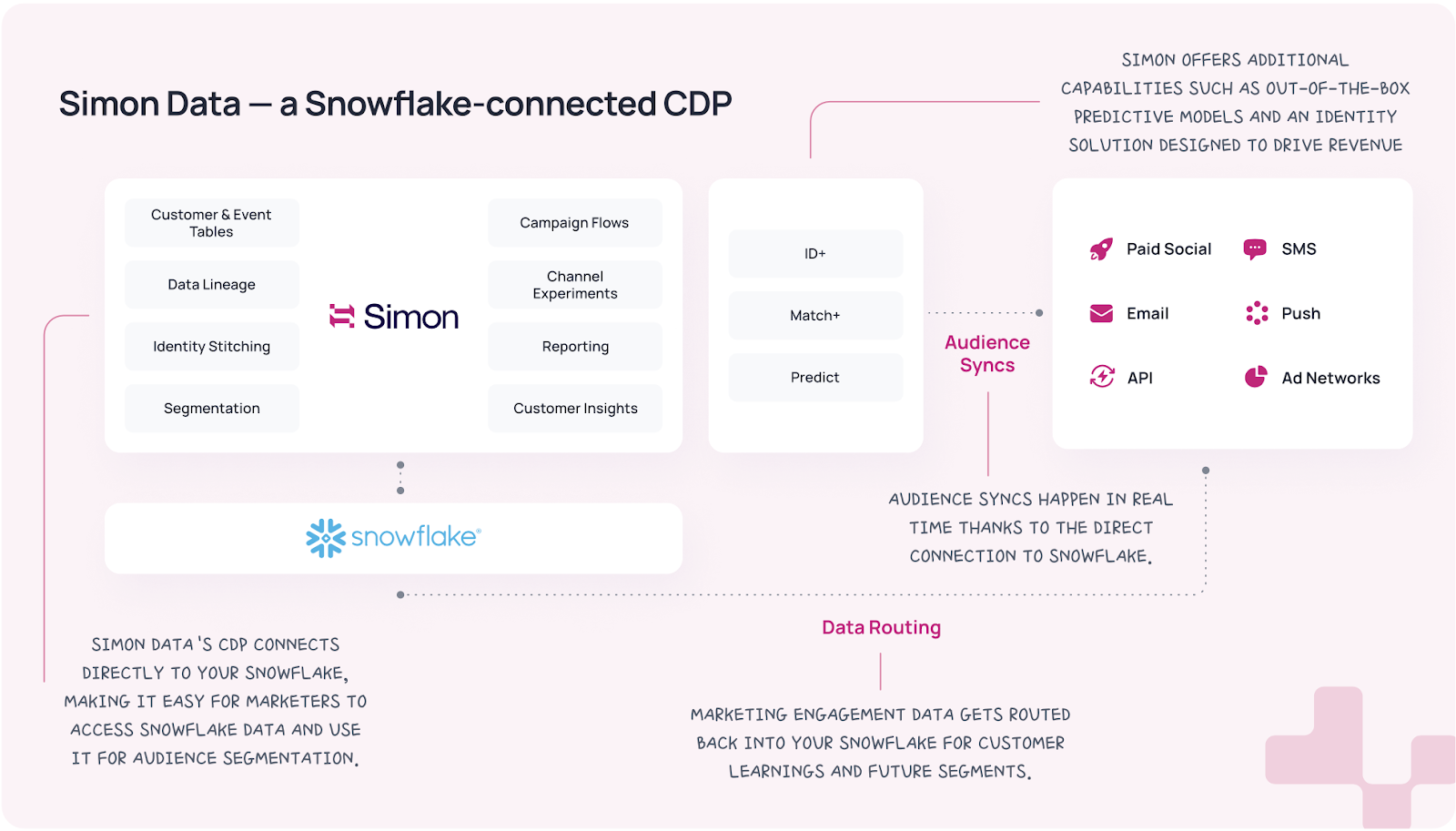
Additionally, most CDPs, including Simon Data, prioritize data governance and security requirements so enterprise marketing teams can rest easy knowing their customer data is protected.
How CDPs help enterprise ecommerce brands thrive
CDPs address common challenges and can contribute to the success of ecommerce brands. A CDP can improve conversion rates, drive increased average order value, and even foster better customer retention and loyalty. Simply put, when used effectively, a CDP can help your ecommerce brand flourish.
This is especially true for enterprise ecommerce businesses as CDPs help larger organizations with:
- Managing complex data ecosystems that include numerous data sources and multiple integrations.
- Achieving a customer 360 view by consolidating disparate customer data. This creates a single customer profile that provides detailed browsing behavior and purchase history.
- Enhancing segmentation capabilities so the marketing team can leverage rich customer data to create granular audiences based on demographics, behavior, and purchase history.
- Personalization at scale, such as custom product recommendations, targeted marketing campaigns, and dynamic content delivery across all engagement.
CDPs empower ecommerce marketing teams to orchestrate customer experiences as well. A tool like this helps ecommerce brands engage customers throughout the journey with precision and intent – creating a personalized online shopping experience across channels (website, email, mobile app, etc.). This ensures consistency and relevance across each customer touchpoint.
Let's break down the customer journey into three phases: acquisition, engagement, and retention.

First, ecommerce brands need to acquire new customers. This is done through brand awareness and engaging with potential customers. Some CDPs, like Simon, can integrate with social media or programmatic ad vendors, such as The Trade Desk, for brands to use first-party data.
Creating a lookalike audience of your most valuable customers will potentially bring in additional high-value customers, for example.
As customers start researching and evaluating the product/service, ecommerce brands want to engage with customers.
Enhancing the customer's pre-purchase experience might involve targeted digital ads, product suggestions based on browsing history, or sending timely messages in response to customer behavior (like abandoned cart reminders) – all of which a CDP can do.
Personalization continues beyond the initial purchase. During the retention phase, ecommerce brands pivot towards fostering customer loyalty, which improves Customer Lifetime Value (CTLV).
CDPs provide essential capabilities for brands to implement strategies aimed at increasing repeat purchases, upselling or cross-selling related products, establishing loyalty programs, and maintaining customer satisfaction.
A customer story: RCI
Resort Condominium International, a Simon Data customer, saw notable results with their new website personalization strategy. Personalized website content increased bookings from their “not likely to book” segments by 4.5% and generated $13MM in revenue.
While RCI only reported on web content personalization, imagine what the results could be from personalizing across all channels across all customer touchpoints. With the right set up and integrations, CDPs can optimally personalize a seamless omnichannel experience.
Conclusion
At Simon, I’ve been hearing from customers about how difficult it is for enterprise marketers to access, secure, and activate the gold mine of customer data they already have to meet consumers’ demands for personalization.
But this is just the beginning. According to a 2022 study by IDC, the volume of data (created, captured, replicated, and consumed) in the world is expected to double by 2026. That’s an estimated 100,000 exabytes (EB) worth of data!
Consumers already want relevant and timely experiences. With the increasing amount of data, enterprise ecommerce brands must maximize its use to drive personalized experiences.
A CDP offers the essential functionalities for ecommerce marketing teams to fully leverage customer data by streamlining data management and providing robust orchestration capabilities.
CDPs also enable enterprise ecommerce businesses to effectively utilize data-driven personalization through single customer views.
Don’t overlook the vast amount of customer data currently available and the unfathomable amounts to come. Learn how to take your ecommerce business to the next level by fully harnessing the potential of your customer data.

The competition for your customer’s attention is steep — and only getting steeper. Traditional marketing tactics have declined in efficacy. Savvy customers have become more discerning about claims in advertisements and are more careful about how and where they spend their money.
Millennials are motivated by brand loyalty predicated on a product’s value, quality, and consistency. Along with Gen Z, these two groups amount to more than half of the United States population, and they prioritize companies that value transparency and provide seamless digital experiences.
Customer loyalty programs have grown in popularity due to these preferences: with a loyalty program, customers can buy experiences from their preferred companies in exchange for access to discounts, experiences, or other benefits.
In this guide, we’ll explore how to build an effective, lasting customer loyalty program focused on building lasting customer relationships. We’ll also highlight how a composable CDP like Simon Data can provide deeper customer understanding and personalized engagement, two key factors in catering to today’s primary consumers.
Why is customer loyalty important?
Customer loyalty is important for many reasons, including:
- Increasing customer lifetime value (CLTV) and retention rate: With a loyalty program in place, you can better maintain and grow your customer’s lifetime value by incentivizing them to make repeat purchases seamlessly and more frequently
- Improving your net promoter score (NPS): Offering your most dedicated customers flexible, personalized options that add value to their experiences helps turn them into champions of your business
- Reducing customer acquisition costs (CAC) and churn rate: Building and maintaining customer relationships through loyalty programs ensure a source of consistent revenue, thereby reducing the pressure to source and secure new customers
The types of customer loyalty programs
There are five primary types of customer loyalty programs: points-based, tiered programs, subscription-based, value-based, and referrals. Each of these provides unique ways of serving content to and engaging your customers. Let’s dive a bit deeper into them below.
Points-based programs
Points-based loyalty programs entice customers to sign up by offering rewards once they make enough purchases or complete certain account activities to reach certain milestones, such as earning 100 or 500 points. These rewards are typically discounts on services or products. You also have the option to gamify your program by offering additional rewards for engaging differently with your brand — by playing a mobile game or hosting triple-point days, for instance.

A popular example is Starbucks’ Star Rewards program, where customers earn a set amount of stars with each purchase they make. When a customer makes enough purchases to earn enough stars to hit a milestone, they can apply their points to new orders to receive free food and drinks. The program incentives more frequent purchases to earn stars, and ensures future purchases with the offer of discounts.
Tiered programs
Tiered loyalty programs offer customers different levels of engagement with your product or service. Often, you can structure tiers in order of spend level, purchase frequency, or order size, and charge accordingly.
For example, a brand selling athletic wear might offer a tiered program to incentivize repeat purchases and engagement. Their program might offer three tiers: Bronze, Silver, and Gold. Bronze members earn points and get early sale access. Silver members enjoy those benefits, plus double points, free shipping, and birthday gifts. Gold members receive all Silver perks with additional benefits like triple points, early product launches, exclusive events, and priority customer service.
Subscription-based programs
One of the most common loyalty programs, subscriptions are popular ways to offer your audience rolling access to their desired content or product. Nearly all streaming platforms drive revenue from their subscription loyalty programs, offering their content at a fixed monthly charge in different tiers. Some brands offer subscriptions so members can gain access to exclusive savings and items, as well as purchase any number of product on a recurring schedule, which offers customers a “set-and-forget” kind of convenience while increasing average order value and encouraging repeat purchases.
Value-based programs
Value-based programs offer customers a secondary reason for their purchase as a means of encouraging repeat purchases. Typically, this secondary reason is focused on social good, such as donating a portion of proceeds to social causes and non-profit organizations. The customer can then enjoy their purchase while knowing they’ve helped their communities.

Value-based programs, though less directly beneficial to customers, still encourage repeat purchases from customers whose values align with the goals of the program. TOMS Shoes and Bombas, a sock company, each promote their products alongside their commitment to donating a pair of shoes or socks to a person in need for every pair that is purchased.
Referrals
If you follow any number of content creators or influencers on social media, you’ve probably seen their referral codes offering special discounts on products or services they’re promoting.
These programs can work for multiple audience types and products and can be deployed on most out-of-the-box online storefronts in the form of unique discount codes or referral links that customers can share with friends.

BARK, a Simon Data customer, offers a customer referral program that gives referred customers free goodies and the referrer a store credit when their friend “joins the pack.” Another example is the underwear and clothing company Parade, which made headlines using this technique through 2020 and 2021 during their initial launch period, targeting micro-influencers and their followers.
Crafting a winning customer loyalty program
Know your audience
Before you decide which type of loyalty program to start, you should have a deep understanding of your customers’ behavior. You may already be aware of key trends in behavior or touchpoints in your primary customer flows, but it’s important to thoroughly understand why those trends occur and which touchpoints to address when developing a successful loyalty program.
You may already be aware of key trends in behavior or touchpoints in your primary customer flows, but it’s important to thoroughly understand why those trends occur and which touchpoints to address when developing a successful loyalty program.
Zero- and first-party customer data is an essential tool for understanding your customers. This can include personal preferences they’ve enabled in their profiles or opted to share with you online. You can also consider patterns of behavior such as daily app scans or visits to a brick-and-mortar store.

In some cases, especially online, customer data platforms (CDPs) can help you identify and gain a 360-view of your customers. Simon Data’s CDP offers a composable architecture, which makes it easy to collect and combine customer data from many different locations, parties, to draw insights on their interests and behavior, and create presentations on your findings.
Setting and aligning program goals
At the end of the day, the goal of any customer loyalty program is to create new revenue streams. But you should also be invested in increasing customer retention, driving repeat purchases, or encouraging your customers to be brand advocates.
Each type of loyalty program covered above offers a different way you can engage your customers. Knowing what your goals are will help you pick the right program. For example, customers may be turned off by a value-based program that doesn’t align with their values and stop making purchases.
Aligning your goals with your program type will help you build a strong, compelling brand loyalty program. If you know your core audience makes frequent, recurring purchases, you can show them their potential savings if they enrolled in a subscription-based loyalty program, or offer guaranteed access to your service a set number of times per month via a tiered program.
From there, using a CDP can help you identify and reach out on the right channel at the right time to only those customers who are most likely to subscribe, helping you build a robust program from the jump.
Designing the program
Once you’ve chosen a loyalty program, Simon Data’s segmentation capabilities can create targeted customer groups based on program engagement and behavior. You can see where customers find or interact with your brand most frequently, and shift your campaign’s acquisition program to focus on that platform.
If your customers are most frequently referred to your website via Instagram, targeted ads and an influencer referral campaign might make the most sense. If your customers use your app, in-app notifications about a loyalty program are likely to draw signups because most users are already using the app.

Once you’ve decided where to reach your customers, you can personalize their invitations. Personalization helps customers recognize the value of a loyalty program when done properly. Simon’s CDP uses AI and predictive analysis to identify customers and their behavior patterns, which can help you tailor each customer’s rewards to their loyalty program activity.
CDPs like Simon Data also offer you the ability to create seamless omnichannel experiences. These are essential to growing programs and retaining customers because they help you stay in touch with your customer at every level.
With a CDP, you can store all of your customer data in a single location — and activate that data from a single location — which helps make their experience with your loyalty program effortless across online, in-app, and in-store purchases.
Launching and promoting the program
Once you’ve built your program, it’s time to start marketing it. Start building your marketing plan by identifying those channels and designing your campaign against them.
Multi-channel and omnichannel marketing strategies are more effective and wide-reaching than single-channel, but it’s important to keep your messaging consistent across platforms.
Remember: the majority of customers prioritize consistency in product quality, value against competitor brands, and seamlessness of customer experience. Take care to develop high-quality experiences alongside the strong imagery and language that your customer base can use to recognize the program quickly.
Some other options for marketing your loyalty program include:
- Leveraging influencers and brand ambassadors
- Offering incentives for sign-ups, such as introductory discounts or bonuses for signing up within a given timeframe
- Making sign-ups seamless: When a customer makes a purchase, offer them a chance to create an account easily by adding a password, or by offering to save their purchase to a new account to earn points toward future purchases
Measuring success and continuing optimization within loyalty programs
Once your program launches, it’s important to regularly optimize the benefits you offer to maximize customer value. Loyalty programs offer clear metrics for measuring success and ensuring continuous improvement, such as:
- Your total active member count: Active members = repeat customers. The higher your active member count is, the more likely you’ll see an increase in purchases from them
- Redemption rates: Similarly to active members, redeeming discounts from your loyalty program often means customers are engaged
- Purchase history: You can chart customer purchase frequency before and after joining a loyalty program
CDPs like Simon Data make information like this readily available to your teams for real-time tracking and analysis. With these metrics available, you can easily gauge the success of your program in regular intervals and more nimbly experiment with new offers and discounts.
Best practices and tips
You’re ready to craft your loyalty program! Before you get started, here are a few best practices to keep in mind:
- Maintain consistency: Offer your customers a reliable, pleasurable experience. Drip campaigns that offer every new customer access to your loyalty program are great for making sure all of your customers learn about and are able to join your loyalty program
- Technical accuracy is important: You don’t want a customer who has earned enough points for a discount not to be able to use it. Make sure your technical teams are prepared to implement your program design, and consider enabling data gathering tools like Simon to accurately assess that your program is applied consistently
- Personalizing campaigns: Consider designing program elements that focus on individual customer preferences and milestones. You can use birthdays to offer discounts, anniversaries for special events, or celebrate program milestones with your customers after months or years of program enrollment
- Engagement: Meet customers where they are. Engaging your customers through multiple touchpoints on multiple platforms is key to driving engagement
- Innovation: Keep it fresh! New discounts, programs, events, games, or other experiences can help excite your customers and entice them into your stores or making purchases online
Customer loyalty matters more than ever
In an attention economy, customer loyalty programs are an important method for capturing engagement and ensuring your customers make repeat purchases. Successful loyalty programs build brand affinity, create opportunities for building trust, and offer clear ways to gauge impact on revenue.
The team at Simon can also help demonstrate the value a CDP can deliver a customer loyalty program. Join customers like JetBlue, WeWork, and Resy in using Simon’s CDP to explore new revenue opportunities and build customer loyalty with personalized experiences, benefits, and discounts.

The customer journey is no longer linear — today's consumers expect brands to understand their unique needs and preferences. This is where Customer Data Platforms (CDPs) come into play. Simon Data is a leading CDP that equips marketing teams with the tools to centralize customer data and personalize experiences across every touchpoint. Our Real-Time Content (RTC) API empowers marketers to keep customers engaged and satisfied, fostering stronger brand loyalty.
The importance of personalization in marketing
Personalization is key to enhancing the customer experience. Tailored marketing improves engagement, fosters loyalty, and increases conversion rates. By understanding and responding to individual customer needs in real time, brands can create meaningful interactions that drive long-term success.
Understanding personalization and real-time content (RTC) API in Simon
Simon’s RTC API allows marketers to fetch data from external sources at the moment of engagement, ensuring that content is always fresh and relevant. Information like inventory, personalized offers, and product recommendations change as quickly as customers’ preferences do. This is where RTC shines.
Whether email, SMS, push notifications, or marketing clouds like SFMC, Simon Data's real-time content API dynamically loads content such as inventory updates, personalized offers, and product recommendations at send time.
This approach ensures that consumers receive the most up-to-date information, enhancing their overall experience and increasing the likelihood of engagement.
How does Simon’s RTC API work?
Real-time content is an API client that fetches data from an external API at send time for dynamic content across all Simon-supported end channels: email, SMS, push notifications, marketing cloud such as SFMC, and our data share suite. Simon customers can connect to an external API to pull information at send time, ensuring the most up-to-date and relevant messages.
Features of RTC
- Real-time data access: Fetch and deliver data in real time, ensuring your marketing messages are always relevant at the time of sending. This enables brands to have a relevant and personalized experience with their customers.
- High throughput and scalability: Handle large volumes of requests efficiently with minimal latency, making it suitable for businesses of all sizes. With Simon’s RTC API, marketing teams can handle large volumes of requests efficiently.
- Flexible data integration: Integrate seamlessly with various data models and systems to provide comprehensive customer insights, ensuring brands make the most out of their comprehensive customer data.
Benefits of using Simon for personalized marketing
There are many benefits of using a cloud data platform like Snowflake and a CDP like Simon Data to power your marketing strategies. Some of the benefits our customers love include:
Enhanced customer profiles: Enrich profiles with real-time data, enabling more accurate targeting and segmentation.
When using RTC, customers can personalize campaign templates with real-time order, inventory, and marketing data that provide accurate information and a pleasing customer experience. Think about how frustrating it is for a customer to receive an email with a newly out-of-stock product! RTC allows you to look at inventory and only showcase in-stock items in real time.
Dynamic personalization: Deliver dynamic content and recommendations across web, email, and mobile channels. RTC allows marketers to populate campaign, email, and content templates in real time with accurate data.
Improved campaign performance: Use detailed customer insights to optimize marketing efforts and drive ROI.
For example, by leveraging RTC, marketing teams can test different personalization and segmentation strategies to drive higher conversion rates.
Examples of marketing use cases using RTC
Let’s look at some examples of how specific industries can use Simon’s RTC API to boost ROI.
Improve repeat product purchases: Encourage repeat product purchases by cross-checking in-stock items with your inventory in real time. Marketers can create email campaigns with product recommendations in the footer of the email to only show in-stock items.
Build customer loyalty: Personalize customer content based on the current number of loyalty points at sends. For example, marketers can mail all customers who are currently opted into your referral program to share the number of points they have in their account and include relevant items they can redeem those points for.
Recommend products using Simon Predict: Leverage Simon Data’s machine learning models to show customer-specific product recommendations at the time of send.
Implementing the RTC API in Simon Data
Real-Time Content is easy to implement with Simon Data. The Simon data team partners closely with our customers to help with:
- Setup: Integrate Simon Data’s API into your existing workflow with a few simple steps. Our team is happy to help!
- Data synchronization: Keep customer profiles up-to-date by effectively synchronizing data automatically.
- Testing and optimization: Continuously test and optimize your personalized marketing efforts to maximize their impact. With RTC, you can understand which style of personalization resonates the most with your customer base.
Conclusion
Simon Data’s real-time content API is a game-changer for personalized marketing. By providing up-to-the-minute data and seamless integration capabilities, it helps brands deliver tailored experiences that drive engagement and ROI.
Ready to see the benefits firsthand? Explore Simon Data’s solutions and book a demo today!

Welcome to the age of personalized marketing. From eerily accurate product recommendations to campaigns that anticipate your next purchase, personalization is revolutionizing the way brands connect with customers.
But here’s the catch: all of this marketing personalization relies on one thing — accurate customer data.
When your favorite brand’s website greets you by name and knows exactly what product you want, it’s easy to forget the complex software and marketing campaign strategies running behind the scenes.
So what exactly is your strategized marketing campaign and martech stack running on? Identity resolution! It’s the secret sauce that helps businesses understand exactly who their customers are.
Why is accurate customer data and identity resolution such a big deal? Imagine trying to send a birthday discount to a loyal customer, only to realize you’ve sent it to someone who visited your site once by accident while looking for cat videos. Not the best way to build customer loyalty or drive revenue, right?
Deterministic identity resolution accurately stitches together data points from multiple sources, enabling businesses to create a single, comprehensive view of each customer. This leads to personalized experiences that not only delight but also convert customers.
This is also where Simon Data shines. Leveraging the power of deterministic identity resolution, the Simon Customer Data Platform (CDP) empowers businesses to truly know their customers, anticipate their needs, and deliver personalized experiences that drive revenue/
Let’s dive into how Simon Data can transform the way brands connect with their customers.
What is identity resolution in a CDP?
In simple terms, identity resolution is the process of connecting multiple data points across various touchpoints to create a single, unified view of a customer. It’s like assembling a puzzle where each piece represents different interactions — emails, web activity, online and offline purchase history, and more — into one complete picture.
Now, not all identity resolution techniques are created equal. Let’s meet our two main contenders: probabilistic and deterministic identity resolution.

Probabilistic identity resolution uses statistical algorithms to match data points based on likelihoods and probabilities. Imagine you’re at a concert where you see someone who looks like an old colleague. Based on their hairstyle and mannerisms, you are fairly sure it’s them, but you can’t be certain until you talk to them.
Deterministic identity resolution, on the other hand, is like having that colleague walk up to you and say, “Hey, it’s me!” It uses unique identifiers such as email addresses, phone numbers, or customer IDs to make exact matches to customers and users. This method is more accurate and reliable because it’s based on hard data rather than educated guesses.
Why is identity resolution so important?
Personalize the customer experience from end to end
Identity resolution enhances the customer experience by empowering marketers to create more personalized marketing campaigns using the data and identifiers in their CDP.
With it, marketing teams can curate customized recommendations, timely offers, and communications that make customers feel understood and valued.
Avoid costly marketing mishaps with deterministic identity resolution
Identity resolution helps brands prevent costly marketing mistakes. With it, you’ll know exactly what channels (social, paid, email, SMS, etc.) they prefer and, more importantly, the messaging that resonates with them.
The cost of sending the wrong email to the wrong person, or, worse, sending a message to a customer who’s opted out, is too high to consider anything less than deterministic identity resolution in a CDP.
Improve marketing ROI
With accurate identity resolution, marketers can target their campaigns more effectively, ensuring that every dollar spent is hitting the right audience at the right time. It’s all about precision and impact.
Build trust with your customers by protecting their data
Ensuring data accuracy and compliance is more important than ever. With laws like GDPR and CCPA in play, businesses must be careful about handling customer data.
Deterministic identity resolution helps ensure that data is accurate and up-to-date, reducing the risk of compliance issues and maintaining customer trust.
Later on, we’ll explore how Simon Data leverages deterministic identity resolution to empower businesses to harness the full potential of their first-party customer data.
Deterministic identity resolution
Now that we have a solid understanding of identity resolution and why it’s a game-changer, let’s look at how deterministic identity resolution works.
Imagine you have a customer named Taylor who interacts with your brand through various channels — emails, social media, in-store visits, and online purchases. In this case, Identity resolution connects all of these interactions to understand that they all belong to the same person: Taylor. It helps you build a complete picture of your customer so you can provide a seamless and personalized experience.

Now, let’s focus on deterministic identity resolution. It’s a more precise way of resolving disparate data to a single customer profile. Instead of guessing based on patterns or similarities (like recognizing Taylor’s behavior), it uses exact identifier information (like Taylor’s email address or phone number) to match data points. This means that you can be certain that all the interactions are indeed Taylor’s and ensure that your marketing messages are always relevant and timely.
What are the advantages of this approach? Let’s break it down:
- Precision and accuracy: Deterministic identity resolution leverages exact matching algorithms, ensuring that each data point corresponds to a unique identifier such as an email address or phone number. This method eliminates the guesswork inherent in probabilistic approaches, providing you with highly reliable and accurate customer data. As a result, your marketing efforts become laser-focused, targeting the right audience with personalized messages at precisely the right moment, thereby maximizing engagement and conversion rates.
- Reduced data redundancy: Ever receive the same email from a brand three times in a row? Deterministic identity resolution helps eliminate such data redundancies by merging duplicate records and streamlining your customer database. This not only improves the efficiency of your marketing campaigns but also saves on storage and processing costs.
- Enhanced customer trust: When customers see that you understand their preferences and needs without bombarding them with irrelevant or repetitive messages, their trust in your brand grows. They’re more likely to engage with your content, make purchases, and remain loyal over time. It’s all about building a relationship based on trust and relevance.
Precision, reduced redundancy, and enhanced trust all lead to increased revenue. By accurately identifying and targeting customers, businesses can optimize their marketing spend, improve conversion rates, and drive more sales. It’s like having a finely tuned engine that runs smoothly and efficiently, propelling your business forward.
Identity resolution within Simon Data
At the heart of Simon Data’s identity resolution capabilities is its robust platform built on top of the cloud data platform. By leveraging Snowflake’s (and other CDWs’) cutting-edge capabilities, Simon ensures that your CDW remains the ultimate source of truth. This means no more second-guessing or cross-referencing between disparate systems — everything you need is in one reliable, scalable, and secure place.
Features of identity resolution in Simon Data
- Seamless data integration: One of the standout features of Simon Data’s platform is its ability to seamlessly integrate data from multiple sources by sitting directly on top of your cloud data warehouse. Whether it’s your CRM, ESP, eCommerce platform, or engagement data, as long as it’s present in your data warehouse, Simon can give you the master key that unlocks all the doors to your customer insights.
- Real-time incorporation of website event data: Time is money, and in the fast-paced world of digital marketing, real-time data is invaluable. Simon ensures that your website event data is incorporated in real time, allowing you to respond to customer actions and behaviors instantly. Did a customer just abandon their cart? Trigger a personalized email offer to increase the chance of conversion while your product is still top-of-mind.
- SQL-based approach: For those who love the flexibility and power of SQL, Simon Data’s CDP offers a SQL-first approach that lets you query and manipulate data with precision. Don’t worry if you’re not a SQL wizard; a user-friendly interface is on its way, making it easy for everyone on your team to harness the power of your data without breaking a sweat.
Benefits of using identity resolution in Simon
- Scalable solutions for businesses of all sizes: Whether you’re a startup just getting off the ground or an enterprise with a global presence, Simon Data’s platform scales to meet your needs. Its robust infrastructure (i.e., the cloud data platform like Snowflake) handles large volumes of data effortlessly, ensuring that your identity resolution efforts grow alongside your business.
- Transparent, customizable workflows: Transparency and customization are at the core of Simon Data’s approach. You get to see exactly how your data is processed and matched, view an audit log of identity table changes over time, and you can customize workflows to fit your unique business requirements.
- Enhanced data security and compliance: Let’s face it: with the depreciation of cookies and more access to first-party data, data breaches and regulatory compliance are top concerns. Simon Data takes data security seriously. Built on your own cloud data platform, Simon offers advanced security features and compliance with major data protection regulations like GDPR and CCPR. Rest easy knowing your customer data is protected and handled with utmost care.

The future of identity resolution
The future of identity resolution is bright and full of promise. The digital landscape is constantly evolving, and with it, the tools and techniques we use to understand and connect with customers. This is what I’ve seen over the past year.
Emerging trends: The role of AI and machine learning
One of the most thrilling trends in identity resolution is the integration of AI and machine learning. These technologies are set to revolutionize the way we process and analyze customer data.
AI will work 24/7, piecing together clues to build the most accurate customer profiles and proactively flag underlying data issues that could have a detrimental effect on downstream marketing activities. It enhances the precision and speed of identity resolution, enabling businesses to react to customer behaviors in real time and predict future actions with uncanny accuracy.
Market predictions: The increasing importance of precise identity resolution
As personalization becomes the norm rather than the exception, and as third-party cookies continue to die a slow, painful death, the demand for precise identity resolution is only growing. Customers expect brands to understand their needs and preferences without being intrusive.
The future landscape of marketing will see businesses investing more in tailor-made identity resolution techniques to meet these expectations. Moreover, as data privacy regulations become stricter, the ability to accurately and securely resolve identities will be a critical differentiator. Companies that can navigate this complex terrain while maintaining customer trust will lead the pack.
Simon Data’s vision: Continuously innovating to drive value
At Simon Data, we’re not just keeping up with these trends — we’re leading the charge. We’re committed to exploring the latest advancements in AI and machine learning into our platform, ensuring that our clients always have access to cutting-edge tools that make their lives easier and their bank accounts larger.
Our goal is to drive more value for customers by making identity resolution more precise, scalable, and secure. We believe that we can help businesses not only meet but exceed their marketing goals when they take advantage of our deterministic identity resolution capabilities.
As we wrap up, it’s clear that the future of identity resolution is both exciting and essential. The advancements in technology promise to make identity resolution more powerful and indispensable than ever before. And with Simon Data at your side, you can be confident that you’re equipped with the best tools to navigate this future successfully.

Creating a consistent experience across marketing channels is far from easy. A successful cross-channel marketing strategy requires a clear vision, reliable and up-to-date customer data, and a good way to manage it all.
Yet, if done right, it can transform your campaigns with relevant, revenue-driving messaging that reaches your target customers at just the right time.
Here’s a deeper dive into all things cross-channel marketing, including strategies, benefits, and how to optimize your approach.
What is cross-channel marketing?
Cross-channel marketing is a comprehensive approach to connecting with customers on multiple channels—such as social media, email, SMS, search, and display advertising. The objective is to deliver unified messaging throughout the entire customer journey. By understanding customer preferences and goals, brands can create seamless, personalized user experiences across multiple platforms.
Why is cross-channel marketing important?
Cross-channel marketing allows B2C businesses to gain valuable insights into customer behavior that help them reach the maximum number of potential customers. Brands can deliver more relevant, personalized experiences that lead to increased customer engagement and loyalty.
But that’s just the tip of the iceberg.
With a cross-channel approach, businesses can track customer journeys across multiple channels, gaining insight into where customers are engaging with their brand. This data is used to improve the overall buyer journey and to inform future marketing campaigns.
Example of cross-channel marketing for B2C businesses
Let’s get a better picture of how cross-channel marketing works.
Imagine a footwear brand wants to promote their new seasonal product line. They reach out to customers online with promotions, targeted ads, and engaging activities such as surveys and giveaways.
They also have a strong presence on social media, posting content daily to keep their audience engaged on various social platforms. They find the Stories feature on Instagram is the perfect place to display their latest sneakers.
With audience segmentation, the brand is able to target Facebook ads and email campaigns to the customers most likely to buy.
Online channels direct back to the company’s website, where customers can find more information about the latest products and promotions and ultimately make their purchases.
Offline, promotion continues with direct mail advertising. Additionally, the business deploys mobile marketing campaigns, such as text messages (SMS) and push notifications, to keep customers engaged.
With a cross-channel approach to marketing, the business increases customer engagement through an integrated experience. They gain a better understanding of customer behavior and preferences, and use that to create a continuous cycle of selling to their most loyal customers.
How is cross-channel marketing different from multichannel marketing?
Cross-channel and multichannel marketing are similar in that they both involve engaging customers on multiple channels.
However, multichannel marketing tends to take a more fragmented approach, focusing on optimizing individual platforms. This is often executed with separate data sets.
Cross-channel marketing takes a more holistic approach, focusing on creating a consistent, personalized customer experience across all channels.
Cross-channel marketing involves working from a unified data set. Customer behavior—like website visits, add-to-carts, or link clicks—is tracked across multiple channels. Ideally, all this data is gathered into a customer data platform (CDP) to create unified customer profiles.
This enables marketers to uncover relevant insights and learn how to better meet customers where they’re at.
How to create a cross-channel marketing strategy
Before jumping into a cross-channel campaign, it’s critical to have a strategy in place. This strategy should be supported by relevant customer data, the right tools, and solutions to ensure your resources and efforts aren’t wasted.
Here’s a step-by-step overview of how to create a cross-channel campaign that gets results:
1. Understand your target customer
It’s important to define who your target customer is and what interests and motivations drive them. Understanding your customer by obtaining a single customer view is the foundation for executing an effective cross-channel campaign.
To do that, you need an increasingly detailed customer persona. This means identifying and segmenting your audience based on different attributes, such as lifestyle, location, or purchase history.
Collect data about customer demographics, interests, behaviors, needs, and goals. Once all of this information is gathered, organize the data and create a profile for each customer segment.
Using these profiles, you can tailor your approach and target each segment with more personalized content and organic experiences.
2. Define your goals
In order to launch a fruitful cross-channel marketing campaign and measure its success, it’s essential to define your goals in advance:
- Identify your main goal. Who is your target audience? What do you want them to do?
- Identify which channels you will use. The channels you choose to reach your customer base—such as email, social media, or paid advertising—will largely depend on customer demographics and behaviors.
- Set specific objectives for each channel. Define key performance indicators (KPIs) that can be used to track progress and measure the effectiveness of your campaign.
- Decide on a timeline for each objective. From there you can work backwards to schedule out your campaign to-dos, including evaluating the results and iterating as needed.
Defining your goals with clear parameters will set the framework to keep your campaign focused and on track.
3. Identify customer touchpoints
Customer touchpoints are any points of contact that customers have with your brand and messaging.
By segmenting customers according to their interests, behaviors, demographics, and other criteria, you can determine which channels are most effective for each segment. Different channels will be more or less relevant depending on which segment you are trying to reach.
Examine which customer touchpoints are associated with each channel, and use this data to design your marketing strategy.
4. Develop creative assets
This is where you’ll want to tap into your team’s content marketing expertise. Developing creative assets for a cross-channel marketing campaign requires planning and research. Brands need to understand the many channels their target audience uses and create content that is tailored for each.
For example, content created for Instagram may not translate well to TikTok because of the different formatting requirements and user preferences of each platform.
Once you’ve decided which channels you will use, develop content that is appropriate for each one. Use video, images, and copy to create different versions of the same message, ensuring consistency in your messaging across channels.
Without a winning set of creative assets, even the most optimized customer segmentation and lifecycle marketing efforts can fall flat. If content creation isn’t your strong suit, hire an experienced content marketer to craft your messaging and align it with your brand voice.
5. Set up tracking mechanisms
Implement tracking methods to measure the performance of each channel and identify areas for improvement. This is where a robust customer data platform is a game changer.
Not only does a CDP centralize all the data you need to launch a cross-channel campaign, it also offers features to help you create accurate customer profiles and uncover insights from your customer data.
The right CDP will allow your marketing team to use tags, website tracking, and integration capabilities to ensure you always know your numbers. With rule-based workflows, you can easily track historical campaign results. And automation will enable you to conduct A/B testing, track customer interactions as they happen, and adjust your campaigns in real time.
6. Measure, analyze, and iterate
It’s important not to overlook this final step.
Once your campaign is underway, begin to analyze the data. Find out which channels and messages are the most successful, what types of customers are engaging, and where there’s opportunity for improvement.
Make adjustments as necessary. Then repeat the process—gather and analyze the new data, then iterate again. Data analysis tools make it easier to examine the results of your campaigns and make adjustments.
As you figure out what does and doesn’t work, keep this data on hand for planning future campaigns.
Benefits of cross-channel marketing
There’s a reason cross-channel marketing exists. When done right, it is an indispensable part of a larger marketing strategy.
Here are some of the benefits you can count on:
Reaching the maximum number of customers
By engaging customers on multiple channels, businesses can reach a wider audience. Maximizing your reach means more sales opportunities—and more data to base future campaigns on.
Creating a unified customer experience
Cross-channel marketing allows brands to create a seamless, consistent customer experience across platforms. This increases both brand awareness and engagement. Potential customers learn to know, like, and trust your brand, which increases the chances that they’ll purchase from you.
Improving customer engagement and loyalty
The more personalized touchpoints you create, the stronger the bond between you and your customers, because you’re staying at the top of their minds. Nurturing these relationships turns one-time customers into repeat customers, and repeat customers into brand evangelists.
Measuring the customer journey for increased ROI
As you track customer journeys across multiple channels, you will gain insights into where customers are engaging with your brand and how to improve the customer experience. Once you know the where and how, it’s simply a matter of doubling down and investing your resources where you’re getting the most ROI. This leads to profitable campaigns that earn more than they spend.
How to measure the success of a cross-channel marketing campaign
A key part of any marketing campaign is knowing your numbers. To execute data-driven campaigns, you must have a good way to track that data in the first place.
So how do you track and measure your success? Here are a few metrics to focus on:
1. Website performance
Industry-standard web analytics tools like Google Analytics can be used to measure your website’s performance. Here you’ll find insights such as website visits, page views, time spent on the site, and click-through rates.
More sophisticated platforms may also include IP address mapping tools, which can help you determine which markets show the most potential.
2. Channel traffic
Tracking traffic from each channel, such as email, social media, organic search, and display advertising, can provide you with valuable insights into customer preferences.
Perhaps you think your largest audience is on Facebook, but once you gather the numbers, you discover it’s your email marketing efforts that are delivering the best results.
Specifics like this can’t be known with certainty unless you accurately track and quantify the results. Automating this process will save you substantial time and resources.
3. Customer engagement
Monitoring customer engagement across channels can provide insights into customer loyalty and activity. Did they sign up for your newsletter? Did they leave an abandoned cart?
Monitoring customer engagement and how many touchpoints they’ve had with your brand gives you a glimpse into where they are in their buyer’s journey. When you combine this with customer segmentation, it becomes easier to target customers with timely messaging that will lead them toward a purchase.
4. Conversions
Tracking conversions across multiple channels can provide insights into which platforms are the most effective at driving sales. Pay attention to specifics like pay-per-click (PPC) conversions and cost per purchase.
By tracking key metrics and analyzing customer data, businesses will uncover first-party data they might not have found otherwise.
Running cross-channel marketing campaigns with Simon CDP
Simon CDP is a comprehensive customer data platform that enables businesses to unify, analyze, and activate customer data from multiple sources.
Simon Data’s powerful automated tools make it a breeze to implement cross-channel campaigns tailored to individual customers. With Simon CDP, businesses can measure the success of their campaigns and gain valuable insights that translate into revenue.
Get a customized demo to learn how to make your cross-channel campaigns a seamless experience with Simon CDP.

You have the recipe for a perfect marketing campaign: eye-catching creative, clear copy, and a watertight distribution strategy. But it’s still missing the most important part — analytics to measure whether or not your campaign was the hit you envisioned or a flop.
Without marketing campaign analytics, you can’t tell if your strategy is effective. If you’ve been struggling to measure campaign performance, you’re in the majority with the 87% of marketers who say data is their company’s most underutilized asset.
Let’s learn how to turn one of marketing’s least utilized assets — data — into your strength with this guide.
What are marketing campaign analytics?
Marketing campaign analytics is the analysis of all data related to marketing campaign performance. Effective campaign analytics include processes for collecting, reporting, measuring, and analyzing campaigns in an omnichannel marketing approach.
Modern campaign analytics tools can collect data in real time and pull it into digestible formats. This enables you to make fast, data-backed decisions to iterate on your successes, reflect on your failures, or change the course of live campaigns. In other words, analyzing your campaigns doesn’t have to be complicated!
Once you learn how to harness campaign analytics, you can effectively measure performance in a variety of ways: through click-through rates, customer acquisition cost, lifetime value, dwell time, or any other KPIs you target.
Why your marketing campaign analytics matter
When you’ve integrated campaign analytics into your marketing loop, you’ll notice it can drive strategy. Insight-rich data is essential for a marketer’s success!
Better market fit
Marketing campaign analytics help you determine the best positioning to reach your audience.
A good analytics tool will show you the demographic data of users who interact with your campaigns. Armed with this knowledge, you can fine-tune your segmentation to better reach the right users.
For instance, you might learn that one segment of your audience responds better to retargeting ads on Facebook, so you increase your retargeting budget for that channel.
Stakeholder buy-in
The pot of gold at the end of the rainbow for marketing? Stakeholder buy-in. Often elusive, it’s key to success; every marketer wants their judgment trusted and respected. Data holds stakeholder approval captive. If you want buy-in, back your decisions with concrete proof.
Campaign analytics help you determine KPIs, measure success, identify issues, and suggest changes. If you set your reporting up correctly, the numbers don’t lie.
Fine-tuned budget allocation
If your marketing analytics delivers actionable insights, you can figure out which channels are successful and which aren’t. This helps you to decide where to allocate your resources.
For instance, maybe you had all the engagement metrics (likes, comments, shares) telling you Facebook ads were a great use of your time, but analytics helped you discover those metrics haven’t led to more meaningful engagement (like click-throughs).
On the other hand, maybe your LinkedIn ads get fewer likes or shares or 3X the amount of click-throughs. These are the types of hints marketing analytics can give you so that you can adjust your marketing strategy quickly and easily.
Refined customer personas
We hold a lot of assumptions about our customers. Analytics don’t just help us fine-tune our messaging — they help us understand who we’re talking to and how to segment our audience to speak to each persona.
With the right data, you can identify which segments of your audience like to shop where, their buying habits, and the best ways to reach them.
The 5 key marketing channels to analyze
Knowing how to collect and activate data can depend largely on the channel. These are the five main channels where running successful campaigns depends largely on analytics.
Paid media campaigns
Paid media is often considered the simplest to analyze because the output and input are straightforward: spend money to make money. However, anyone who works with paid media knows it’s never that simple.
With paid media, you serve your ads to users through social media platforms, search engines, and ads native to their platforms to entice them to buy. These types are essential to track:
- Social media ads
- Search engine marketing
- Native ads
- Display ads
Paid media serves ads to users with preferences that match your product niche, remarkets to former or pending customers, serves discount and sale information to loyal customers, and builds more touchpoints for brand awareness.

The perk of paid media is you’re typically playing in “walled gardens,” or closed platforms that control the content within. They typically require first-party data to access the platform, and with that comes the ability to track user behavior and gather information about user preferences.
The platforms you serve ads on will typically have dashboards to track campaign performance.
Depending on the platform, you can expect metrics reporting:
- Cost per click (CPC): The hallmark paid metric. This measures the cost for each click you get on an ad, the total cost divided by total number of clicks
- Click-through rate (CTR): How many people see your ad versus click it
- Conversion rate: The percentage of clicks that result in “conversion,” however you measure that. Typically measured by completing a form or a purchase
- Impressions: Your ad campaign’s overall reach. The number of users who’ve viewed your ad
- Return on ad spend (ROAS): The revenue you’ve generated divided by your total ad spend. This measures your campaign’s financial efficiency
- Customer per conversion (CPA): This is your cost to achieve a conversion. Similar to ROAS, it helps you track whether your campaign is reaching its goals and can be more effective than CPC alone
- Cost per mile (CPM): Your cost for every 1,000 impressions
- Lifetime value (LTV): How much revenue you expect to gain from a customer over a lifetime
Social
We mentioned social media in the paid section, but earned and owned social media is a category of its own. You can work on your company’s social influence by creating your own content, or you can work with others to increase reach:
- Influencer marketing
- User-generated content
- Company-owned content
- Partner content

Tracking social media campaigns can be more difficult than in paid advertising. That’s often because social platforms can’t adequately track a customer journey across several posts, videos, or other touchpoints like it can the single touchpoint of a paid ad.

Nonetheless, there are still some social metrics you can track to gauge reach and efficiency:
- Engagement (likes, comments, shares): Keeping an eye on engagement can show overall growth of brand awareness. If one post has way more engagement than another, it’s a safe bet the post with more engagement has better reach. This metric is best tracked in proportion to impressions
- Impressions: The number of people who viewed a post
- Followers: Measuring follower growth over time shows the number of people supporting your brand
- Click-through rate (CTR): The number of people that have clicked a link on a social post. In conjunction with UTMs, you can gauge which social posts drove action
- Mentions: This measures if others mention or tag your brand
Email campaign analytics
Email campaigns can vary largely by the product or service you offer. If you work in ecommerce, you may see huge value from a single email. For an expensive one-time purchase, you may need a long drip campaign before you see conversions. These are the marketing email campaigns you could expect to report on:
- Newsletters or educational content
- Promotional mail
- Product announcements and updates
Though email analytics are trickier to track than paid media, for instance, they’re an important part of any campaign and therefore need clear reporting — 87% of brands say that email marketing is critical to business success.
A good email marketing software will compile campaign results and give you these data points:
- Open rate: This is straightforward — how many people opened your email? The more, the better, but average open rates for emails hover around 20%.
- Click-through rate (CTR): Similar to the click-through rate on paid or social media, the CTR is how many users click a button on your email. A good email CTR is between 2 and 5%.
- Unsubscribe rate: Like managing a social media follower count, you’ll keep an eye on your email subscribers. Unlike social media, you should expect several subscribers to opt-out after you send an email. However, you want to keep an eye on any spikes in the unsubscribe rate.
SEO
Often considered a top-of-funnel (ToFu) marketing initiative, SEO and organic search can be versatile and low-cost. It’s still a good way to establish authority or help users discover you. You can run these types of campaigns with SEO:
- ToFu keyword content (such as “What is X?” or “How to do X”)
- Product comparisons
- Branded keyword ownership

SEO helps you own keywords you’d otherwise pay for, which is one way investing in it helps you in the long run. That’s why these metrics are important to track:
- Keyword cost: Many SEO tools estimate the value of your owned keywords. This proves how much you save by appearing organically rather than bidding for that keyword
- Traffic/pageviews: This is the top-level metric to track. More pageviews means more visitors, which can optimize into more conversions
- Keyword rankings and keyword ownership: More high-ranking keywords mean more visibility on search engines. Many SEO specialists optimize specifically for Google keywords
- Conversion rate: As with all campaigns, the ultimate question is how your content prompts users to take a desired action. For SEO, this can be signing up for a demo or downloading gated content
The elements of successful marketing analytics
Now you know the types of data you might collect and where you might collect them. The difficult part, however, is in gathering and making sense of data.
Data works for you when it’s clear and actionable. Here are the elements of clear and actionable marketing analytics.
Data collection
How you collect your data makes a world of difference. If you consult disparate dashboards and multiple spreadsheets to make sense of your analytics, the process costs you hours of extra manual work.

Ideally, you’ll want to consolidate your data in one place. A CDP works well for serving all your consolidated data and making it actionable. This way, you’re not only able to collect accurate data from all your campaigns and channels, but you’re also able to use your platform to build better future campaigns with segmentation, automated triggers, and more.
In sum: the fewer dashboards you have, the better!
Clear attribution model
How you attribute data determines how well you’re able to quantify marketing efforts. With clear attribution, you can allocate the budget better to the channels that succeed.
Companies choose from these attribution models the one that works best for their campaigns:
- First-touch: Full credit goes to the first attributed action
- Last-touch: Full credit goes to the last attributed action
- Linear: All touchpoints receive equal credit
- Time decay: Touchpoints closer to the time of conversion receive more credit
- U-shaped: First- and last- touches are given the biggest credit while other touchpoints are given partial credit
- W-shaped: First- and last-touch are given the biggest credit in addition to any mid-funnel activities that generate quality leads
Robust reporting
Do your priorities change every quarter, every week, or every day? Since you’re a marketer, the answer is probably a mix of the three. You probably make long-term investments but need to pivot on the minutiae to achieve your goals.
Reporting needs to be robust enough to support these pivots, so search for a reporting platform that delivers real-time updates with the latest information. Because data and customer experiences change quickly in digital marketing, it’s difficult to act on data from a previous quarter.
Better yet, search for a tool that can use machine learning to predict data trends so you can plan pivots ahead of time.
Data activation
Once you have real-time data access, develop ways to systematically act on it or receive insights. We teased predictive analytics in the last section, but that’s a good example of activating data.
Another is using that data to segment your audience, personalize marketing messaging, and send tailoring campaigns for particular triggers. For instance, you can use your data to activate a trigger when someone abandons their cart and sends an email with a coupon code.
This process requires experimentation. Iterate on your findings to tailor your campaigns — it’s all trial and error.
Conclusion
In theory, data analytics is a separate function from most marketing roles. But in reality, you’ll work with data regardless of where you fall in the marketing department. Learning to gather and act on marketing campaign analytics is key to your success, and it will put you in the upper echelons of marketers.

Personalization has a huge impact on your campaigns. Companies (and customers) know this, and there are dozens of products vying for your attention that harness customer data to deliver personal experiences. With all these options, it can be difficult to choose the most effective combination of tools.
Customer data platforms (CDPs) and email service providers (ESPs) both offer valuable features that help businesses manage their customer data and create targeted marketing campaigns. But, as their names suggest, they deliver different benefits.
Which one is right for your business? Keep reading to find out.
What is a CDP?
A customer data platform (CDP) centralizes and unifies customer data from multiple sources to create a single, comprehensive view of each customer. You can use this data to create personalized marketing campaigns, analyze insights, and predict future trends. It’s useful for:
- Data integration: CDPs gather zero- and first-party data from the web, apps, CRMs, email marketing platforms (like ESPs), social media, and so on. This includes both structured and unstructured data from hundreds of integrations
- Customer profiles: CDPs take your data from multiple sources and create a single, coherent profile for each customer based on their behavior
- Real-time data: CDPs can process and update customer data in real time, which means you get to react to this data in real time with triggers for campaigns to ensure the right message gets to the right customer on their preferred channel
- Segmentation: CDPs help you segment customers by demographic and behavior, allowing you to tailor your campaigns for each segment.

CDPs normally work with customer data from a cloud data platform or warehouse like Snowflake to help marketers access and activate real-time customer data for personalized campaigns. Snowflake keeps all of your customer data in one spot by acting as a single source of truth, while also keeping it private, secure, and actionable when combined with a CDP.
What are the benefits of a CDP?
The benefits of a customer data platform go beyond simply providing tools and features to create email marketing campaigns. By pairing key user data with a suite of marketing tools — which can include an ESP — a CDP enables marketing teams to create hyper-personalized marketing campaigns that lead to higher revenue.
Using a customer data platform for your marketing campaigns can make a difference in whether you reach your KPIs or fall short. Consider the following advantages:
Creating unified customer 360s
A CDP makes sense of all the data it gathers through each touchpoint in the marketing lifecycle, making it easier to create unified customer profiles. These comprehensive customer views offer insight into real pain points, interests, wants, needs, and even firmographic data — often in real time. With unified ICPs on hand, your marketing team can execute new marketing strategies and create segmented, more personalized campaigns.
Saving time and resources through automation
In a data-driven world, automation is your best friend. It takes repetitive yet critical tasks off your to-do list so you’re able to focus on higher ROI initiatives. Automation also makes it possible for marketers to establish evergreen strategies that bring in a consistent and predictable stream of new customers and more data while also building brand awareness.
In a CDP, you’re orchestrating cross-channel campaigns from one unified platform with all your data. This is an important benefit for marketing teams because the alternative is having to pull data from different sources, which is time consuming.
Plus, without a centralized source of data, you set yourself up to create disparate campaigns from different channels without any real integrated strategy.
Personalizing marketing campaigns
Today, marketing is all about personalization. About 76% of consumers get frustrated when they aren’t able to find a personalized experience with a brand. Yet you can’t launch a personalized marketing campaign without first gathering, cleaning, centralizing, and organizing your data to make it usable. Not to mention, your CDP helps you collect and activate first- and zero-party customer data to adhere to new government data regulations. This data also helps you drive more personalized campaigns.
A CDP also makes it easier to run hyper-personalized campaigns because it enables easy access to data from other sources. A CDP performs all these tasks, making it much easier for marketers to draw data-driven insights about what customers want and need by using browser behavior, purchase history, or even email engagement.
Using predictive models in a CDP
Having the ability to predict the wants, needs, and sometimes even actions of customers will take any brand’s marketing efforts to the next level. Though not all CDPs offer this feature, using a CDP with machine learning and genAI predictive analysis capabilities enables brands to gain a competitive advantage by using it to:
- Uncover new marketing opportunities
- Optimize sales strategies
- Improve resource management
Data becomes harder to use when it’s siloed inside different applications. A CDP works to unify zero-, first-, second-, and third-party data from all your data sources to help you improve your messaging and execute proactive marketing campaigns.
CDP example: Simon Data
The Simon Data CDP is a no-code customer data platform designed to help marketing and tech teams deliver results in the form of new customers and better retention.
With the automation and tools needed to create a true omnichannel experience, Simon Data’s customer data platform enables teams to establish ongoing marketing funnels that are hyper-personalized and built with the customer in mind.
Simon’s CDP’s invaluable features provide the functionality to meet all your marketing team’s needs:
- Audience management
- Email marketing campaigns
- Customer identity
- Predictive modeling
- Data unification
- Cross-channel orchestration
- Multichannel orchestration & experimentation
- Customer data segmentation
Let’s say you’re trying to build a recurring workflow that sends email messages to specific customer segments about special deals or seasonal offers. Simon Data’s dashboard simplifies the automated workflow creation process by enabling you to set your desired frequency, maximum period, date and time, and messaging.
The Simon CDP combines the automation and detailed data you need to execute highly personalized campaigns that won’t fall flat. Plus, it eliminates the need to work with siloed apps by unifying data collection with robust go-to-market tools.
What is an ESP?
An email service provider (ESP) offers tools to send, manage, and track emails. You typically use an ESP with a campaign or subscriber list to send emails en masse.
With an ESP, you can expect these core features:
- Email sending: Obviously, ESPs let you send emails. You can do this on an individual level or in bulk
- Email templates: ESPs usually offer customizable email templates. This is helpful for small businesses without dedicated design teams. Simply choose a template and type
- List management: ESPs offer tools to manage email lists, including segmentation, subscriber management, and data import and export capabilities. That helps you choose the right audience for a specific campaign
- Automation: You can automate certain email sequences off of trigger events like subscribing to your newsletter or visiting a certain webpage
- Analytics and reporting: ESPs help you track key data points on email performance, like open, click-through, bounce, and conversion rates
- Deliverability and compliance: This seems straightforward. But honestly, ensuring your emails are in legal compliance can be tricky, and most ESPs handle the dirty work for you
It might be clear to you already how ESPs shape up in terms of benefits, but let’s go through them.
What are the benefits of an ESP?

An email service provider offers many advantages for businesses that are looking to improve their customer engagement and communication.
Managing campaigns with automation
ESPs enable marketers to manage customer contact lists, automate email campaigns, track customer engagement, and measure the success of their campaigns. The right ESP can save you a significant amount of time and effort, integrating with your data and cutting out much of the manual work with automation.
Testing and improving campaigns
Email service providers offer a lot of features to help you to improve your email campaigns. A/B testing, for example, allows you to test different versions of an email to see which performs better.
ESPs also provide detailed reports on your email campaigns, which can help you understand what is working well and what needs improvement. Overall, an ESP can be a valuable tool for business communication.
ESP example: Mailchimp
Mailchimp is undoubtedly one of the best-known ESPs out there with 11 million users. It has all the features you’d expect, and since it’s been around for a while, it integrates with over 300 apps to help send targeted campaigns.
Mailchimp is used by small and big businesses alike to test and send bulk email campaigns, track performance, and use email templates. It’s relatively simple to get started and has a free academy to train you on the software. Now, Mailchimp is expanding its capabilities to SMS.
CDP vs. ESP: The key difference
A CDP is a platform that helps manage all data-driven marketing efforts, while an ESP is a service that allows marketers to create, automate, and send email campaigns to a list of subscribers.

The key difference between them is that a CDP provides marketers with a 360-degree view of the customer, while an ESP only provides data about the customer's interactions with email.
A CDP can help marketers segment their audience, track customer behavior, and optimize marketing campaigns. An ESP can help marketers automate their email campaigns and track the performance of those campaigns.
How to choose between a CDP and an ESP
When choosing between a CDP and an ESP, you should consider your needs and objectives. If you're simply looking for a way to automate your email marketing efforts, then an ESP will likely be all you need.
But if you want to manage and unify all your customer data from various sources, create customer segments, and better target your marketing campaigns, then a CDP with ESP features built in, like Simon Mail, is the way to go.
Whether you choose to integrate a separate ESP platform with your CDP or opt for one with built-in features will largely depend on how much data you have to work with and how much you lean on marketing campaign efforts.
Businesses with a smaller list of subscribers can run successful automated email campaigns with just an ESP. Those with a large amount of customer data will benefit from a CDP and ESP combination.
Fuel your data-driven marketing with Simon Data
Simon Data’s powerful CDP gives marketers the ability to collect, clean, and connect data from multiple sources, creating unified customer profiles. With Simon CDP, you can easily manage all your customer data via several functions:
- Use Simon Mail to expertly craft and automate email marketing campaigns based on data
- Collecting data from any source, including first-party, third-party, and social data
- Cleaning and deduplicating data to create a single, unified view of each customer
- Segmenting audiences for more personalized marketing
- Enriching data with insights from customer behavior and interactions
- Activating data in real time across all channels, including email, web, mobile, and social
- Harness the power of machine learning and GenAI to personalize your campaigns more than ever before
The Simon Data CDP is the only product that offers a complete set of data management capabilities all in one platform. This makes it easy for marketers to run data-driven marketing campaigns without the headaches of using multiple-point solutions.
Request a demo today to see how Simon CDP can take your marketing efforts to the next level.

Ever wish you could better understand and leverage your customer data? You're not alone.
Marketers today are bombarded with customer and non-customer data from a million different places. It’s hard enough to see the forest through the trees, let alone create personalized experiences that resonate with your customers.
But this is where your martech stack can truly make or break your enterprise marketing team — and your bottom line. At Simon, we build a Customer Data Platform (CDP) that helps you see a complete picture of each customer so that you can see both the individual trees and the forest.
No more data silos, no more guesswork. Just a unified view that lets you easily segment audiences, personalize campaigns, and orchestrate incredible multi-channel customer journeys — all from one central hub.
But for our customers, the most overwhelming part of purchasing a CDP isn’t understanding the power of a CDP and a cloud data platform like Snowflake, convincing their bosses, or even conducting CDP research.
It’s the CDP implementation process. That’s why we’re writing this blog post — so you can better understand how Simon sets all marketers up for success.
Getting started with the Simon CDP implementation process
We know starting a new platform can feel overwhelming. That's why we make the Simon implementation process smooth and collaborative. Here's what you can expect.
Chatting about your marketing goals and customer data
First things first: we'll chat about what you want to achieve. What are your marketing goals? What kind of data do you have? Do you have access to this data? What’s your current infrastructure?
This initial discovery phase helps us tailor the implementation to your specific needs. We'll also take a deep dive into your current data infrastructure to see how everything fits together. Here’s what we’ll focus on:
- Data sources: We identify all potential data sources like your data warehouse, CRM systems, email platforms, and e-commerce sites to ensure comprehensive data integration.
- Marketing goals: We discuss goals such as enhancing customer segmentation, improving personalization, and optimizing multi-channel campaigns.
- Identity discovery: We ensure a robust identity foundation by assessing how customer data is currently identified and linked across various sources, which is crucial for building unified customer profiles and gaining actionable insights.
Scoping and planning for CDP implementation
Next comes the detailed planning phase. Here's what we focus on:
- Integration scoping: We ensure existing integrations and capabilities meet your specific use cases.
- Detailed plan: We develop a tailored execution plan, prioritizing initial use cases based on effort and impact. This means getting high-impact, low-effort campaigns like abandoned cart recovery up and running quickly.
Building the foundation for data ingestion and identity resolution
With a clear plan in place, we begin by focusing on data ingestion and identity resolution.

- Data ingestion: We seamlessly integrate your data sources into Simon to ensure smooth data flow.
- Identity resolution: We help you consolidate data from different sources to create unified customer profiles, linking data points like email addresses, phone numbers, and purchase histories.
Modeling and quality insurance when it comes to your customer data
Once data ingestion is complete, we model your data.
- Data modeling: We organize and structure your data within the Simon CDP to prepare it for segmentation and campaign orchestration.
- Quality assurance: We conduct thorough quality checks to ensure data accuracy and completeness, providing reliable customer profiles and insights.
Building campaign logic and orchestration in your CDP
With your data ready, we’ll then set up your campaign logic.
- Campaign logic: We devise and implement the logic for your marketing campaigns within Simon, allowing for sophisticated segmentation and targeting.
- Multi-channel orchestration: We enable seamless orchestration of multi-channel customer journeys, ensuring consistent and personalized experiences across all touchpoints.
User training and onboarding for your marketing team
A successful CDP implementation goes beyond technical setup. Our implementation team provides resources to equip your marketing team for success:
- Training sessions: We provide comprehensive training that covers all aspects of Simon Data, from data integration to segmentation and multi-channel campaign orchestration.
- Documentation: We send over detailed documentation and user guides to serve as ongoing reference materials for your team.
- Support: We offer ongoing support to address any questions or issues as your team starts using the platform.
Testing and validating your Simon Data CDP
Before fully deploying Simon, we conduct extensive testing to ensure all integrations and configurations function correctly, including:
- Data validation: Checking data accuracy and completeness for reliable customer profiles.
- Functionality testing: Ensuring all features work as expected and meet your marketing needs.
- User Acceptance Testing (UAT): Allowing your team to test the system and provide feedback to ensure it aligns with their workflows and requirements.
Going live and optimizing Simon Data
Once everything is tested and validated, we go live with Simon Data! Post-launch, we focus on:
- Monitoring: We will continuously monitoring the system to ensure smooth and efficient operation.
- Feedback loop: We’ll gather feedback from your team to identify areas for improvement and adapt to evolving needs.
- Optimization: Our CDP implementation will make adjustments and optimizations based on real-world usage and performance data. Your account manager will work with you on a success plan to maximize your ROI from Simon.
A tailored CDP implementation journey with Simon
Implementing a CDP is a collaborative and streamlined process designed to fit your unique marketing needs. From initial consultation to post-launch optimization, the Simon team is dedicated to ensuring a smooth transition and empowering you to leverage your customer data effectively.
With Simon Data, you'll be well on your way to managing customer relationships and orchestrating complex customer journeys with a more personalized, efficient, and impactful approach.

Gone are the days when it only took fair pricing and quality service for a business to satisfy customers. Modern customers expect businesses to understand their needs and buying behaviors, providing personalized interactions and a consistent experience across channels.
To understand these needs and behaviors, you need the right data. Customer analytics allows you to take a deeper look into customer behavior, understand why they do what they do, and make better-informed, data-driven business decisions.
Let’s dive into what customer analytics is, how to track your metrics, and the best practices for implementing this process.
What are customer analytics?
Customer analytics refers to collecting, organizing, and analyzing customer data across various channels in order to generate actionable insights into customer behavior. Techniques used in the customer analytics process include:
- Predictive modeling
- Customer segmentation
- Information management
- Data visualization
Using customer analytics, businesses capture and analyze customer data. This process helps them create strategies to identify, attract, and keep high-value customers and improve the overall customer experience.
The importance of customer analytics
Analyzing customer data gives businesses a holistic view of their customers, setting the foundation for successful sales, product, and marketing strategies. A good customer analytics platform can help your business in several ways:
- Increasing customer engagement, sales, and revenue
- Promoting higher customer satisfaction
- Improving brand awareness
- Increasing customer retention
- Lowering lead generation and acquisition costs
Customer analytics helps you understand who each customer is as an individual. By collecting data as customers move through each stage of the customer journey, you can identify how customers discover your products, the features they like best, where they find value, and what might cause them to leave.
Example of customer analytics
Amazon: Product recommendations
Amazon, inarguably the largest ecommerce company in the world, collects and analyzes a wealth of big data to gain customer insights and create better experiences. The more Amazon knows about a customer, the better it can predict what that customer wants to buy.

Whether a customer purchases a product, places it in their cart, or just browses product details, Amazon collects and uses that data to create a complete picture of the customer and figure out what they want. Using this data and information from other sources, such as shipping details and customer feedback, Amazon can fine-tune its product recommendations to persuade customers to buy.
Customer analytics also allows Amazon to use look-alike modeling to make product recommendations based on customers with similar buying habits.
The Farmer’s Dog: Personalized emails
Personalization is essential to The Farmer’s Dog, a company that delivers fresh pet food on a subscription basis. The Farmer’s Dog ran on three lifecycle solutions before unifying its data and delivering personal emails based on the questions users ask when they sign up for service.

Based on these questions and user behavior on the site, The Farmer’s Dog can follow up on abandoned carts with emails:

Unifying customer data for faster analytics 10x’d The Farmer’s Dog’s email experimentation.
Travel + Leisure: RFM analysis
Travel + Leisure tailors their marketing efforts with campaigns based on shopper interest. However, 1:1 personalization isn’t easy to achieve. Travel + Leisure uses a CDP to pull data from everywhere across their company to achieve a score for each customer similar to an RFM:
- Propensity: How likely they were to complete that particular action
- Value: What’s the action’s value to the business?
- Urgency: How urgent is it that the action be completed?
Travel + Leisure aggregates these factors into a score that helps them tailor messaging and timing for customers.
The 4 categories of customer analytics
You can do a lot with customer data! That’s why there are so many disciplines and projects that use it. You can group customer analytics into four main types:
Descriptive analytics
As the name suggests, descriptive analytics help you gather and understand past customer behavior. This type doesn’t give the why, just the how, and it focuses on historical events, not predicting future events.
Diagnostic analytics
Unlike descriptive analytics, diagnostic analytics attributes a reason to past customer actions. This is best paired with descriptive analytics to understand what has happened and why! Diagnostic analytics can be more qualitative — for instance, open-ended review responses or survey forms.
Predictive analytics
This category of analytics is typically powered by ML or AI, and it’s grounded in predicting future customer behavior based on historical data. With predictive analytics, you can identify trends, forecast seasonal changes, and prepare the right messaging for future events.
Prescriptive analytics
Prescriptive analytics is the next step to predictive analytics. Prescriptive analytics can suggest what to do based on historical data, as opposed to simply predicting future or ongoing trends. This can suggest the right times to send a follow-up email, or what type of campaign to run for your product.
Types of customer analytics
While there are specific categories of analytics, there are also various types within these disciplines. Let’s look at how different types of customer analytics can add value to your business.
Customer journey analytics
Being aware of all the ways a customer interacts with your business is important. But the customer journey is complex, with several stages and multiple touch points.
Customer journey analytics focuses on the most important metrics for evaluating the customer journey. It analyzes data sets from different customer interactions — such as shopping cart abandonment rates, previous purchases, or product page browsing data — to identify patterns that provide insight into future customer behavior.
Customer experience analytics
Customer experience analytics gives insight into how your customers feel when they interact with your brand. Data is analyzed from sources such as support tickets, email, live chat, and customer satisfaction feedback.
This form of analytics focuses on customer support and customer onboarding metrics, including first response time (FRT), time to resolution (TTR), user adoption, and time to value (TTV). These are used to measure the performance of your customer success and support teams and determine whether customers are being served promptly and satisfactorily.
Customer engagement analytics
Organizations can use customer engagement analytics in two ways:
- To measure the engagement of existing customers with your products or services (by tracking usage metrics)
- To understand and influence new prospects as they engage with your brand
Analyzing customer data in this way can help you improve your customer engagement by decreasing response times, delivering customized marketing messages, and boosting overall customer experience initiatives.
Customer loyalty and retention analytics
Exceptional experiences with your business lead to loyal customers. Customer loyalty and retention analytics help you understand why customers come back to buy your products or services time and time again.
It gives you insight into how loyal your customers are by highlighting information such as how many of your customers are repeat buyers and what percentage of customers churn. This type of analytics is particularly useful for identifying current or potential issues with your current marketing strategies.
Customer lifetime analytics
Knowing who your best customers are is crucial to creating long-term strategies that encourage them to keep buying. Customer lifetime analytics shows you how much revenue you can expect from an individual customer throughout the lifetime of their relationship with the business.
Using customer lifetime value (CLTV) metrics, you can gain crucial insights into which customers are most likely to repurchase, drive the most revenue, and become loyal brand advocates. This helps you optimize your marketing and sales strategies to target your most valuable customers.
Voice of customer analytics
What customers say about your business is important — both negative and positive feedback can help you understand customer expectations. Voice of customer analytics captures customer opinions, preferences, and expectations so you can understand what your customers are saying about your business.
It uses data collected from surveys, social media, customer support sessions, product reviews, and other customer feedback to get into the minds of your customers. This is a great way to discover new trends, win back dissatisfied customers, and improve your business practices to stay ahead of the competition.
How to implement customer analytics
Follow these five steps to implement customer analytics in your business.
1. Decide what data you want to collect
The first step to implementing customer analytics is identifying the data sets you want to collect. To do this you can ask questions such as the following:
- Who are our customers?
- What is their age range?
- What are their demographics?
- What touchpoints do they prefer at the various stages of their journey?
- How do they like to communicate with the business?
Use customer journey mapping to identify the best channels and touchpoints for more relevant data collection.
2. Capture the data
Collect a lot of data from multiple sources. These can include your website, online and in-store interactions, internet browsing, email marketing, social media interactions, marketing tools, customer relationship management (CRM) tools, and third-party data.
3. Store customer data securely
Choose a secure platform to store data and ensure you frequently back up your information.
Consider merging customer data from all your sources into a central repository such as a customer data platform (CDP). Besides unifying all your customer data into a single trusted location, a CDP helps you structure it in a way that eliminates the occurrence of inaccurate results, which will help us with the next step.
4. Clean and organize the data
Unorganized data makes it more difficult to get accurate, actionable insights. Organize and clean the data you’ve captured to remove irrelevant, outdated, and duplicate data.
Be sure your data is standardized, so it’s consistent formatting, styling, and categorization across all your records.
5. Track metrics and analyze the data
Tracking key customer analytics metrics such as net promoter score (NPS), customer satisfaction (CSAT), and CLV helps you to understand how your marketing campaigns are performing and whether your business is moving toward its strategic goals.
Analytics tools (like a CDP) backed by artificial intelligence (AI) and machine learning (ML) technologies extract useful insights to help you make sense of your data. These tools combine various data types such as demographics, social media data, and customer purchase history to identify trends and patterns.
6. Turn insights into action
Once you understand the actions of your customers and why they take them, you can better predict their future behaviors. This kind of insight drives more customer-centric decision-making, helping you combat issues such as poor customer retention and high churn rates, and allowing you to create marketing strategies around customer segments that offer relevant experiences.
Customer analytics best practices
Here are a few best practices to help you make the most out of your customer analytics.
- Organize your data. To gain the most clarity, consolidate your data into a single customer view to create comprehensive unified profiles of customers or segments.
- Make use of technology. Use advanced analytics tools with AI and machine learning to identify trends and recommend the next best steps.
- Listen to your customers. Their opinions (and complaints) can reveal useful information about their preferences and lifestyles.
- Analyze omnichannel customer interactions. Look at data from several relevant sources to understand how your product is catering to different customers in various ways.
- Prioritize customer retention and loyalty. Identify your at-risk customers, and take action to reduce churn, increase customer retention, and extend customer lifetime value.
- Gather qualitative insights. This is trickier to track and aggregate, but some of your richest insights come from surveys, reviews, and interviews. Don’t ignore this data in favor of quantitative responses — use both to back up your findings.
Customer analytics tools
For every task, there’s a tool that gets the job done quicker. These are tools that can help you collect, organize, and make sense of your customer data.
Google Analytics
Google Analytics is the old reliable. It’s one of the old-school tools for measuring and attributing website traffic. GA largely helps with the collection of data, but not the organization of insights.

Hotjar
When people think of quick and simple tools to analyze user experience, they think of a tool like Hotjar, which records user sessions and heatmaps. This information gives you a better idea of how a user travels across your site.

Tableau
While some tools are known for collecting data, Tableau is famous for visualizing that data. Tableau can pair with your CRM to gather customer data, visualize it, and provide AI-powered predictive analytics.

Kissmetrics
Kissmetrics is a time-honored classic tool trusted by dozens of big logos. Like Hotjar, it’s a tool for understanding customer behavior and identifying UX pain points.You can track behavior across sites and products.

Simon Data
CDPs are heavy lifters when it comes to customer data. Simon is a CDP that helps you aggregate and activate your data. It has AI tools to analyze customer behavior and predictive analytics to suggest how to act.

Get to know your customers with Simon Data’s CDP
Customer analytics plays a big role in understanding your customers, their preferences, and their choices. In-depth insights into a customer’s journey, experience, engagement, and loyalty can help you build closer connections, improve retention, and create marketing campaigns that drive business growth and success.
With Simon’s CDP, marketers can build and personalize cross-channel experiences using customer attributes, demographic, psychographic, and behavioral data – like where your customers are coming from, what they say about your business, the channels they engage with most, and which products they love most.
Our seamless integration with many marketing tools and data sources enables you to create a unified view of your customer, and optimize your marketing efforts to increase revenue. Request a customized demo to find out how our customer data management solutions can help you better understand your customers.

Advances in technology have given consumers more options for interacting with businesses than ever before. And whether engaging online or in-store, customers expect a consistent personalized experience no matter which channels they use.
An omnichannel marketing strategy allows marketers to create holistic engagement across all channels, leading to more personalized customer experiences and consistent brand interaction.
Below, we take a closer look at what omnichannel marketing is and how it works. We also give you several tips for implementing your own omnichannel marketing approach and highlight a few examples of brands with exceptional omnichannel marketing strategies.
What is omnichannel marketing?
Omnichannel marketing is the seamless integration of branding and messaging across the various online and offline channels — such as brick-and-mortar, ecommerce, mobile apps, social media, point of sale (POS), etc. — that an organization uses to interact with its target audience.
The goal of this cross-channel strategy is to create a consistent, personalized experience as customers access the company’s products, offerings, and customer support services across both traditional and digital channels.
An omnichannel approach improves the customer experience as they move down the sales funnel through their preferred channels, ensuring that the experience remains the same regardless of which channel, platform, or device they are using.
What is omnichannel marketing vs multichannel marketing?
Both multichannel marketing and omnichannel marketing use more than one channel to engage customers, but not with the same level of integration. Let’s look at the differences between the two.
Multichannel marketing
Multichannel marketing aims to give customers as many options as possible to interact with your brand. But these channels don’t necessarily always work together.
Multichannel marketing focuses on each channel individually, without deliberate integration, personalization, or synchronization of content or messaging between channels. Customers may encounter different brand messaging on one channel than they would on another. This can result in a disjointed marketing strategy and potential confusion when a customer interacts with your brand through multiple channels.
Omnichannel marketing
An omnichannel marketing strategy accounts for each channel, platform, and device that a customer will use to interact with your company and seeks to create a seamless experience as the customer moves between them.
Channels are integrated to give customers a consistent experience — whether online or offline, and regardless of the device or setting.
Benefits of an omnichannel approach
The seamless integration and unification of a successful omnichannel campaign offer several benefits to an organization.
Improved brand visibility and recall
Omnichannel marketing not only allows you to present a consistent message to your customer every time they engage with your brand, but it also allows the customer to see your brand in the same way across all channels.
This consistency increases familiarity, creating a stronger, more memorable experience — ultimately leading to heightened brand recall, which can be especially important for new or prospective customers.
Enhanced customer experience and increased loyalty
Omnichannel marketing allows you to customize messaging and promotions for specific segments of your target audience based on demographics or behaviors. This higher level of personalization can lead to increased customer loyalty and higher conversions.
Increased revenue
Customers who engage with multiple touchpoints have a higher lifetime value. While repeat customers are often a smaller portion of your consumer base, loyal customers bring great value to a business. An omnichannel approach makes it easier for customers to purchase from you again and again, leading to recurring revenue.
More efficient campaigns
An omnichannel approach means you are relying on the same messaging, branding, and creatives across channels. Even if you need to make slight adjustments to creative assets when leveraging them for email vs social media, for example, or between multiple social platforms, this is typically much more cost-effective than starting from scratch in each channel. Better cost discipline means a greater ROI for your campaigns.
5 steps for creating a successful omnichannel marketing campaign

An omnichannel approach considers how a customer experiences your brand as a whole. Here are a few things to consider when creating a successful omnichannel marketing campaign:
1. Choose a few channels to start
Determine which channels to focus on first by finding out where your customers like to engage most. Where do they search online for products? Where do they go most often for information? Consider online channels, like social media and email marketing, as well as offline channels, such as television or print ads.
Most companies have a website and are present on at least one or two social media channels. Focus on engaging consistently on these channels before moving to other platforms. Starting small will help you keep your marketing efforts consistent across each channel as you increase the number of channels you’re targeting.
2. Segment your users and personalize your messaging
Once you understand your customer engagement, you can create customer segments that help you tailor your message to a variety of audiences.
Customer segmentation allows you to organize your customers based on various metrics such as age, income, or geographic location. You can then target each group with personalized experiences and content based on their segments. Personalized messages make customers feel known and appreciated, leading to greater customer engagement and increased loyalty.
3. Create a customer journey map
A customer journey map evaluates the various touchpoints at which a customer engages with your business, from first discovering your brand to making an offline or online purchase. It allows you to create marketing campaigns around individual interests and user experiences.
If you know how and where your customers are engaging with your brand most, you can tailor your marketing campaigns to the specific ways they interact and the best channels to reach them.
4. Establish clear brand guidelines and consistent messaging
Develop a brand identity using clear guidelines that marketers can use across all channels. This creates a more cohesive message that fosters increased brand awareness. A guideline document can help you set the tone of voice for your brand and ensure that all content created remains true to your brand identity.
Clear brand guidelines also allow you to use the same messaging across all channels without creating duplicate content. As long as the overall messaging is within your guidelines, you can tweak the wording or mix it up a bit for each channel while remaining consistent.
5. Conduct testing and optimize your strategy
Continuously testing the efficacy of your omnichannel strategy is important to its success. This allows you to identify the best ways to optimize your messaging and campaign budget.
Accessing accurate sales and customer data can reveal which product categories, channels, and customer segments are driving the most revenue, and will add to the success of your strategy. It will also help you identify areas of improvement and how you can revise your strategy to optimize future campaigns.
What is an example of omnichannel marketing? Here are 4 brands with exceptional omnichannel experiences

Sephora
Sephora, a multinational mega-shop for personal care and beauty products, features nearly 340 brands. The company connects its customers’ online and in-store experiences by providing tablets for customers to use while shopping in the physical store. Using these tablets and Sephora’s highly rated app, customers can connect to their online “My Beauty Bag” accounts, look up product info, try products virtually, purchase them, or add them to their wish lists to purchase at a later date.
The online app further personalizes the experience with a live chat feature called “Live Beauty Help,” which offers expert product advice, recommendations based on in-store and online interactions, application tutorials, and the ability to book in-store appointments.
Timberland
Timberland, a maker of authentic boots, shoes, apparel, and accessories since 1973, uses near-field communication (NFC) technology to combine online and in-person customer experiences. When a customer enters a store, they receive a tablet that they can use to interact with NFC-enabled products. By touching the tablet to the product, they receive information about that product along with discounts, deals, and related product recommendations.
Customers can also browse products physically, create wish lists using the app, and then order online at their own convenience. Allowing customers to build a shopping list in-store increases the chance that they will complete their purchase down the road.
Starbucks
Starbucks, the world’s largest coffeehouse chain, offers a top-tier omnichannel experience that allows customers to interact with the brand from wherever they are in the world. Its mobile rewards app, Starbucks Rewards, integrates mobile and in-store activities for greater customer convenience.
Through the app, customers can order online for in-store pickup and earn rewards on purchases that can be applied to free coffee, merchandise, or gift cards. Users can also check their profiles and reload their loyalty cards via the app, phone, website, or in-store, and updates are reflected across all the various channels in real time.
Disney
Disney, one of the largest entertainment and media companies in the world, can be considered the gold standard for omnichannel experiences. Take planning a visit to Disney World, for example.
The customer journey begins on their mobile-responsive website, where a visitor can book their Walt Disney World Resort visit. Once booked, the customer moves to the My Disney Experience tool, where they can plan every minute of their trip. Once in the park, visitors can use the app to locate attractions and see estimated wait times. Disney’s MagicBand program also integrates with the customer’s My Disney Experience account to allow visitors to unlock hotel rooms, enter parks, check in with the Disney Genie service (the post-pandemic FastPass and MaxPass replacement), save photos to their Disney PhotoPass account, and charge purchases to their hotel room.
Optimizing the omnichannel experience with customer data
An omnichannel marketing strategy is all about targeting the right customer at the right time across every channel. To do this, you need to understand your customer data to see where you can improve the customer experience and your overall strategy.
Simon’s industry-leading customer data platform (CDP) unlocks the power of your customer data, making it essential to any omnichannel campaign. Its seamless integration of real-time and historical first-party data across several tools and sources — including customer relationship management (CRM) tools and data management platforms (DMPs) — creates a unified, comprehensive platform that allows you to optimize your omnichannel marketing efforts.
Ready to learn more about how Simon’s platform can help you with cross-channel orchestration to create and manage a holistic omnichannel customer experience? Request a demo today.
